
Jason Name Meaning: Symbolism, Heritage, and Everyday Appeal
Jason is one of those rare names whose meaning and mythology seem, at first, to pull in opposite directions. The historical meaning is “healer,” a word associated with restoration, medicine, and repair. But the most famous Jason in Western memory is not a quiet physician at all. He is the bold Greek hero who sails with the Argonauts in search of the Golden Fleece. That tension is the central mystery of the name, and also its power. Jason is a name where motion and mending meet. It belongs equally to the world of action and to the world of recovery. Few boys’ names carry that kind of double charge so cleanly.
That helps explain why Jason has lasted so long in English-speaking life. It is simple to say, familiar without becoming shapeless, and rooted in a Greek past that still feels culturally legible. The sound is brisk and balanced: JAY-sun. The meaning is humane. The story behind it is heroic. And in the United States, the name has already lived more than one life: mythic import, mainstream classic, generational marker, and now a durable name with enough distance from its peak to feel individual again. Jason does not have to be rediscovered from scratch. It only has to be heard with more care than people often give it.
Jason's U.S. popularity rank over time, 1880–2024
Popularity statistics are based on official data from the Social Security Administration baby name records.
Jason: A Venerable Pillar with a Defined Era Signal
Jason presents a chart pattern of a broader past with a clearer present, reflecting a massive naming cycle that reached its height at #2 for several years in the 1970s. While it now behaves as a “legacy classic,” it continues to offer a sense of reliability and long-running cultural familiarity parents trust.
While historical traces exist for girls, the modern era defines it as a primarily masculine staple. Meaning “healer,” its simple two-syllable structure remains both professional and widely recognized across generations.
Jason in one clear frame
| Key Facts | Information | Quick Insight |
|---|---|---|
| Name | Jason | Compact and familiar, Jason feels strong without theatricality and classic without stiffness. |
| Origin | Greek | The Greek foundation gives the name both etymological depth and a mythic cultural afterlife that still shapes how it feels today. |
| Meaning | healer | This is a meaning of repair and restoration, which gives Jason a gentler moral center than many masculine names built on conquest or rank. |
| Pronunciation | JAY-sun | The sharp opening and easy second syllable make the name highly usable in public life while keeping it warm and approachable. |
| IPA (U.S. / U.K.) | /ˈdʒeɪsən/ / /ˈdʒeɪsən/ | The matching American and British forms help Jason travel smoothly across English-speaking settings. |
| Syllable count | 2 | Two syllables give Jason clarity and speed, but enough body to feel complete rather than clipped. |
| Primary gender usage | Male | Jason remains a clearly male name in current use, which keeps its style signal steady and recognizable. |
| U.S. boys’ rank (2024) | No. 148 | Official data places Jason in the familiar-but-not-dominant range, giving it broad recognition without the crowding of a top-tier trend name. |
Jason means healing, but not in a sentimental way
The fact at the center of Jason is surprisingly plain. Major naming references agree that the name comes from the Greek Iason and ultimately from a verb meaning “to heal.” That gives Jason a meaning that can feel unexpectedly tender beside the sound of the name and the mythic story attached to it. “Healer” is not a flashy meaning. It does not announce status. It does not promise rule, battle, or victory. It points instead toward repair, relief, and usefulness to others. In a field crowded with names that suggest force, Jason suggests competence in making things whole.
That distinction matters. The strongest names are often those that carry depth without requiring constant explanation, and Jason does exactly that. It sounds like a straightforward mainstream boys’ name, but the meaning underneath it is morally specific. A healer is not just good. A healer is active in goodness. The role implies skill, attention, steadiness, and service. It is a name of intervention rather than decoration. That gives Jason an emotional seriousness that people may not consciously hear, but often still feel.
Why “healer” changes the mood of Jason
If Jason meant merely “strong” or “warrior,” it would fall into a more crowded masculine tradition. “Healer” makes it different. The name can still sound decisive and masculine, but its inner logic is not about domination. It is about restoration. That subtle shift helps explain why Jason often feels balanced. It has enough firmness to sound capable, but enough humanity to avoid coldness.
Why the meaning has stayed relevant
Some name meanings feel remote from modern life. Jason’s does not. Healing remains one of the most universally valued human actions, whether the word is heard medically, emotionally, or metaphorically. Parents do not need to be choosing the name for overtly symbolic reasons to feel the draw. A name that carries the idea of repair still lands powerfully now.
There is also something quietly sophisticated in the way Jason handles that meaning. The name does not sound soft in the shallow sense. It sounds clear, practical, and socially untroubled. That means the gentleness of the meaning arrives as a discovery, not a performance. Jason therefore manages something many names fail to manage: it holds care and strength in the same frame.
How Jason moved from Iason and Greek legend into ordinary life
Naming books that trace Jason back to Greek sources usually do two things at once: they connect it to Iason, and they connect it to mythology. Both are important. The mythic Jason, leader of the Argonauts, is one of the most enduring figures of the classical world. He is not a minor name-bearer tucked away in an obscure text. He belongs to one of the great quest narratives. This matters because names carry the weather of their stories long after most people forget the details. Jason therefore comes with a built-in atmosphere of journey, risk, and public action.
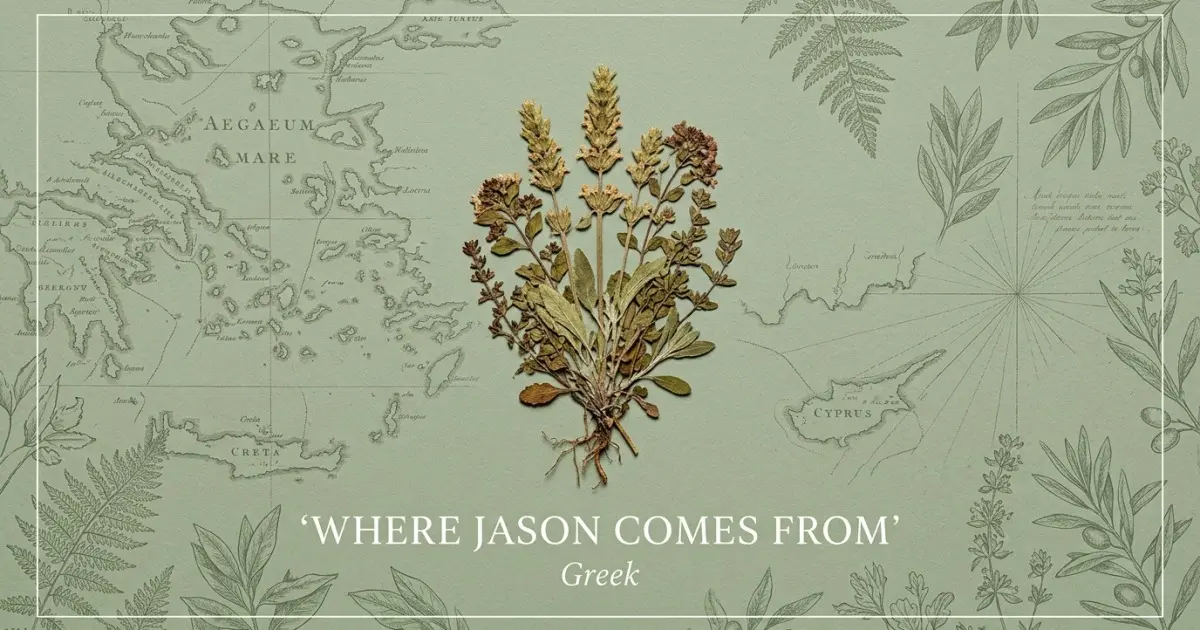
And yet the name’s etymology points in a different direction: healing rather than conquest. That combination is not a contradiction so much as a clue. Jason is a name in which adventure and restoration coexist. The hero’s fame gave the name cultural reach. The etymology gave it moral texture. Once those two layers combined, Jason became unusually durable. It could appeal to families who liked classical myth, to families who liked Greek roots, and later to families who simply liked how naturally it sat in English.
That transition into everyday use is part of the name’s achievement. Some mythological names remain too overtly legendary to function easily in ordinary life. Jason did not. It crossed from epic narrative into mainstream naming with remarkable success. That usually happens only when a name has two qualities at once: a memorable story and a usable sound. Jason has both.
Jason sounds modern because the sound is efficient, not ornamental
Phonetically, Jason is built for survival in ordinary speech. The opening JAY is immediate and bright. The second syllable, -sun, is lighter and more relaxed. This gives the name a satisfying two-step rhythm: firm beginning, easy finish. There is no clutter in it. No difficult consonant cluster. No unstable vowel sequence. No obvious obstacle to pronunciation in American or British English. That practical clarity matters more than many parents realize.
The sound also helps explain why Jason never felt as ornate as some other Greek or classical imports. It lacks the formal weight of names like Alexander or Demetrius and the obvious mythic stamp of names like Orion or Atlas. Jason sounds like it belongs in the present tense. Even when it was at the height of its popularity, it did not sound baroque or overfurnished. It sounded like a name people could actually live in.
Why Jason never became awkwardly antique
Many historically rich names have to choose between depth and usability. Jason did not. The Greek background gives it pedigree, but the sound keeps it socially nimble. This is one reason it was able to become so common in late twentieth-century America without feeling overformal or foreign. The name entered English not as a museum piece, but as something already suited to ordinary mouths.
How Jason compares to nearby styles
Jason sits in an interesting position between classic and contemporary. Compared with Mason, it feels more literary and less surname-driven. Compared with Jacob, it feels less biblical in surface impression and more secularly classic. Compared with Jaxon or Jaxson, it feels less stylized and more historically anchored. Compared with Joshua, it feels leaner and more neutral in tone. These comparisons help define Jason’s present identity: not trendy, not dusty, but settled.
That settled quality is not the same as blandness. In fact, one of Jason’s current strengths is that it has enough familiarity to avoid friction, but enough historical and etymological interest to reward closer attention. The sound does not try too hard. That restraint has become one of its virtues.
Jason in American memory: from generational giant to durable classic
Official Social Security Administration (SSA) data places Jason at No. 148 for boys in 2024. That current rank tells only part of the story. Project naming references also show that Jason was one of the defining American boys’ names of the 1980s, when it appeared near the top of decade lists. That historical memory still matters. Jason is not simply a name in current use. It is also a name many adults already know in the world: on classmates, coworkers, athletes, musicians, neighbors, and fictional characters. That kind of cultural familiarity changes how a name feels.
But distance from the peak has changed Jason’s tone in a useful way. At the height of popularity, a name can become almost transparent. People hear it so often that they stop noticing its shape, meaning, or story. Once it moves down the charts, those features become audible again. Jason is now in that interesting middle state: clearly familiar, but no longer overwhelmingly common among newborns. That gives it a kind of second life. It starts to feel chosen again.
Why Jason wears its history well
Some once-popular names become trapped in a narrow generation and struggle to return. Jason has fared better than many because its roots run deeper than fashion. It has Greek origin, mythic association, and an unusually humane meaning. Those layers help the name carry its past without sounding stuck in it. To keep exploring names from the same background, see names from Greek tradition.
What the current rank suggests
At No. 148, Jason remains socially effortless. People know it. They know how to spell it. They know how to say it. But it no longer feels like the most obvious pick in the room. For many parents, that is a very attractive position. The name offers recognizability without overexposure and tradition without antiquarianism.
Jason offers a rare kind of masculine ideal
There are many ways boys’ names try to signal value. Some do it through power. Some through nobility. Some through brightness or victory. Jason does something subtler. It combines a heroic public story with a healing private meaning. That makes it one of the more balanced masculine names in circulation. It suggests action, but not only action. It suggests courage, but also care. That is a richer vision of manhood than many names manage to hold. If you want to branch out from Jason without leaving this category, explore masculine baby names.
This is one reason Jason can still feel quietly refreshing now. In a naming climate often split between hyper-stylized modern inventions and aggressively rugged masculine choices, Jason offers another model. It is recognizably male, but not hard for hardness’ sake. The name feels capable rather than performative. Useful rather than dominant. Respected rather than theatrical. That is a different kind of strength, and it may be one of the reasons the name continues to matter.
Its meaning also invites a broader reading. Healing can be physical, emotional, communal, or symbolic. The name therefore remains open to modern interpretations without losing its etymological center. A Jason can be imagined as steady, perceptive, competent, and good in crises. That is a powerful set of associations for a name that otherwise seems almost modest in its presentation.

What Jason opens next
Middle names that deepen Jason
Because Jason is so phonetically balanced, middle names can push it in several directions. A classic middle can intensify its timelessness, while a softer or longer middle can bring out the healer side rather than the heroic one. If you want the full pairing logic behind that contrast, see Jason middle names.
Nicknames that keep Jason flexible
Jason has a practical nickname field, with forms such as Jay and Jase already well established in naming references. That gives the name social flexibility without making the full form feel secondary. To see how those different moods shorten in real life, explore nicknames for Jason.
Pronunciation that almost never gets in the way
The name’s pronunciation is one of its quiet assets. It is stable across major English accents, easy to recognize, and simple enough that most speakers get it right immediately. If you want the full sound pattern behind that rhythm, read how to pronounce Jason.
Why Jason still sounds like wholeness in public
The deepest appeal of Jason may be that it never has to shout its complexity. On the surface, it is just a clear, familiar two-syllable name. But beneath that surface lies an unusually rich architecture: Greek origin, mythic quest, the root of healing, and a long American public life that has already tested the name in ordinary use. Jason is one of those names that became mainstream not because it was empty, but because it was strong enough to support many kinds of meaning at once.
In the end, Jason remains compelling because it joins what many families still hope to join in a child’s life: action and care, courage and usefulness, story and steadiness. It is a healer’s name that does not sound fragile, and a hero’s name that does not sound self-important. That is a difficult balance to strike. Jason strikes it with an ease that can make people underestimate how rare it is. But once heard properly, the name reveals itself. It is not only familiar. It is quietly whole.