
How to Say Jacob Correctly: A Clear Guide to Saying It Correctly

Jacob is the kind of name people rarely stop to question until they have to say it with care. A teacher reads it from a class list, a coach calls it across a field, a nurse says it from a waiting room doorway, and almost everyone recognizes it instantly. That everyday familiarity is the best real-life anchor for the name’s pronunciation. Jacob does not feel difficult in use. It feels settled, well worn, and socially fluent. Even so, names that seem obvious often become more interesting the moment you look closely at how they actually work in the mouth.
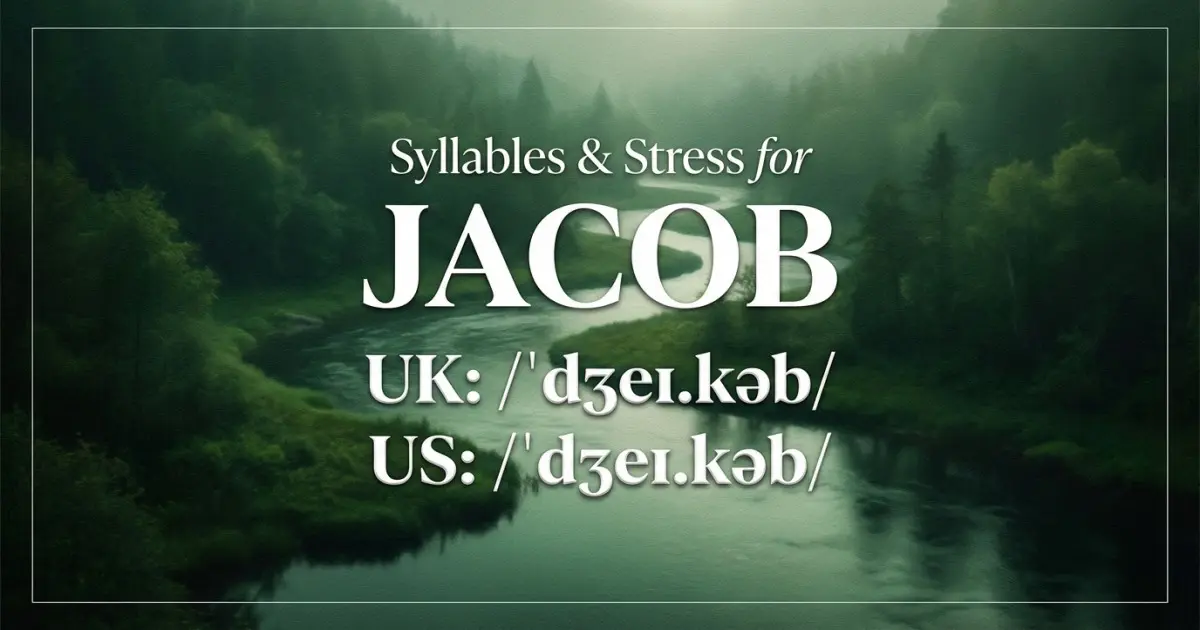
In ordinary English, Jacob is pronounced JAY-kəb. In both US and UK notation here, the IPA is /ˈdʒeɪkəb/. The stress falls on the first syllable, and the second syllable relaxes into a softer ending. That structure is part of why the name has remained so easy to live with. Jacob has enough sound to feel substantial, but not so much that it becomes cumbersome. It begins with brightness, settles quickly, and leaves a clear, stable impression behind.
What Jacob is really doing when people say it correctly
| Element | Phonetic Detail | Quick Tip |
|---|---|---|
| Everyday guide | JAY-kəb | Put the energy on the first syllable and let the second syllable soften naturally. |
| IPA (US) | /ˈdʒeɪkəb/ | The stress mark before dʒeɪ shows that Jacob begins strongly and then relaxes. |
| IPA (UK) | /ˈdʒeɪkəb/ | The broad pattern is essentially the same in standard British and American speech here. |
| Syllables | 2 syllables | Think in two beats, not three: JAY-kəb. |
| Stress | First syllable stressed | If the stress drifts away from the opening, the name starts to sound less natural in English. |
| Opening sound | Affricate /dʒ/ | Begin with the same soft j sound heard in jam or judge. |
| Middle consonant | Hard /k/ | Let the k separate the two syllables clearly without punching it too hard. |
| Ending | Schwa /ə/ plus final /b/ | The second syllable should sound relaxed and reduced, not fully spelled out as a heavy cob. |
Jacob sounds natural because the stress arrives immediately
The most important thing to know about Jacob is that the first syllable carries the name. English speakers instinctively place the main stress on JAY, which gives the name its clarity and forward motion. This is one reason Jacob feels so familiar. English handles names very comfortably when the main beat arrives early. The listener knows the name almost as soon as it begins. The sound matters more once you know what the name is meant to carry, which is why the wider frame starts in Jacob meaning.
Why the first syllable gives Jacob its brightness
The opening of Jacob contains two important pieces. First comes the affricate /dʒ/, the same sound family heard at the beginning of job or June. After that comes the diphthong /eɪ/, the broad vowel glide heard in words like day or say. Together, those elements create a strong, bright opening. Jacob does not mumble its way into the room. It arrives clearly.
That brightness matters because it offsets the heavier history inside the name. Jacob may carry a deep and serious meaning, but the sound itself is welcoming. The pronunciation opens with confidence rather than weight.
Why the second syllable should stay soft
The second syllable of Jacob is where some speakers either over-enunciate or flatten too much. In standard speech, it contains a schwa, the relaxed vowel written in IPA as /ə/. In plain language, that means the ending should sound more like kəb than a full, forceful cob. The second syllable supports the name, but it should not compete with the first.
This softer ending is part of what makes Jacob so wearable. The name begins with clarity, then settles. It does not end with a theatrical flourish. It lands gently and cleanly, which is exactly right for a name used so often in everyday life.
Jacob’s sound structure is simple, but not flat
Jacob works well because it balances firmness and ease. Linguistically, it begins with an affricate, moves through a bright diphthong, crosses a clean hard k, and relaxes into a reduced second syllable. That is more structure than many people notice at first. Yet the name never feels fussy. Its technical parts cooperate instead of calling attention to themselves.
The hard k keeps Jacob from becoming too soft
Without the middle k sound, Jacob could easily drift into something blurrier. The k acts like a hinge between the bright first beat and the relaxed ending. It gives the name definition. Parents often sense this intuitively. Jacob sounds friendlier than some classic boys’ names, but it still has enough internal edge to avoid feeling vague.
The final b should close, not dominate
The last consonant matters too. Jacob should finish with a neat b sound, but not an exaggerated one. If the ending becomes too heavy, the name can sound more blunt than it really is. If it becomes too weak, the second syllable vanishes. The right effect is a quiet closure. Jacob should finish in a controlled way, not with a dramatic stop.
Jacob changes little across accents, which helps the name travel well
One of Jacob’s advantages is its stability across English-speaking regions. In the guidance used here, both US and UK IPA are given as /ˈdʒeɪkəb/. That tells you something useful at once: the broad structure of the name does not need to change much from one major English accent to another. Families often value that kind of portability because it reduces friction in everyday life.
What shifts slightly from speaker to speaker
The small differences that do appear usually involve the degree of reduction in the second syllable. Some speakers make the ending a little clearer, while others reduce it more heavily. Some voices make the first syllable sound slightly wider or brighter than others. But these are normal accent-level differences, not different names. Jacob remains highly recognizable across them all.
Why Jacob stays intelligible in fast speech
Another reason the name travels so easily is that it holds its shape in fast conversation. The stressed opening gives it a strong anchor, and the hard k keeps the syllables from smearing together. Even when spoken quickly, Jacob usually remains clear. That is a practical advantage not every two-syllable classic has.
Where Jacob gets slightly mispronounced in real life
Jacob is not a name that usually attracts dramatic pronunciation problems, but there are a few common slips. Most of them come from overreading the spelling or from giving the second syllable too much or too little weight.
Turning the second syllable into a full “cob”
One of the most common issues is making the second syllable too literal. In everyday English, Jacob is not usually said as JAY-cob with a strong, fully pronounced final vowel. The second syllable should be lighter and less prominent. Over-enunciating it can make the name sound more stiff than natural.
Swallowing the ending too much
The opposite error is reducing the second syllable so far that it nearly disappears. Jacob should still sound like two syllables. If the ending collapses too much, the name can start to sound clipped or unfinished. The goal is balance: not heavy, not vanished.
Confusing Jacob with nearby sound neighbors
Jacob sits near several names that can shape expectations in the ear: Jake, Jason, Jaden, and even international forms like Jakob or Yaakov. That can matter when people are reading quickly or hearing only part of the name. But Jacob has its own clear English pattern. It is more grounded than Jason, less stylized than Jaden, and fuller than Jake. Once heard clearly, it is hard to mistake. Once the sound pattern is clear, some shortenings stop feeling optional and start feeling natural, and the clearest map is in Jacob nicknames.
How to practice Jacob until it feels automatic
The easiest way to settle Jacob into natural speech is to use it in real phrases rather than in isolation only. That helps the name’s rhythm feel lived rather than mechanical. Try saying these aloud:
- Jacob is ready.
- Can Jacob come too?
- We named him Jacob Thomas.
- Jacob sounds strong and easy.
- Jacob called back.
What to listen for in your own voice
As you say those lines, listen for three things: a bright JAY opening, a clear middle k, and a relaxed second syllable that still remains audible. If the ending sounds too heavy, soften it. If it disappears, bring it back slightly. If the first syllable feels dull, open the vowel more clearly.
Why Jacob sounds balanced in almost any setting
This is the most useful final observation. Jacob does not feel difficult because its phonetics are doing exactly what a widely successful classic name should do. The stressed opening gives it identity. The consonants give it structure. The relaxed ending gives it ease. That is why Jacob can sound equally right in a nursery, a school hallway, a workplace, or an old family story. The name is not only meaningful. It is well built.
So the practical guide remains simple: Jacob is pronounced JAY-kəb. In both US and UK notation here, the IPA is /ˈdʒeɪkəb/. It has two syllables, first-syllable stress, a clear hard k in the middle, and a softer reduced second syllable. That balance is one of the key reasons the name has remained so durable.
Jacob Pronunciation FAQ
How do you pronounce Jacob correctly?
Jacob is pronounced JAY-kəb, with the stress on the first syllable and a softer second syllable.
Is Jacob pronounced differently in American and British English?
Not in any major way. In the guidance used here, both US and UK IPA are written as /ˈdʒeɪkəb/, with only small natural accent differences in how lightly the second syllable is reduced.
Why doesn’t Jacob sound like “JAY-cob” in everyday speech?
Because the second syllable usually contains a reduced vowel, or schwa, in normal English pronunciation. That makes the ending lighter and more natural in conversation.
What is the most common pronunciation mistake with Jacob?
The most common issue is either over-pronouncing the second syllable as a full cob or swallowing it too much. The best version keeps the ending soft but still clearly present.