
How to Pronounce Jace: What People Often Get Wrong
The real pronunciation test for Jace rarely happens in a dictionary. It happens at the ordinary moments when a name has to succeed on first contact: a teacher calling attendance on the first day of school, a nurse reading the next patient from a waiting-room screen, a coach scanning a roster under noisy field lights, a grandparent sounding out a birth announcement without help. Jace usually does very well in those moments. It is brief, visually clean, and easy to repeat once heard. But precisely because it is so short, every sound matters. A one-syllable name has nowhere to hide. If a speaker gets the vowel wrong or hesitates over the final consonant, the whole name changes shape at once.
That is part of what makes Jace interesting. It looks contemporary and stripped down, almost effortless, yet the full impression depends on exact sound. The intended pronunciation here is simple: JAYS. One beat. One clean stress. A bright opening and a crisp finish. There is no extra syllable to soften it, no decorative ending to spread the sound out. Jace succeeds because it is precise, and that precision is exactly what gives the name its modern confidence.
What the Jace sound guide clears up immediately
| Element | Phonetic Detail | Quick Tip |
|---|---|---|
| Common pronunciation | JAYS | Say it in one clean beat so it rhymes with “face” and “grace.” |
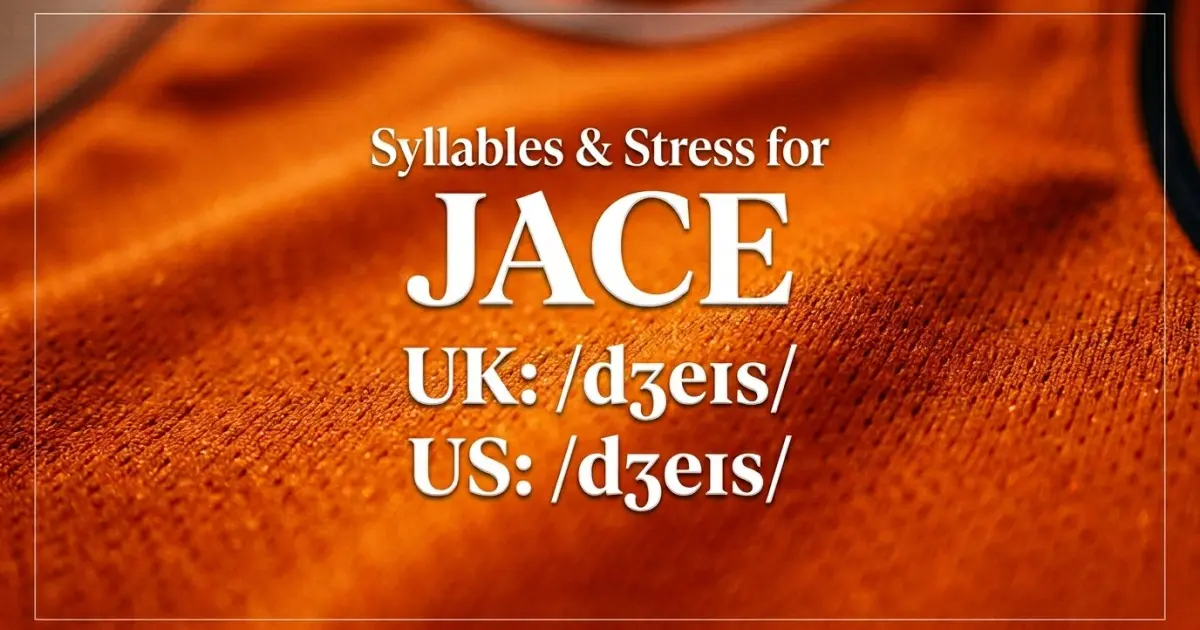
| U.S. IPA | /dʒeɪs/ | The opening is the same j sound you hear in “judge,” followed by the long ay of “day.” |
| U.K. IPA | /dʒeɪs/ | Standard British pronunciation keeps the same sound pattern and same single-syllable shape. |
| Syllable count | 1 syllable | Do not split the name into two parts. Jace is short because its force depends on staying short. |
| Primary stress | Full stress on the whole word | There is no secondary weak syllable. The name is one direct stressed unit. |
| Opening consonant | /dʒ/ | Start as you would with “Jay” or “June,” not with a hard g. |
| Vowel sound | /eɪ/ | Use the long ay sound from “say,” not the shorter vowel of “set” or “sat.” |
| Ending sound | /s/ | The final c is pronounced softly here, so the name ends with a clean s sound. |
Why Jace sounds so quick and so certain
Jace is a one-syllable name, but it is not abrupt in a crude way. Its sound is actually very balanced. It begins with an affricate, /dʒ/, which is the blended consonant sound heard at the start of words like “jump” and “joy.” An affricate begins like a stop and releases like a fricative, which gives Jace a clear, energetic opening. Then comes the long vowel /eɪ/, the same vowel glide heard in “day.” That keeps the name bright rather than flat. Finally, the closing /s/ gives it a neat, controlled finish. Before focusing only on syllables and stress, it helps to step back into the fuller frame of Jace meaning.
All of that matters because short names depend heavily on phonetic architecture. A long name can afford some internal softness or ambiguity and still remain recognizable. Jace cannot. Every sound has a structural job. The opening gives it momentum, the vowel gives it brightness, and the final consonant gives it shape. That is why the name feels crisp rather than thin. It is short, but it is well built.
The opening of Jace carries the confidence
The first sound in Jace is not merely a letter. It is a social cue. The /dʒ/ opening immediately places the name in a familiar English sound family with names like Jay, Jake, and James. That familiarity makes Jace easy to process on first hearing. Listeners are not fighting the sound. They already know how to handle it. Because the strongest energy lands early, the shorter forms often grow from the opening of the name, and that pattern is easier to see in nicknames for Jace.
This also explains why Jace feels modern and easy in public life. The name starts in a place English speakers trust. There is no uncertainty about where the mouth should go first.
The long vowel gives Jace its brightness
The long ay sound in the middle is what keeps Jace from sounding heavy. A flatter vowel would make the name duller and more closed. Instead, /eɪ/ gives it lift. Even though the name ends quickly, it does not sound clipped in a harsh way. It opens just enough before it lands. That is part of why Jace can feel energetic without sounding aggressive.
How Jace behaves in American and British English
One practical strength of Jace is that it stays remarkably stable across major English accents. The IPA given here is the same in U.S. and U.K. English: /dʒeɪs/. That means the essential sound pattern does not shift in any meaningful way between the two. The opening consonant remains the same, the long vowel stays the same, and the name still finishes on a clean /s/.
Accent differences are usually minimal
In real speech, different speakers may color the vowel very slightly with their own accent, but these are small texture differences rather than actual pronunciation splits. Jace does not become a different name from one English-speaking region to another. That stability makes it especially easy to carry in modern life. A child can hear it from teachers, relatives, friends, and strangers in many places without feeling that the name keeps changing shape.
Fast speech does not damage Jace
Another advantage of Jace is that quick speech rarely distorts it badly. Since the name is only one syllable, there is no weak second syllable to swallow and no middle consonant cluster to blur. If anything, fast speech suits the name. It keeps the sound clean and direct. That is exactly how Jace is meant to function in daily life: quickly, clearly, and without fuss.
Where people misread Jace and why
Because Jace is visually short and modern, the most common problems usually come from brief hesitation rather than deep confusion. A reader sees the final c and pauses for a moment over whether the name is meant to sound hard or soft. Once they hear it once, the uncertainty usually disappears.
The most common mistake patterns
The first common mistake is flattening the vowel so the name stops rhyming with “face.” That weakens the bright central sound that gives Jace its character. Another possible error is overthinking the final letter and momentarily expecting a harder ending. In standard pronunciation here, that does not happen. The final c produces a clean /s/ sound.
A different kind of mistake is trying to elaborate the name, as if such a short form must secretly contain another syllable or more ceremony than it actually does. But Jace works precisely because it does not. Its elegance lies in restraint.
Why one-syllable names are easy to overdo
With very short names, some speakers become too careful and accidentally make the name sound stiffer than it should. They separate sounds too much or press each element too hard. Jace sounds best when it is said naturally and cleanly. The name does not need dramatic articulation. It needs accuracy and ease.
Practicing Jace until it feels effortless
Use Jace in ordinary spoken lines
The easiest way to settle the pronunciation is to place the name in real conversational lines rather than saying it in isolation:
“Jace, your turn.”
“Have you met Jace?”
“Jace is here.”
“I asked Jace already.”
These examples make the sound pattern obvious. Jace should arrive and finish in one motion. No pause. No second beat. Just one clear, bright stroke.
Three reminders that solve most problems
First, say it so it rhymes with “face.” Second, keep it to one syllable. Third, let the final c sound like an s. If those three things are in place, Jace will sound natural in almost any English-speaking setting.