
Isla Pronunciation: Speaking Tips for a Smoother Pronunciation
Isla is one of those names that reveals the difference between seeing a name and hearing it. A teacher pauses for half a second at roll call, a receptionist glances twice at the form, a barista reads the letters silently before speaking—and that brief hesitation usually comes from the same place: the spelling looks as though it should say one thing, while the lived pronunciation says another. That real-world moment is the best anchor for understanding Isla. On the page, the silent s can mislead unfamiliar readers. In actual speech, however, the name is remarkably smooth. It is said as EYE-luh.
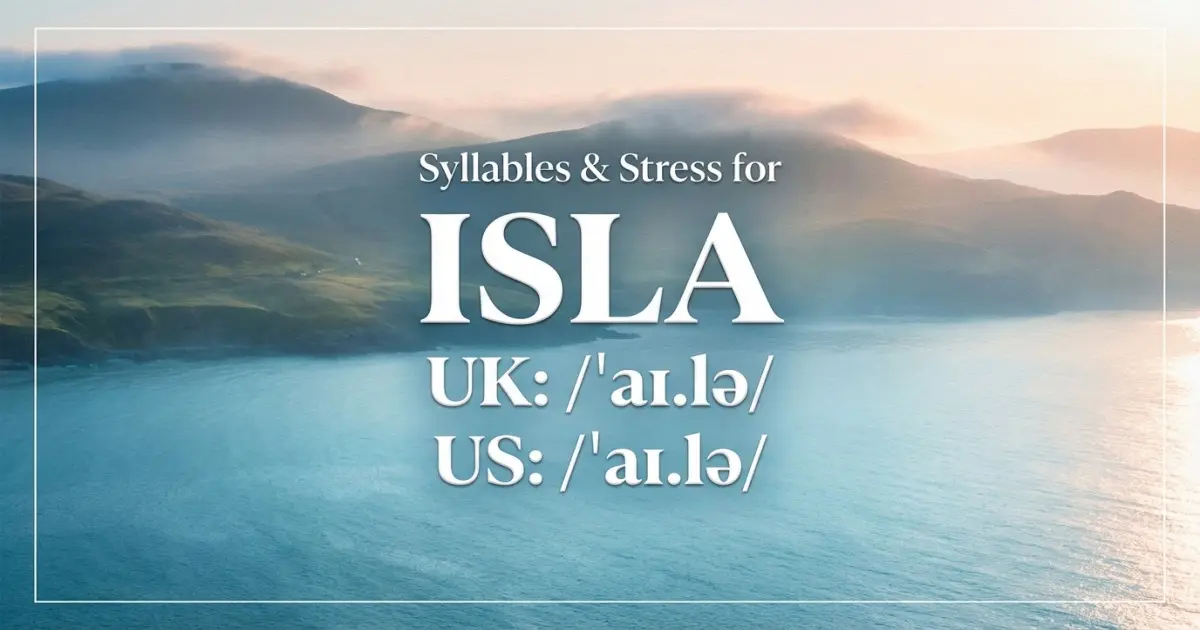
Once that one fact is clear, the whole name falls into place. Isla has only two syllables, with the stress on the first: EYE-luh. In both US and UK notation here, the IPA is /ˈaɪlə/. That gives the name a bright, open beginning and a soft landing. The spelling may briefly slow the eye, but the sound does not usually slow the mouth. In ordinary conversation, Isla is one of those names that feels easier than it looks, and that gap between visual uncertainty and spoken ease is a large part of its appeal.
What Isla’s sound is really clarifying for anyone who first meets it on paper
| Element | Phonetic Detail | Quick Tip |
|---|---|---|
| Everyday guide | EYE-luh | Say the first syllable like eye, then let the second syllable relax softly. |
| IPA (US) | /ˈaɪlə/ | The stress mark shows that the first syllable carries the main weight. |
| IPA (UK) | /ˈaɪlə/ | The broad pronunciation remains essentially the same in standard US and UK guidance here. |
| Syllables | 2 syllables | Keep it to two clean beats rather than stretching or overcomplicating the ending. |
| Stress | First syllable stressed | The name should open brightly and then soften, not start flat and rise late. |
| Silent letter | The s is not pronounced | This is the key correction many first-time readers need to make. |
| Middle consonant | Liquid consonant /l/ | Let the l connect the first bright syllable to the softer ending without chopping the name apart. |
| Ending | Soft schwa /ə/ | Finish lightly with an unstressed uh, not a sharp or overly emphasized final sound. |
Isla becomes easy the moment the silent letter stops getting in the way
The hardest part of Isla is not saying it. It is trusting that the spelling is not asking you to pronounce every letter. For readers unfamiliar with the name, the eye often wants to produce something closer to ISS-lah or IZ-lah. But once you know the s is silent, Isla becomes one of the more straightforward two-syllable names in modern use. Before focusing only on syllables and stress, it helps to step back into the fuller frame of Isla meaning.
Why the first syllable carries almost everything
The name begins with the diphthong /aɪ/, the same broad sound heard in words like eye, sky, or my. Because that syllable carries the stress, it is the most important part of the name to get right. If the opening is right, the rest usually follows. Isla should begin with brightness and clarity, not with a short i sound like the one in sit.
This bright opening is one reason the name feels so open and visible. It gives Isla a little flash of light at the front before the softer second syllable lowers the volume. That emotional movement is part of the name’s charm.
Why the second syllable should stay light
The ending -luh contains a liquid consonant, l, followed by a schwa, the relaxed vowel sound represented in IPA as /ə/. In ordinary English terms, that means the second syllable should feel easy and unstressed. It is there to finish the name gently, not to compete with the opening. When speakers overemphasize the ending, the name can sound heavier than it really is.
The best rhythm is simple: bright first syllable, soft second syllable. That is what makes Isla feel elegant without strain.
How Isla moves across accents without losing its identity
One of Isla’s strengths is that the pronunciation remains very stable across major English-speaking settings. In the guidance used here, both US and UK IPA are given as /ˈaɪlə/. That does not mean every speaker sounds exactly the same, but it does mean the overall structure is remarkably consistent. The silent s, the stressed first syllable, and the soft ending all stay in place.
What changes slightly from voice to voice
The main accent differences are usually very small. Some speakers make the opening diphthong broader or more relaxed. Others make the final schwa a touch lighter or slightly more audible. But these are normal accent shadings rather than competing pronunciations. Isla remains Isla.
This stability is helpful because names with unexpected spellings can sometimes vary a lot in public speech. Isla generally does not. Once the silent s is understood, the name tends to settle into the same pattern across regions.
Why Isla feels more international than its spelling first suggests
Because the spoken form is so clean, Isla often travels better than newcomers expect. The spelling may cause a moment’s pause, but the sound itself is simple: two syllables, first stress, easy vowel, light close. Many parents find that once people hear it once, they remember it. That is a practical advantage. A name can have visual distinction without demanding constant spoken correction, and Isla sits in that sweet spot more successfully than many names with silent letters.
Where Isla gets misread, even by careful readers
The most common Isla mistakes are almost always spelling-driven rather than sound-driven. People look at the letters, apply ordinary English rules too literally, and overpronounce what should stay silent.
Reading the s when it should disappear
The most frequent mistake is producing an audible s, as in ISS-lah. That is understandable, especially for readers seeing the name for the first time. But it is not how the name is said. The correction is simple: ignore the s entirely and begin with eye.
Turning Isla into a harsher or more exotic sound than necessary
Another mistake is overcorrecting and pushing the name toward something like EES-lah or EEZ-lah. These readings may come from trying to apply other language patterns or from confusion with visually similar names. But Isla does not need that kind of reinterpretation. It is not complicated once the basic English pronunciation is known. It is EYE-luh, plain and clear.
Confusing Isla with nearby sound neighbors
Isla lives near several names and words that can shape expectations. Ila, Ayla, and Lila all sit nearby in sound. Isla may also be visually confused with names that begin with Is- and do pronounce the consonant, such as Isabelle or Isla-like variants a reader thinks they recognize. But Isla’s identity is distinct. It begins with eye, not iss, and it ends more softly than many of its neighbors. Because the strongest energy lands early, the shorter forms often grow from the opening of the name, and that pattern is easier to see in Isla nicknames.
This is why hearing the name once is often enough. After that, the sound tends to override the misleading first impression of the spelling.
Isla sounds more graceful when the rhythm stays simple
Because Isla is so short, small mistakes in rhythm become very noticeable. The name does not have many extra sounds to hide inside. That means the clean two-beat pattern matters.
Do not overlengthen the ending
Some speakers stretch the second syllable too much, making the name feel heavier or more decorative than it needs to be. Isla should taper off gently. The ending is a release, not a performance.
Do not flatten the first syllable
If the opening loses its brightness, Isla can sound duller and less distinct. The first syllable should be clear and open. It does not need theatrical emphasis, but it does need enough energy to carry the name’s whole contour.
That is really the entire secret of Isla: a bright entrance and a quiet exit.
How to practice Isla until the pronunciation feels automatic
The easiest way to practice Isla is to use it in real phrases rather than saying it once in isolation. That lets the rhythm settle naturally. Try these aloud:
- Isla is almost here.
- Can Isla come too?
- We chose Isla Jane.
- Isla sounds bright and calm.
- Isla loves the sea.
What to listen for in your own voice
When you say those lines, listen for three things: a clear eye opening, a smooth l in the middle, and a gentle unstressed finish. If the name sounds too sharp, soften the ending. If it sounds too flat, brighten the opening. If the s sneaks back in, remove it completely and start again.
Why Isla feels easier once it is heard than when it is first read
This may be the most useful final point. Isla is harder for the eye than for the ear. Once spoken, it feels natural almost immediately. That combination of visual distinctiveness and spoken ease is part of what has made the name so successful in recent years. It looks a little unusual, but it behaves beautifully in conversation.
So the practical guide is simple: Isla is pronounced EYE-luh. In both US and UK notation here, the IPA is /ˈaɪlə/. It has two syllables, first-syllable stress, a silent s, and a soft ending. The spelling may cause a moment of uncertainty, but the spoken form is one of the cleanest and gentlest in current use.
Common Questions About Accent Differences in Isla
How do you pronounce Isla correctly?
Isla is pronounced EYE-luh. The stress falls on the first syllable, and the s is silent.
Why doesn’t the s in Isla get pronounced?
In the standard pronunciation of the name, the s remains silent. This is the main reason first-time readers sometimes hesitate, but once learned, the pronunciation is very straightforward.
Is Isla pronounced differently in American and British English?
Not in any major way. In the guidance used here, both US and UK IPA are written as /ˈaɪlə/, with only minor natural accent shading from speaker to speaker.
What is the most common pronunciation mistake with Isla?
The most common mistake is pronouncing the s and saying something like ISS-lah. The correct form is EYE-luh, with no audible s.