
Best Middle Names for Irene: Solid Options for a Complete Full Name
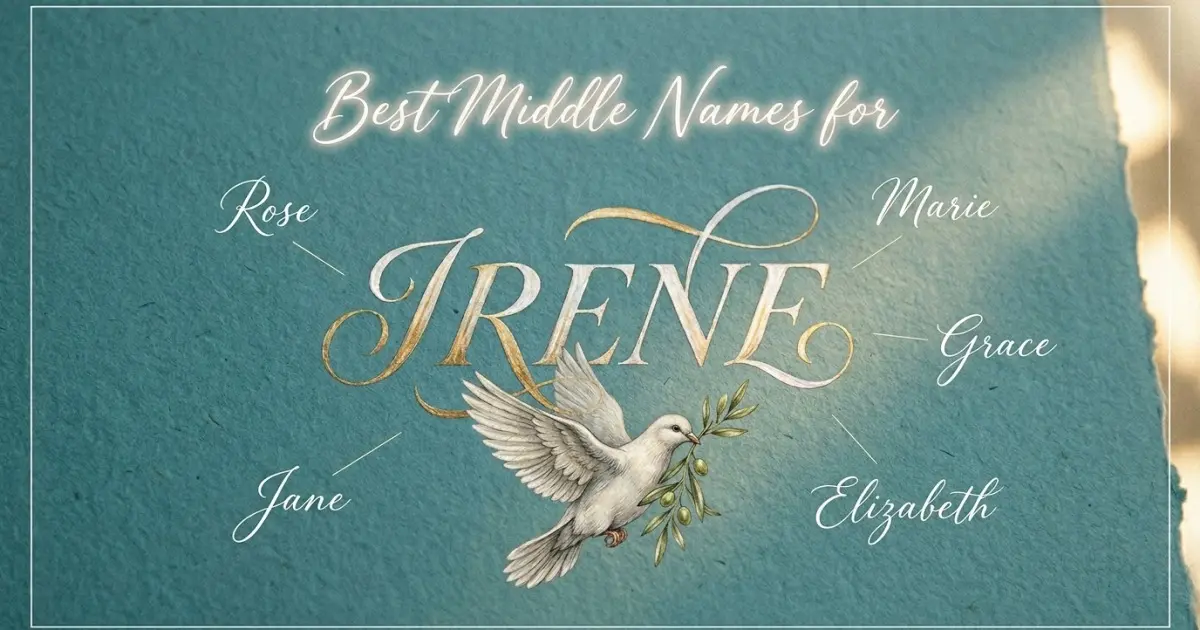
A middle name rarely carries the daily weight of a first name, yet it often carries more family intention. It is where parents become slightly more revealing. The first name has to survive school rosters, introductions, email signatures, and ordinary speech. The middle name gets to do quieter work. It can honor a grandmother, restore a surname branch, soften a sharp first name, add gravity to a light one, or create a fuller rhythm when the first name feels almost too self-contained. That is why middle names matter so much in practice: they are not decorative extras, but the hidden architecture of a full name.
With Irene, that hidden architecture becomes especially important. Irene is already refined, already complete, already meaningful. It does not need rescuing. What it needs is calibration. A middle name for Irene should either deepen the name’s calm authority, widen its emotional range, or give it a more personal family signature. Because Irene means peace and has such a poised two-syllable shape, the wrong middle can make it feel either too soft or too formal. The right one, however, can make the whole name sound inevitable: balanced on paper, memorable out loud, and easy to imagine from childhood into adulthood. Pairing is practical, but it still rests on the first name’s deeper frame, so the best place to begin is Irene meaning.
The middle-name lanes that suit Irene best
| Style | Recommended Names | Why it works with Irene |
|---|---|---|
| Crisp classic | Claire, Jane, Rose, Ruth | These names give Irene a clean finish and help the full combination sound polished, intelligent, and easy to remember. |
| Soft romantic | Louise, Sophia, Camille, Juliet | Longer lyrical middles add warmth and movement, making Irene feel more flowing without losing its composure. |
| Vintage dignified | Catherine, Margaret, Pauline, Beatrice | These pairings strengthen Irene’s mature, enduring side and give the full name a stately, cross-generational feel. |
| Light nature note | June, Violet, Hazel, Pearl | Nature-leaning middles bring freshness to Irene and keep the overall effect graceful rather than severe. |
| Modern edge | Blair, Quinn, Paige, Maeve | A sharper middle can stop Irene from feeling too hushed, creating a full name that sounds contemporary and self-possessed. |

What a middle name does for Irene
Irene is one of those rare first names that arrives with an already formed personality. It is calm, elegant, and morally legible. Parents choosing it are often drawn to exactly that steadiness. The middle name, then, should not compete with Irene for attention. It should either support its rhythm or reveal a second layer that the first name does not state on its own.
There are usually three good reasons to add a middle to Irene. The first is rhythm. Irene rises at the end, with stress on the second syllable, so a middle name can either create a satisfying stop or continue that upward motion into something more musical. The second is emotional color. Irene by itself can sound restrained; a warmer middle gives it softness, while a crisper middle gives it structure. The third is family signaling. Historically, middle names have often been the place where parents tuck in lineage, memory, tribute, or a slightly bolder choice than they were willing to use first.
This is why Irene benefits from intentional pairing. The name is not hard to match, but it is easy to flatten. If the middle is too vague, the full name can feel polite but forgettable. If it is too ornate, Irene can begin to sound like a period costume rather than a living name. The best combinations respect Irene’s clarity. They let the first name remain the center while giving the full name better weight, motion, or warmth.
Why short middles sharpen Irene
One-beat names give Irene a confident finish
Short middle names are often the most effective choice for Irene because they do something the first name does not do on its own: they stop the line cleanly. Irene rises; a one-syllable middle lands. That contrast sounds satisfying to the ear. It is the difference between a sentence that trails and a sentence that closes with intention.
Irene Claire is a strong example. Claire gives Irene a clear, bright ending and keeps the whole combination feeling educated and self-possessed. Irene Jane has a similar effect, but with slightly more understatement. It sounds literary, sensible, and deeply wearable. Irene Rose is softer, but still disciplined, because Rose is so compact. Irene Ruth is even firmer: quieter, plainer, and full of backbone. Irene June adds lightness without losing precision, which makes it especially useful if the surname is long or heavy.
This category works well for parents who want the first name to remain fully in charge. A short middle does not pull focus. It supports. It also helps in everyday paperwork and signatures, where a concise full name often looks stronger. If your surname is multisyllabic, formal, or double-barrelled, a short middle is usually the safest and smartest choice with Irene.
Short does not have to mean plain
The mistake some people make is assuming that a brief middle must be minimal in feeling. In reality, one-syllable names often carry the most tonal precision. Claire feels cool and exact. Rose feels classic and luminous. Maeve feels sharper and more modern. Pearl feels antique in the best sense. A short middle can therefore change the flavor of Irene quite dramatically without changing its structure.
If you want Irene to sound timeless, lean toward Claire, Jane, Rose, or Pearl. If you want it to feel more current, Blair, Quinn, and Maeve all create a firmer silhouette. Irene Blair, for instance, has real poise because the softness of Irene meets the edge of Blair and neither overwhelms the other. That kind of tonal contrast is often what makes a full name memorable.
Why lyrical middles soften Irene without weakening it
Longer names give Irene more atmosphere
Not every parent wants Irene to sound clipped and tailored. Some want the full name to bloom a little more. That is where longer middles come in. A three-syllable or flowing two-syllable middle can take Irene from composed to quietly romantic. The key is choosing a name that extends the music rather than muddies it.
Irene Louise works beautifully because Louise begins with a consonant and then opens out. The transition is clean, and the result feels polished but affectionate. Irene Sophia is softer and more luminous. Irene Camille adds French-style smoothness while preserving adult gravitas. Irene Juliet feels literary and light, offering just enough movement to widen the name without turning it decorative. Irene Catherine is more formal, but in a very stable way; it sounds like a name that can age through every decade without effort.
These pairings are especially useful when the surname is short. If the last name is blunt, one beat, or very Anglo-Saxon in sound, a longer middle can prevent the full name from feeling abrupt. Irene Hart, for example, may benefit from something like Louise or Camille in the middle because it creates a bridge between the serene first name and the crisp surname.
Choose warmth, not clutter
The caution with lyrical middles is excess softness. Irene already carries gentleness in meaning, so pairing it with an overly breathy, highly embellished middle can make the full name feel blurred. Names that are beautiful on their own are not always the best companions. What Irene needs is not more delicacy, but controlled warmth.
That is why names like Louise, Margaret, Pauline, and Beatrice often outperform more frilly choices. They add richness without adding fuss. Even floral or seasonal options should be chosen carefully. Irene Violet works because Violet has structure and consonant definition. Irene Hazel works because Hazel is grounded. Irene Lily may be too light for some surnames, while Irene Elodie may become too airy if the last name is also flowing. With Irene, elegance improves when it is anchored.
How Irene behaves with your surname, initials, and family pattern
Initials, signatures, and the private life of the full name
Middle names do more than sound nice in the nursery. They show up in signatures, school records, monograms, and family paperwork. That practical side matters. Because Irene starts with I, parents should always check the full initials before finalizing a combination. Three-letter initials can accidentally spell a real word, an awkward abbreviation, or something unintentionally comic. Even when the initials themselves are harmless, the first and middle initial together may look odd against a surname. If you want the IPA, accent detail, and stress pattern behind the flow advice, the next stop is how to pronounce Irene.
There is also the question of repetition inside a household. Some families enjoy coordinated initials, while others find them confusing once mail, labels, and digital forms enter the picture. If several family members already use I-initial names, Irene may benefit from a middle that breaks the pattern rather than repeats it. A combination like Irene Claire can feel cleaner in real life than Irene Isabel if the surname also begins with I or another vowel.
Another practical point: historically, the middle name often becomes the fallback option if the child later wants more distinction, more privacy, or simply a different register. That makes usability important. Irene Margaret and Irene Louise both offer perfectly strong secondary identities. A highly whimsical middle may be charming in theory but less helpful if it ever has to stand on its own.
When Irene meets a short surname or a long one
Surname harmony is where many good combinations either settle or collapse. Irene generally works with most surnames because it is concise and well balanced, but the middle name can improve that fit dramatically.
If the surname is long, dense, or double-barrelled, keep the middle compact. Irene Jane Whitmore is likely to sound cleaner than Irene Juliet Whitmore. If the surname is very short, however, the opposite may be true. Irene Hart can feel a little abrupt, while Irene Louise Hart has more room to breathe. If the surname begins with a strong R or long E sound, test the flow aloud, because some combinations can create echoes that make the line less crisp than it looks on paper.
It is also worth checking whether the full name accidentally sounds like a public figure, a fictional character, or a brand. Research suggests that families are usually happiest when a name feels familiar but still clearly belongs to the child rather than to an association everyone else will hear first. Irene is discreet enough that it usually avoids this problem, but the middle and surname together can still create it.
Practical caution notes before you choose
- Avoid middles that make the full initials awkward, silly, or accidentally rude.
- If your surname is long, favor shorter middles to keep Irene from becoming overextended.
- If your surname is short and clipped, a two- or three-syllable middle can give the full name better balance.
- Be careful with overly breathy combinations if you want Irene to keep its authority.
- Say the whole name out loud several times, not just once. Irene often changes character depending on what follows it.
Irene combinations that sound complete, not just pretty
The strongest middle-name pairings for Irene are usually the ones that seem to know exactly what job they are doing. Irene Claire is for parents who want clarity and confidence. Irene Louise is for those who want grace with warmth. Irene Jane feels literary and steady. Irene Margaret gives Irene historical depth. Irene Rose adds a little glow without losing discipline. Irene Camille offers softness with polish. Irene Ruth sounds morally serious in a way that many parents find deeply appealing. Irene Violet brings a fresher, more visual note to a name that can otherwise feel very classical.
If the goal is pure balance, the safest standouts are Irene Claire, Irene Louise, Irene Jane, Irene Catherine, and Irene Rose. If the goal is more personality, Irene Blair, Irene Maeve, Irene Juliet, and Irene Violet each move the name in a distinct direction while keeping it coherent. The common thread is that all of them respect Irene’s central trait: calm authority. None of them try to turn it into something louder than it is.
That is the real test. A good middle name for Irene should not merely sound attractive in isolation. It should make the full name feel more usable, more memorable, and more faithful to why Irene was chosen in the first place. When that happens, the result is not just a lovely pair of names. It is a name with inner structure.
Irene Middle Name Pairing FAQ
What kind of middle name suits Irene best?
Does Irene need a short middle name?
Should I check initials carefully with Irene?
