
Harmony Name Meaning: Origin, Symbolism, and Story

Harmony is one of the few modern names that sounds like an aspiration without sounding artificial. Some names inherit their authority from saints, dynasties, or long biblical repetition. Harmony works differently. It asks whether balance itself can be a form of beauty strong enough to name a life. That question is more serious than it first appears. Harmony is not merely a pretty musical word. It belongs to an older intellectual and emotional idea: the belief that separate things can be brought into right relation without losing their distinctness. That is why the name feels so unusually calm. It does not point toward domination, speed, or spectacle. It points toward proportion.
This is also why Harmony has lasted beyond the novelty that often shadows modern word names. It is vivid but not flashy, gentle but not weak, idealistic but still practical. The name carries music, certainly, but also ethics, domestic peace, social concord, and the classical belief that beauty emerges when different parts belong together. In a culture that often rewards sharp contrast and loud individuality, Harmony proposes another kind of strength: the power to hold complexity without collapse. That is a surprisingly durable idea to give a daughter, and it explains why the name feels more substantial than many word names of the same era.
Harmony's U.S. popularity rank over time, 1915–2024
Popularity statistics are based on official data from the Social Security Administration baby name records.
Harmony: A Rhythmic and Modern Melodic Favor
Harmony reads as a name with one unmistakable center of gravity, with the girls’ side of the chart providing nearly all of its recent visibility and momentum. Its appeal likely stems from its melodic Greek roots and a naming culture preference for virtue names that offer a sense of “agreement and concord” .
The trace presence in other lanes behaves more like niche experimentation than a broad identity shift. Its three-syllable rhythm provides an easy, musical balance that has helped it find renewed force in the modern era.
What Harmony tells you before the larger story begins
| Key Facts | Information | Quick Insight |
|---|---|---|
| Name | Harmony | The full form is already expressive, which means the name enters the room carrying mood, image, and value at once. |
| Primary gender usage | Female | Although it can cross gender lines in rare cases, current use makes Harmony feel overwhelmingly feminine in practice. |
| Origin | Greek | The Greek root gives the name intellectual and mythic depth, helping it feel older and more grounded than a purely modern invention. |
| Core meaning | Agreement; concord | This is not just a sound-based meaning. It points to relational order, social balance, and the art of things fitting together well. |
| Pronunciation | HAR-muh-nee | The strong opening keeps the name from floating, while the softer ending preserves its gentleness. |
| IPA (US) | /ˈhɑːrməni/ | The American form gives the first syllable breadth and authority, then lets the rest of the name move lightly. |
| IPA (UK) | /ˈhɑːməni/ | The British form smooths the center slightly, which makes the name feel even more fluid while keeping the same identity. |
| Syllable count | 3 | Three syllables give Harmony enough room to feel lyrical without becoming ornate or cumbersome. |
| U.S. girls’ rank (2024) | No. 264 | Official data shows Harmony remains visible and recognizable, but far enough from overuse to keep its distinctive character. |
| U.S. boys’ rank (2024) | No. 9278 | The boys’ ranking is so low that Harmony now arrives socially as a girls’ name almost by default. |
Harmony makes agreement feel alive rather than abstract
Why “agreement” is larger than it sounds
At first glance, “agreement; concord” can look like a dry dictionary meaning compared with names that promise stars, flowers, victory, or light. But Harmony is one of those names whose meaning expands the longer you sit with it. Agreement does not merely mean sameness. In its richest sense, it means different parts aligned without being erased. Concord does not mean silence. It means coexistence under a pattern that makes sense. This is why Harmony has more emotional intelligence than many names built from gentler vocabulary words. It is not just soft. It is ordered.
That makes the name surprisingly modern in a deep rather than fashionable way. Parents today often want names that express values without sounding preachy. Harmony manages that better than most. It suggests peace, but not passivity. It suggests cooperation, but not weakness. It suggests beauty, but not decoration alone. The name carries a model of relationship: voices held together, differences made legible rather than destructive, emotion disciplined into form. Those are large ideas to pack into one everyday name.
There is also a practical social appeal in that meaning. A daughter named Harmony is being named not only for how pleasant something sounds, but for how well parts belong to one another. That can be heard as a family ideal, a spiritual ideal, or a social one. It is one of the rare abstract names that still feels rooted in ordinary life because everyone knows what harmony looks like when it is present and what is lost when it is absent.
Why the name feels calmer than many other virtue or word names
Some modern names built from positive words can feel either overly earnest or too airy to wear. Harmony avoids both traps because it has structure. A word like Bliss can feel all glow. A word like Destiny can feel declarative. Harmony sits somewhere else. It is less an emotion than a relation. Less a boast than a condition. That makes it emotionally believable. Parents do not need to imagine their child as permanently cheerful or spectacularly gifted in order to find the name meaningful. They only need to value balance, attunement, and peace made through arrangement rather than through force.
That is why Harmony often appeals to very different kinds of families. Music-minded parents hear one thing. Spiritually inclined families hear another. Parents drawn to word names hear simplicity and beauty. Parents wary of flashy names hear restraint. The meaning is broad enough to welcome all of those readings without becoming vague.

From Greek Harmonia to modern Harmony, the name kept its center
The mythic and classical inheritance beneath the modern word
Although Harmony feels fresh in English, it carries an older Greek inheritance through Harmonia, the classical figure associated with harmony and concord. That background matters because it gives the name more than surface prettiness. It links Harmony to a long tradition in which harmony meant proportion, accord, and order both in music and in the arrangement of life itself. Classical thought did not treat harmony as a sentimental extra. It treated it as a principle of beauty, ethics, and sometimes even the universe.
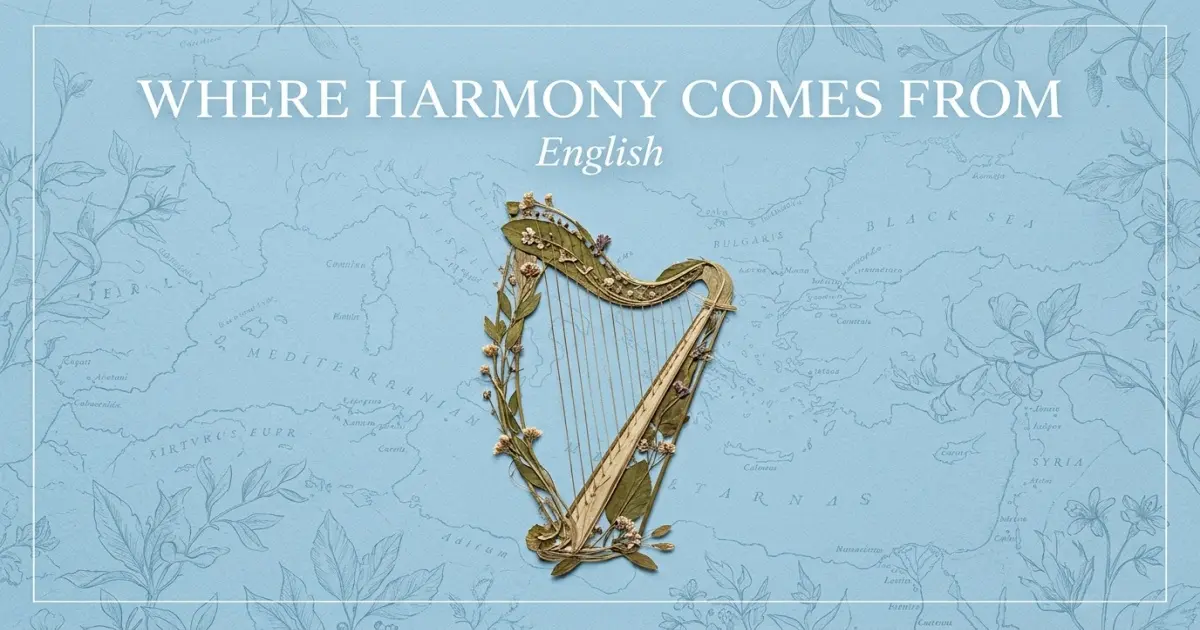
This larger inheritance helps explain why the name still feels more grounded than many abstract modern choices. Harmony is not an arbitrary virtue name invented by contemporary taste. It is an English form of a much older idea. The Greek root gives it backbone. In classical and literary thinking, harmony was repeatedly linked to simplicity, grace, rhythm, and the proper relation of parts. Those associations still shadow the name now, even when a modern parent only half-consciously senses them.
That depth also protects the name from sounding too flimsy. Without the classical layer, Harmony might remain merely a sweet English word. With it, the name gains intellectual seriousness. It belongs not only to music rooms and soft imagery, but to philosophy, poetics, and the old conviction that order can be beautiful.
How Harmony moved from concept to given name
Modern baby-name references often note that Harmony functions as an English form of Harmonia and, in contemporary use, also as a direct vocabulary name. Those two pathways matter together. One gives the name mythic ancestry; the other gives it modern accessibility. That combination is part of why Harmony works. It can sound both ancient and current, both wordlike and name-like, both expressive and established.
It also helps that English naming culture has long made room for value-laden names, from older virtues to newer nature and music words. Harmony entered a landscape already prepared to hear meaning in names. Yet unlike some word names that feel trendy because they entered suddenly, Harmony carries enough history behind it to feel less accidental. It sounds chosen, but not improvised.
In other words, Harmony modernized without severing its roots. That is one of the strongest things any contemporary name can do.
Harmony sounds musical, but music is only half the story
Why the musical association helps, but does not define the name
Many popular references naturally connect Harmony to music, and that connection is real. The name sits comfortably near Melody, Lyric, Cadence, and Symphony in the modern imagination. It is easy to understand why parents drawn to songs, instruments, or musical life would find it appealing. The word already carries the idea of pleasing sound and of notes fitting together in a way that produces something larger than themselves.
But Harmony is stronger than names that remain purely musical because it also operates outside music. It can describe family life, architecture, friendship, interior design, religious vision, or public peace. That semantic breadth matters. It keeps the name from becoming narrow. A daughter named Harmony does not need to be musical in order for the name to make sense. The concept has already overflowed its technical artistic origins and become a moral and social one. To continue exploring names from this part of the naming world, visit a wider list of Greek names.
This gives the name unusual versatility. It can appeal to parents who love art, but also to parents who are drawn to calm, to relational health, or to the idea of beauty as balance. In that sense, Harmony is richer than many other arts-inspired names. It refers not only to a genre or a performance, but to an organizing principle.
The sound pattern keeps Harmony from drifting into mist
Phonetically, Harmony succeeds because its sound is more disciplined than its meaning might suggest. The first syllable, HAR, is strong and grounded. It gives the name a steady entrance. Without that opening, Harmony might sound too vaporous. The middle syllable softens, and the final -nee adds brightness without becoming childish. This is a very effective structure. The name sounds gentle, but it does not float away.
The internal m and n sounds also matter. They are softer consonants, which support the calm mood of the name, but they are placed inside a strong rhythmic frame. That balance allows Harmony to feel feminine and warm without sounding fragile. It is lyrical, yes, but it is also clearly built.
That sound design helps explain why the name can survive adult life. Some abstract names shine only in theory or in infancy. Harmony has enough architectural clarity to remain credible on a grown woman. It is pleasant, but not flimsy. Expressive, but not uncontrolled. The sound itself teaches the listener how to hear the meaning: strength holding softness in place.
Harmony in current life is recognizable, feminine, and not overrun
Visible, but still distinctive
Official Social Security Administration (SSA) data places Harmony at No. 264 for girls in the United States in 2024. That is an especially interesting position for a name like this. It is well within public recognition, which means people are unlikely to stumble over it or treat it as too unusual, but it is still far enough from the center of naming traffic to preserve its distinctiveness. For many parents, that is exactly the balance they want from a meaningful modern name. For more options with a similar overall profile, see baby girl names and meanings.
This rank also suggests that Harmony has crossed an important threshold. It is not merely a fringe word name anymore. It has enough presence to feel established. Yet it has not become so common that its imagery has flattened. The name can still arrive with intention around it.
How Harmony compares with its stylistic neighbors
Style-wise, Harmony sits near names like Melody, Haven, Serenity, Lyric, and Hope. But it does different work from each of them. Melody is more specifically artistic. Serenity is more inward and meditative. Hope is sharper and more declarative. Haven is more place-based. Harmony feels relational. It implies parts fitting together rather than a single emotional state. That gives it a social intelligence many of its neighbors do not carry in the same way.
It also explains why the name feels less fragile than some of the softer virtue or word names. Harmony suggests not just a mood, but a system. Not just sweetness, but arrangement. That difference is subtle, but it is exactly what gives the name its staying power.

Where Harmony opens three more doors
Middle names that can either steady Harmony or deepen its lyricism
Because Harmony is already vivid and value-rich, the middle name matters a great deal. A crisp classic middle can ground it and keep the full name from feeling too airy, while a softer or more romantic middle can intensify its musical and emotional atmosphere. If you want the full pairing logic behind that contrast, see middle names for Harmony.
Nicknames that make Harmony more casual or more intimate
Harmony has a useful nickname landscape because the full form is melodic and familiar, but still long enough to invite shorter family and peer versions. Those short forms can make it sound more playful, more modern, or more domestic without stripping away its elegance. To see how those different moods shorten in real life, explore nicknames for Harmony.
Pronunciation that helps Harmony sound stronger than many word names
Harmony’s pronunciation is one of its hidden strengths. The firm opening stress gives the name structure, while the softened ending keeps it approachable. That combination is part of why the name works so well in ordinary speech. If you want the full sound pattern behind that rhythm, read how to pronounce Harmony.
Why Harmony still sounds like Harmony
In the end, Harmony lasts because it names an arrangement people still long for. Its Greek root gives it old-world gravity. Its modern English life gives it immediacy. Its meaning connects beauty to balance rather than display. Its sound keeps it gentle, but not vague. Its current ranking keeps it recognizable without wearing it out. And its emotional range is broad enough to serve families who hear in it music, peace, relational intelligence, or simply the hope that a life might hold its parts together well.
That is why Harmony does not feel like a passing word turned into a name. It feels like an old human wish translated into modern English. Not perfection. Not silence. Not sameness. Agreement. Concord. Different parts held in right relation. That is a lovely thing to hear in a name, and an even lovelier thing to ask a life to carry.