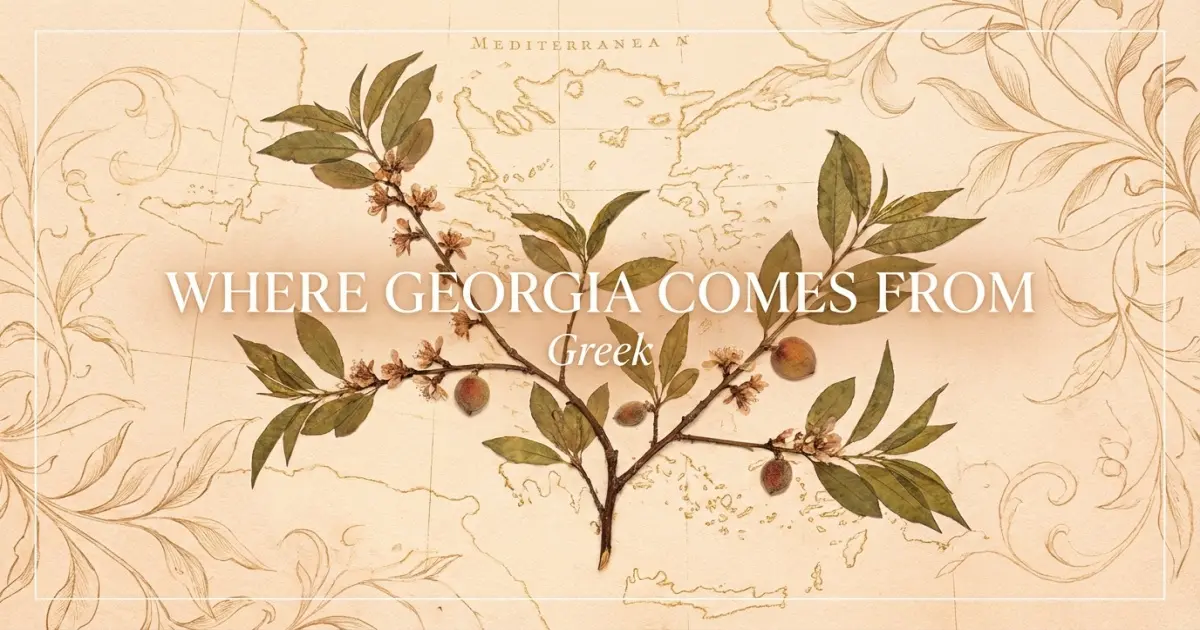
Georgia Name Meaning: Origin, Symbolism, and Story
Georgia is a name that carries an unusual kind of dignity because its beauty does not begin in fantasy. It begins in work. At the center of the name is the old idea of cultivation, the human act of tending land, preparing ground, staying with seasons long enough to make something grow. That is what gives Georgia its emotional depth. Though the name has elegance, softness, and public polish, its root meaning points somewhere sturdier. It belongs to a vocabulary of making, keeping, and nurturing rather than merely adorning. In an era when many names are chosen for shimmer alone, Georgia still sounds as if it knows the difference between bloom and labor.
That is why the name holds together so well across very different settings. Official Social Security Administration (SSA) data shows Georgia ranked No. 110 for girls in the United States in 2024, which places it in a persuasive middle ground: visible, established, and rising in confidence without feeling overused. It has Greek roots, is traditionally treated as the feminine form of George, and carries the meaning “farmer.” Yet in modern English, that meaning does not make the name feel rustic or plain. It makes it feel grounded. Georgia turns an old agrarian word into something refined, and that transformation is the real story of the name. It is a name about cultivation that has itself been cultivated over centuries.
Georgia's U.S. popularity rank over time, 1880–2024
Popularity statistics are based on official data from the Social Security Administration baby name records.
Georgia: A Classic with Deep Geographic Charm
Georgia reads as a name with one unmistakable center of gravity in the naming landscape, with the girls’ side of the chart carrying nearly all of its long-term visibility. Its enduring appeal often reflects a taste for “vintage classics” that feel both traditional and accessible, fitting comfortably beside other vowel-rich favorites .
While the boys’ lane shows trace historical visibility, it behaves more like a scattered edge than a true crossover. Meaning “farmer,” its rhythmic two-syllable sound helps it travel well while remaining grounded in a sense of southern elegance.
Georgia’s record on paper already hints at its deeper character
Before tracing the history and style of the name, it helps to look at the facts that shape how Georgia reads in the present. Even its basic profile tells a richer story than many names do.
| Key Facts | Information | Quick Insight |
|---|---|---|
| Primary origin | Greek | Georgia comes from one of the oldest naming traditions in the European and biblical inheritance, which gives it historical depth without making it feel archaic. |
| Core meaning | Farmer | The meaning gives Georgia a foundation in cultivation, usefulness, and care, not in ornament alone. |
| Name family | Traditionally treated as the feminine form of George | Its lineage ties it to a familiar classic, but Georgia has long since developed a separate mood and identity of its own. |
| Everyday pronunciation | JOR-juh | The compressed two-syllable pronunciation makes the name feel more direct and modern than its spelling might suggest. |
| Syllable count | 2 | That shortened rhythm gives Georgia speed and confidence, helping it move easily from childhood to adulthood. |
| U.S. girls’ rank (2024) | No. 110 | Georgia is familiar enough to feel established, but not so common that it loses its distinct silhouette. |
| Gender pattern | Primarily female in contemporary use | Although it comes from a masculine line, modern Georgia reads strongly and unmistakably as feminine. |
| Sound profile | Soft opening, grounded center, light ending | The sound pattern helps explain why Georgia feels warm and substantial at the same time. |
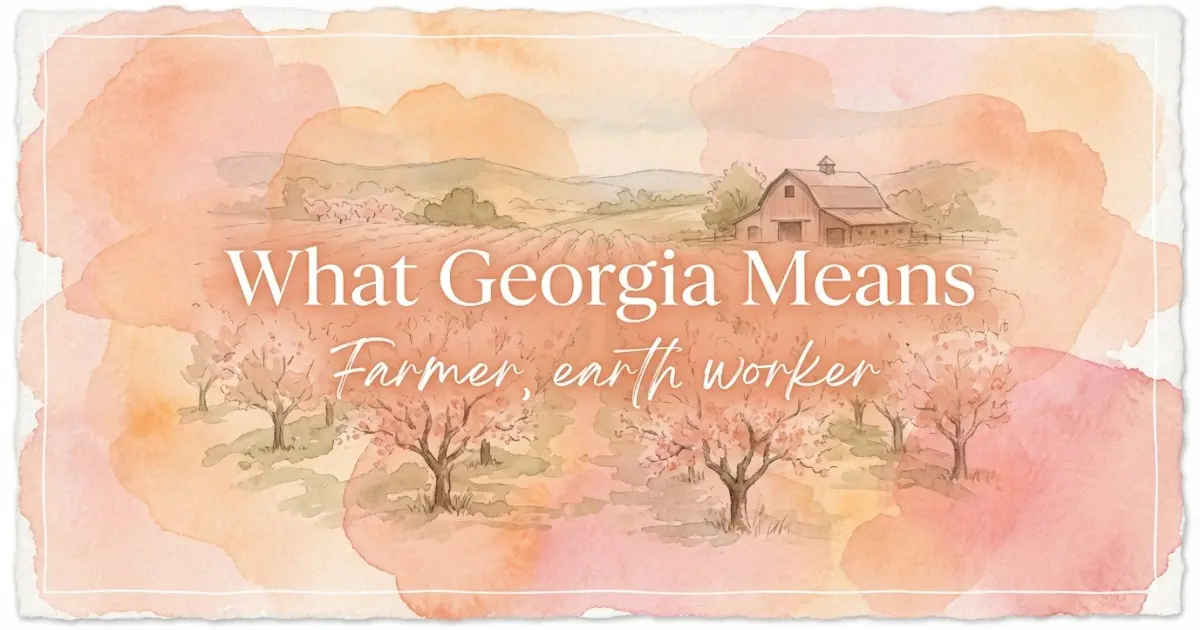
Georgia begins in cultivation, and that matters more than it first seems
Many parents encounter the meaning “farmer” and assume it is plain, perhaps even too practical for a name as graceful as Georgia. But historically, “farmer” is not a small word. It belongs to one of the deepest human vocabularies: sowing, tending, yielding, sustaining. Names that come from this world often age well because they are connected to durable human realities. They do not depend on novelty, fantasy, or temporary fashion. They belong to work that must be repeated, cared for, and handed on.
Why “farmer” makes Georgia feel steadier than many romantic names
In modern naming culture, many feminine names are chosen for softness, lyric beauty, floral imagery, or light. Georgia offers something different. It may sound elegant, but its root meaning gives it ballast. That ballast changes how the name is felt. Georgia does not sound fragile. It sounds composed. It suggests not just loveliness, but competence and continuity. The person behind the name seems as though she could make things happen, keep a household, finish a project, or stay present through a difficult season. If this is the kind of name you are drawn to, you can explore more in girl naming ideas.
That is one reason the name feels more substantial than some of its sound-neighbors. Georgia has warmth, but it also has grain. It is not sheer prettiness. The old agricultural meaning presses quietly against the modern surface and keeps the name from floating away into pure style.
How cultivation became a cultural metaphor inside Georgia
Over time, words related to farming often widened beyond literal fieldwork and became metaphors for formation, discipline, patience, and stewardship. Georgia carries some of that widened meaning even now. A cultivated person is shaped, educated, and inwardly tended. A cultivated garden is organized life rather than wild abundance. A cultivated reputation is something earned and maintained. Georgia sits beautifully within that broader semantic field. It is not merely a name about soil. It is a name about care applied over time.
That broader meaning helps explain why the name can feel equally believable on a child, an artist, a scholar, or a public professional. It carries an underlying idea of growth, but growth with structure. It suggests not only life, but formation.

Georgia grows out of George, but it no longer feels borrowed
Naming books commonly explain Georgia as the feminine form of George, and historically that is essential to the story. The line matters. Georgia belongs to a longstanding family of names shaped by the Greek root behind George, and the attached naming references preserve that connection clearly. Yet in modern use, Georgia rarely feels like a derivative or secondary form. It has become one of those names that clearly comes from an older trunk yet now stands with its own silhouette.
What the George connection gives Georgia
The relationship to George contributes two important things: familiarity and inheritance. George is among the most durable classic names in the English-speaking world and across Europe more broadly. Because Georgia comes from that line, it inherits a sense of stability at once. Even listeners who have never thought consciously about the etymology often feel that weight. Georgia does not sound invented. It sounds anchored in something older than current taste. For more names connected to this tradition, see Greek-origin names.
That inherited stability is part of why Georgia can afford to feel stylish without seeming flimsy. Names that sound too freshly coined are often more vulnerable to dating. Georgia, by contrast, is protected by lineage. It can participate in contemporary taste while still sounding older than the trend cycle around it.
Why Georgia became softer than George without becoming weaker
The transformation from George to Georgia is instructive because it changes not only gender presentation, but emotional register. George is compact, clipped, and weight-bearing. Georgia opens that form, adds breath, and softens the edges. Yet the softened form does not become insubstantial. Instead, it carries some of George’s firmness into a more expansive shape.
This is one of the most successful things about the name. Georgia feels feminine in a full, confident way, not by becoming tiny or overly ornamental, but by widening a classic structure. It is gentler than George, but not gentled into fragility. That distinction matters. It is why the name feels adult even when spoken sweetly, and poised even when placed beside more decorative names.
Georgia sounds more modern than its history because English compresses it
One of the most interesting parts of Georgia is that its spelling seems longer and more elaborate than its actual spoken form. On the page, some readers expect something closer to three syllables. In practice, Georgia is usually heard as JOR-juh, a compact two-syllable rhythm. That compression changes the entire feel of the name.
How the pronunciation gives Georgia immediacy
Two-syllable names often move more quickly through daily life. They answer more easily to conversation, introductions, and repeated use. Georgia benefits from that. Although it looks rich and somewhat stately in print, it sounds brisker and more direct when spoken aloud. That keeps it from becoming overly grand. The voice simplifies what the eye might otherwise imagine.
Phonetically, the name begins with a voiced affricate, the sound at the start of “joy,” which gives it immediate clarity and warmth. The rounded vowel in the first syllable adds depth, while the ending falls away into a soft schwa. The result is a name that begins with presence and finishes with ease. That is part of why Georgia can sound both refined and approachable at once.
Why Georgia avoids the stiffness that affects some classics
Some historically rich names suffer in modern use because their spoken form feels too formal, too segmented, or too ceremonious. Georgia escapes that problem. The compressed pronunciation keeps the name conversational. It can sit comfortably in a family kitchen, an academic office, or an artist’s bio without changing its face.
This is an important clue to the name’s staying power. Georgia is supported by history but not burdened by it. The sound has been sanded smooth by use. It has enough weight to feel classic and enough flexibility to feel current.
Georgia in art and public imagination has always carried more atmosphere than explanation
Some names become meaningful not because people memorize their etymology, but because culture keeps surrounding them with memorable figures and associations. Georgia is one of those names. It often arrives with atmosphere already attached. In the naming references, Georgia O’Keeffe appears among artistic names, and that is more than a celebrity footnote. O’Keeffe helped give Georgia a visual register in modern consciousness: spare, intelligent, modernist, and intensely American without being provincial.
What a figure like Georgia O’Keeffe does for the name
When a name is worn by a major artist, it absorbs some of that person’s public silhouette. Georgia O’Keeffe gives the name a vocabulary of boldness, clarity, and cultivated individuality. The effect is subtle but real. Georgia can therefore sound creative without sounding whimsical. It can sound serious without sounding severe. Those are valuable style signals in a first name, especially one with historical roots.
Importantly, this association does not reduce the name to one figure. Rather, it widens the field of what Georgia can feel like. The name can still be domestic, literary, polished, or warm. But it also has a credible artistic edge available to it.
Why Georgia also lives well as a place-shaped sound
Georgia is unusual in that many listeners will also recognize it as a geographic name. That can give the word a broader horizon than many classic feminine names have. Place names often carry atmosphere, scale, and public memory, and Georgia benefits from that without being trapped inside it. It does not feel like a novelty place-name in the contemporary sense. Instead, the place association and the personal-name tradition seem to reinforce one another, making the name feel both intimate and spacious.
That layered quality is one reason Georgia feels larger than many names of comparable popularity. It carries not just lineage, but landscape. Not just family use, but cultural reach. Yet because the sound is so natural in English, none of that grandeur becomes heavy-handed.
Georgia stands in a rare middle ground between classic, literary, and contemporary
In the current naming landscape, Georgia occupies a particularly attractive position. It is recognizably traditional, but not stern. It is feminine, but not sugary. It is familiar, but not tired. And because it sits outside the most saturated top tier while remaining very much alive in use, it often feels more intentional than predictable.
How Georgia compares with nearby classics
Placed beside names like Charlotte, Eleanor, Josephine, or Caroline, Georgia feels less ornate than some and less formal than others. It has a broader, more open sound than Claire or Jane, but more grounded structure than lighter, more fashion-driven choices. It can share a room with vintage revivals and contemporary favorites without disappearing into either camp.
This flexibility is not accidental. Georgia’s meaning gives it depth, its sound gives it ease, and its history gives it legitimacy. Those three qualities together allow it to cross style boundaries gracefully. It can be read as Southern, literary, cosmopolitan, artistic, or quietly traditional depending on the surname and the family around it.
What the current popularity position says about Georgia now
Official SSA data placing Georgia at No. 110 in 2024 matters because it suggests healthy visibility without mass oversaturation. That often becomes the sweet spot for parents who want a name that is known, pronounceable, and socially legible, but still somewhat distinctive in a classroom. Georgia belongs there. It has clearly reentered modern confidence, but it has not been worn down by trend intensity.
Names often become especially elegant in this zone. They are not fighting for recognition, and they are not suffering from overfamiliarity. They simply sound right. Georgia now seems to be benefiting from that exact effect.
Three practical paths Georgia naturally opens after the first-name choice
Middle names that either sharpen Georgia or deepen its atmosphere
Because Georgia already sounds broad and cultured, middle names usually do one of two things beside it: bring crisp contrast or add further warmth. The strongest combinations depend on whether the surname needs control, softness, or lift. If you want the full pairing logic behind that contrast, see middle names for Georgia.
Nicknames that reveal Georgia’s private and public selves
Georgia is one of those names with believable nickname possibilities that can change the emotional temperature quickly. Some forms feel familial and affectionate, while the full name keeps its poise in public settings. To see how those different moods shorten in real life, explore Georgia nicknames.
Pronunciation that explains why Georgia feels easier than it looks
The spoken form JOR-juh is a major part of the name’s charm. It compresses a visually elegant spelling into a confident, highly usable everyday sound, which is one reason Georgia travels so well through real life. If you want the full sound pattern behind that rhythm, read Georgia pronunciation guide.
Why Georgia still sounds like a name that knows how to grow
The deepest appeal of Georgia may be that it never had to choose between usefulness and beauty. Its meaning belongs to labor, stewardship, and cultivation. Its sound belongs to warmth, polish, and ease. Its history ties it to one of the strongest classic naming lines, yet its modern identity feels wholly its own. Over time, that combination has made Georgia more than a feminized classic or a stylish revival. It has made it a name with internal coherence.
That coherence is what many parents are really hearing when they are drawn to it. Georgia sounds grown rather than manufactured. It suggests a self that can ripen, not just sparkle. It can carry art, intelligence, steadiness, and tenderness without strain because the name has always had more under the surface than its elegant outline first reveals. In literary terms, Georgia is a name whose beauty is inseparable from its substance. It begins in the field, passes through history, and arrives in the present still sounding fertile, composed, and fully alive.
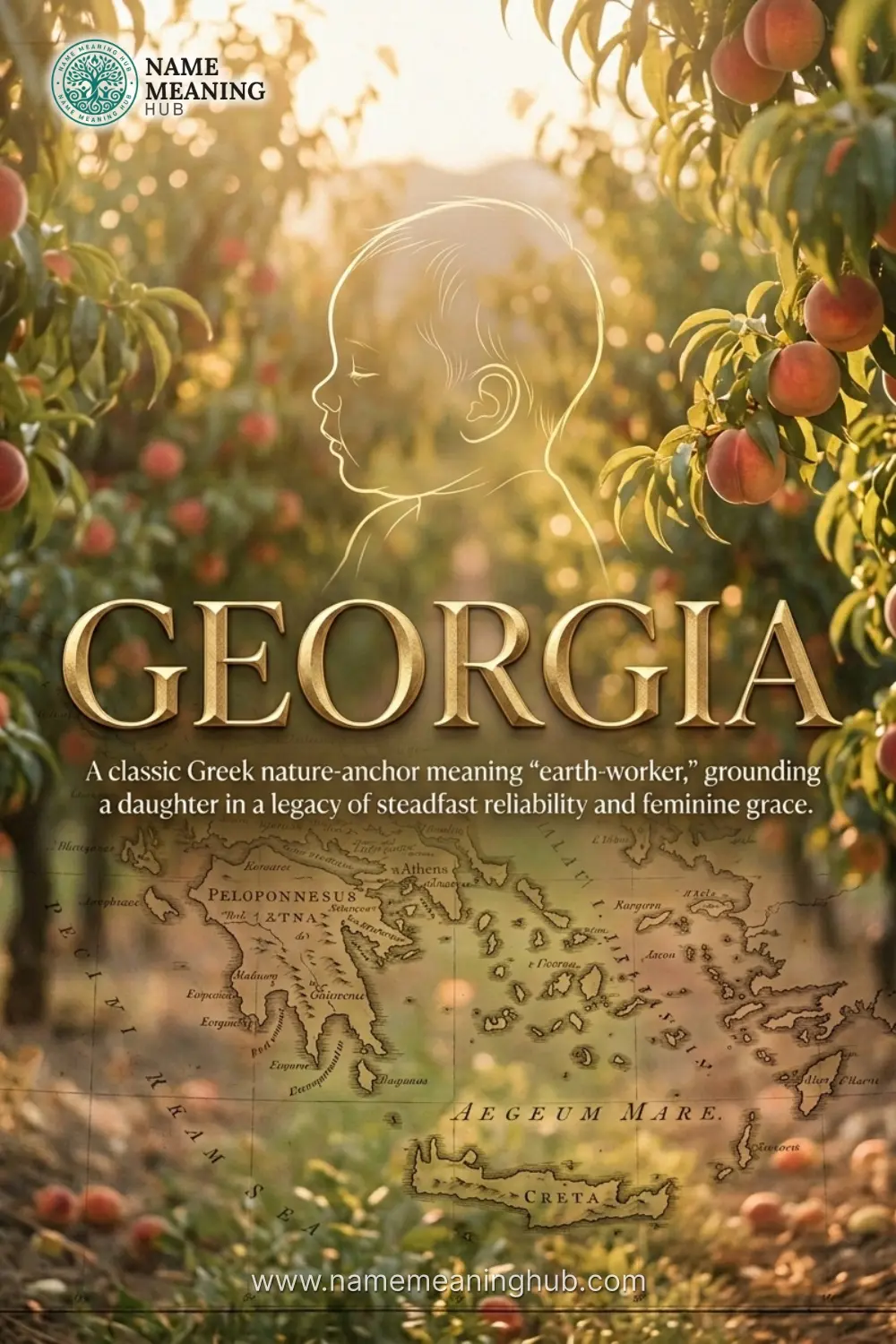
Meaning and Origin FAQ for Georgia
Does the meaning “farmer” make Georgia sound too plain?