
How to Pronounce Frank: Sound Breakdown for Confident Speech
Imagine a name being called across a workshop, printed on a roster, or read aloud at a formal ceremony: Frank. It has no extra syllable to cushion it, no decorative ending to soften it, and no hidden sound to explain. The pronunciation lands in one clean beat: FRANK. It should sound like rank with an fr beginning, not like Fronk, not like Fran, and not like a two-syllable form.
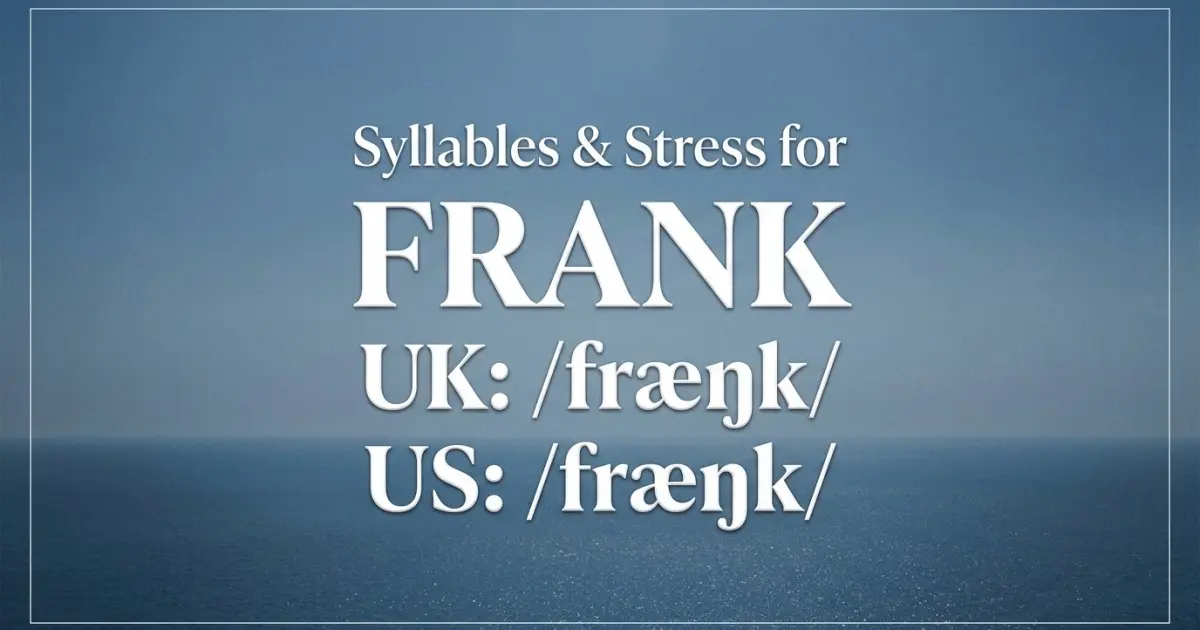
That direct spoken shape fits the name’s character. Frank is German in origin and means “free man,” a meaning built around independence, dignity, and self-possession. Official data shows Frank ranked 468 for boys in the United States in 2024, keeping it familiar without making it feel crowded among current baby names. Both the U.S. and U.K. IPA forms are /fræŋk/, so the pronunciation is stable across major English-speaking contexts. In everyday guidance, the full answer is simple: FRANK, one syllable, short a, firm ending.
How Frank Is Actually Said When One Syllable Does All the Work
| Element | Phonetic Detail | Quick Tip |
|---|---|---|
| Standard pronunciation | FRANK | Say it as one clear syllable, with no extra ending or second beat. |
| Syllable count | 1 syllable | The whole name lands at once: FRANK. |
| Main stress | Single stressed syllable | Because Frank has one syllable, the entire name carries the stress. |
| U.S. IPA | /fræŋk/ | The American form uses a short a sound and a firm final k. |
| U.K. IPA | /fræŋk/ | The U.K. form matches the U.S. form, making the name especially stable. |
| Opening sound | Fr- | Begin with the fr blend, as in fresh or from. |
| Vowel sound | /æ/ | Use the short a sound heard in cat, map, and rank. |
| Ending sound | -nk | Close with a clear nk sound, not a soft or missing ending. |
The One-Syllable Shape That Gives Frank Its Force
Frank is pronounced FRANK, and its one-syllable structure is central to the name’s personality. There is no separate stress pattern to learn. The name begins, opens, and closes in a single compact movement. That makes it easy to call across a room, easy to introduce, and easy to remember after one hearing. The sound matters more once you know what the name is meant to carry, which is why the wider frame starts in Frank meaning.
The opening begins with f, a fricative sound made with a stream of air, followed by r, a liquid consonant that gives the name movement. The middle vowel is the short a sound shown in IPA as /æ/. The final -nk gives the name its decisive close. Frank sounds plainspoken because every sound is doing practical work.
The fr opening gives Frank forward motion
The name does not begin with a blunt stop. It begins with air, then moves into the r. That fr blend gives Frank a slightly active feeling before the name closes. It should be pronounced smoothly, not broken into separate sounds.
The short a keeps Frank from becoming Fronk or Frahnk
The vowel in Frank should be the short a sound, as in rank or bank. It should not become Fronk, with an o sound, or Frahnk, with an exaggerated broad vowel. The clean guide is FRANK.
Frank Across American and British English
Frank has the same standard IPA form in American and British English: /fræŋk/. That gives the name strong pronunciation stability. Some regional accents may slightly color the short a, as they naturally do with many common words, but the structure remains the same: one syllable, fr opening, short vowel, and firm -nk ending.
This stability is one of Frank’s practical strengths. Parents do not need to teach separate U.S. and U.K. versions. The spelling and pronunciation line up clearly, and the name is familiar enough that most speakers will say it correctly on the first try.
American Frank stays crisp and compact
In American English, Frank is usually crisp, with a clear r and a firm final k. The name should not be stretched. Its strength comes from being compact.
British Frank follows the same main shape
In British English, the standard form remains /fræŋk/. Accent differences may affect the texture of the r, but the name remains one syllable and keeps the same short-vowel center.
Where Frank Is Most Likely to Be Mispronounced
Frank is generally easy, but very short names leave little room for error. The most likely mistakes involve changing the vowel, dropping the final consonant, or softening the name into a different form. A simple correction usually works: “It’s FRANK, like rank with fr at the front.”
Mistake pattern: Fronk
The most common vowel mistake is turning Frank into Fronk. The standard pronunciation does not use an o sound. It uses the short a in rank.
Mistake pattern: Fran
Another mistake is losing the final k. Frank should not become Fran. The final k is important because it gives the name its firm, complete ending.
Mistake pattern: adding a second syllable
Frank should not become Frank-uh or Fran-kay. It is one syllable only. The whole name should land cleanly as FRANK.
Sound Neighbors That Help People Remember Frank
Frank is easiest to remember through its rhyme family. It rhymes with rank, bank, blank, and thank, though it begins with the distinct fr blend. That makes the pronunciation simple to teach if someone hesitates over the spelling. Because the strongest energy lands early, the shorter forms often grow from the opening of the name, and that pattern is easier to see in nicknames for Frank.
The sound also supports the meaning “free man.” Frank does not sound ornate or dependent on extra flourish. It sounds self-contained. The name begins with movement, holds a short central vowel, and ends with a firm stop. Its pronunciation feels as independent as its meaning.
The final nk gives Frank its grounded close
The -nk ending is one of the strongest parts of the name. It closes the sound decisively and keeps Frank from feeling soft or unfinished. That ending is part of why the name feels so direct.
The name’s brevity makes clarity essential
Because Frank has only one syllable, every sound matters. The fr, the short a, and the final nk all need to be present. When each part is clear, the name sounds strong without effort.
Practice Lines for Saying Frank Naturally
The easiest way to settle Frank’s pronunciation is to place it in ordinary sentences. The name should sound clear, firm, and complete.
- This is Frank. Keep it one syllable with a short a.
- Frank is here. Let the final k close the name clearly.
- Can you call Frank? Avoid changing the vowel into Fronk.
- Welcome, Frank. This tests the name in a formal setting.
- Frank, are you ready? Useful for hearing the name as direct address.
- My son’s name is Frank. A natural line for parent introductions.
When pairing Frank with a surname, listen for crowded hard consonants. Because Frank ends firmly, a middle name or surname with smoother sounds can help the full name breathe. The pronunciation itself remains simple: FRANK, one clean syllable.