
Frank Name Meaning: Meaning, Character, and Quiet Strength
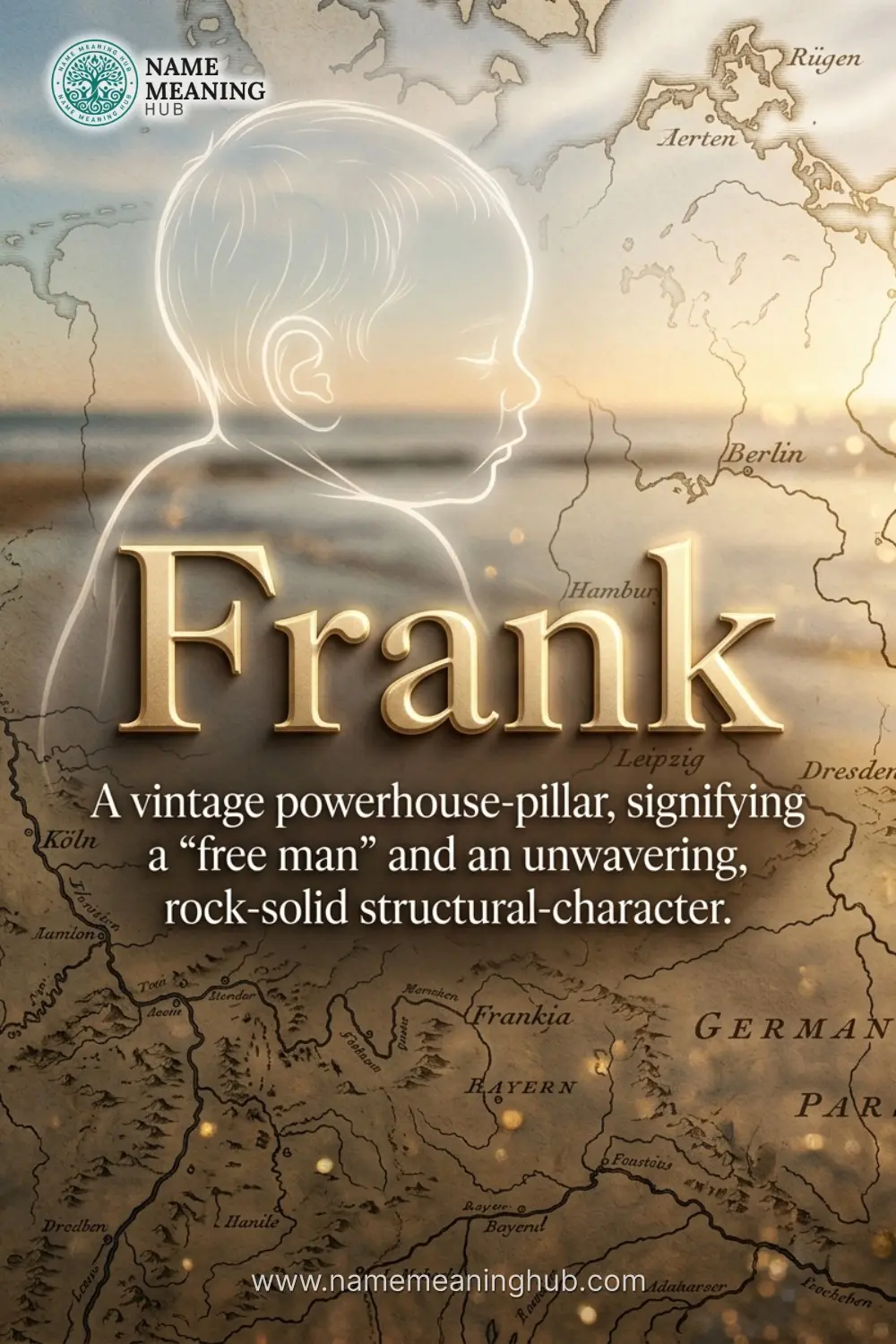
Frank is a name that sounds like a hand offered without ceremony. It does not arrive wrapped in ornament, myth, or elaborate rhythm. It is one syllable, firm at the beginning, clipped at the end, and unusually transparent in feeling. Its meaning, “free man,” gives that compact sound a larger human idea: independence, dignity, and the right to stand in one’s own personhood. Frank is not a name that performs freedom dramatically. It states it plainly.
Pronounced FRANK, the name has a German origin and a long-established masculine profile. Official data shows Frank ranked 468 for boys in the United States in 2024, placing it in a familiar but quieter part of current naming. It is recognizable without being crowded, traditional without sounding decorative, and strong without needing extra syllables. Frank feels direct because everything about it points toward directness: the sound, the spelling, the meaning, and the social impression of a name that has always seemed more interested in substance than display.
Frank's U.S. popularity rank over time, 1880–2024
Popularity statistics are based on official data from the Social Security Administration baby name records.
Frank: A Foundational and Sturdy Heritage Classic
Frank presents a chart pattern of a broader past with a clearer present, reflecting a massive naming cycle that reached its height at #2 in the late 19th century. While it behaves as a “legacy classic” today, it continues to offer a sense of reliability and quiet strength that parents are starting to rediscover through “vintage revival” energy.
The absence of crossover usage helps the name maintain its clear masculine clarity across generations. Meaning “free man,” its simple single-syllable punch provides a sense of permanent and ancient resonance.
Frank Comes Into Focus Through Freedom, Brevity, and Plain Strength
| Key Facts | Information | Quick Insight |
|---|---|---|
| Name | Frank | The name feels compact, grounded, and unmistakably direct, with no ornamental excess. |
| Primary gender usage | Male | Frank reads clearly masculine in current use, supported by its traditional profile and latest ranking. |
| Primary origin | German | The German origin gives Frank a sturdy, old-world foundation rather than a purely modern sound-based identity. |
| Meaning | Free man | The meaning gives Frank a powerful inner theme of independence, dignity, and self-possession. |
| Pronunciation | FRANK | The pronunciation is immediate and complete in one clear syllable. |
| U.S. IPA | /fræŋk/ | The American form keeps the name crisp, with a firm consonant cluster and a clean final stop. |
| U.K. IPA | /fræŋk/ | The matching U.K. form gives Frank strong pronunciation stability across major English-speaking contexts. |
| Syllable count | 1 syllable | The one-syllable shape makes Frank brisk, memorable, and naturally strong in everyday speech. |
| Latest U.S. year | 2024 | Current data shows Frank remains active in modern naming rather than belonging only to earlier generations. |
| U.S. boys’ rank (2024) | No. 468 | Frank is familiar without feeling overused, giving it room to sound refreshed by simplicity. |
The Meaning of Frank Turns Freedom Into Character
The meaning “free man” gives Frank a strong ethical center. It is not a meaning built around wealth, beauty, conquest, or brightness. It is built around status and personhood: the condition of being free, self-directed, and not owned by another. In a baby name, that meaning can feel surprisingly deep because it suggests more than independence as a personality trait. It suggests dignity as a human condition.
Frank’s one-syllable shape makes that meaning feel even stronger. A longer name might unfold the idea slowly; Frank delivers it in one firm beat. The name sounds like someone standing upright. It carries the idea of a person who is not easily disguised, softened into vagueness, or pushed out of shape. The meaning gives Frank a kind of moral plainness: freedom without extravagance.
Frank’s freedom is grounded rather than rebellious
Some names associated with freedom sound restless or romantic. Frank does not. Its freedom feels steadier. It suggests the right to be oneself, to speak clearly, to work honestly, and to stand without unnecessary performance. That makes the name feel more mature than wild.
This matters for parents who want strength without aggression. Frank does not sound like a name trying to dominate. It sounds like a name that knows where it stands. The meaning “free man” gives it independence, but the sound keeps that independence practical and human.
The meaning gives Frank more depth than its brevity suggests
Because Frank is short and familiar, it can be easy to underestimate. Yet its meaning gives it a layered interior. A name can be simple on the surface and still carry a large idea. Frank proves that. It does not need four syllables to feel meaningful. It needs one syllable with conviction behind it.
That combination of brevity and depth is part of Frank’s lasting appeal. It is easy to say, but not empty. It is familiar, but not flimsy. It has the compact authority of a name that has nothing to prove.
Frank’s German Origin Gives the Name Its Sturdy Frame
Frank’s German origin gives it a strong historical and linguistic foundation. The name does not feel newly invented or assembled from fashionable sounds. It feels inherited, practical, and deeply settled. Its meaning, “free man,” fits that atmosphere: direct, social, and rooted in identity rather than ornament.
Many German-origin names have a sense of structure and weight, and Frank shares that quality in miniature. It is not long, but it is dense. Every sound in it does work: the fr opening gives force and movement, the vowel gives a short central body, and the final nk closes the name with firmness. Frank has no spare syllable, no decorative ending, and no uncertainty about where it lands. To continue exploring names from this part of the naming world, visit more names from this heritage.
Why Frank feels traditional without needing ceremony
Frank belongs to the category of names that feel traditional because they have been socially understood for a long time. It does not need an elaborate ending to sound complete. It does not require a nickname to feel approachable. The full name is already brief enough for daily life and strong enough for formal records.
This makes Frank different from names that depend on a long formal version and a casual short form. Frank is both. It can be used on a birth certificate, in a classroom, in a workplace, and at home without changing shape. That consistency is one of its practical strengths.
The German frame helps Frank resist trend fatigue
Names tied too tightly to a particular style moment can feel dated once that moment passes. Frank has a different kind of durability. Its origin and meaning give it a rooted identity, while its sound is too plainspoken to feel like a trend experiment. It may move up and down in popularity, but it does not depend on novelty to make sense.
For parents drawn to names with long-term wearability, this matters. Frank is not trying to be sleek, rare, or delicate. It is trying to be clear. That clarity can age remarkably well.
The Sound of Frank Is Short, Firm, and Unmistakable
Pronounced FRANK, the name has one syllable. Both the U.S. and U.K. IPA forms are /fræŋk/, which gives Frank strong pronunciation stability across major English-speaking contexts. There is no hidden vowel, no second syllable, and no alternate stress pattern. The whole name lands at once.
The opening fr blend gives Frank forward motion. The f sound is a fricative, made by a stream of air rather than a hard stop, while the r adds movement and texture. The final nk closes the name firmly. This gives Frank a sound profile that is both breathable at the beginning and solid at the end.
The fr opening gives Frank movement
The opening of Frank is not blunt in the way a hard stop can be. It begins with air, then moves into the r. That gives the name a sense of forward motion before it closes. The sound feels active, but not noisy.
This movement suits the meaning “free man.” The name begins with motion and ends with firmness, almost as if it holds both independence and stability in the same syllable.
The final k gives Frank its decisive close
The final k sound is one reason Frank feels so complete. It does not trail off. It does not soften into ambiguity. The name closes with a clean stop, which gives it a practical, decisive quality.
That ending also keeps Frank from feeling overly gentle despite its familiar warmth. The name is plainspoken, but not weak. It has a firm edge at the end.
Frank’s Style Lives Between Vintage Strength and Everyday Honesty
Stylistically, Frank belongs to a group of short, traditional boys’ names that feel grounded and adult-ready. It has more blunt strength than names like Alan or Paul, more old-fashioned warmth than modern surname names, and more directness than longer classics such as Frederick or Theodore. Frank is not ornate. Its appeal lies in its honesty. If you want to branch out from Frank without leaving this category, explore a wider list of boy names.
Parents who like Frank may also appreciate names such as George, Paul, Dean, Grant, Mark, Clark, Hugh, Walter, Arthur, or Warren. These names share some combination of sturdiness, brevity, and grown-up simplicity. Frank’s particular distinction is the way its meaning and everyday impression reinforce each other. A name meaning “free man” sounds exactly as independent as it ought to.
Frank feels mature from the beginning
Some names sound childlike first and must grow into adulthood. Frank begins with adulthood already available. That does not mean it cannot work for a child. It means the name has a built-in seriousness that can carry a person across life stages.
A baby Frank may sound charming because the name is slightly unexpected on a child. An adult Frank sounds natural because the name has always had a mature center. That age range gives the name flexibility even though it is short.
Frank’s plainness can feel refreshing now
In a naming landscape filled with sleek surnames, revived antique choices, and soft vowel-rich names, Frank feels noticeably direct. It has no fashionable flourish. That can make it feel fresh in a different way. Simplicity can become distinctive when so many names are designed to impress.
Frank’s style is not minimalism for fashion’s sake. It is plainness with history behind it. That gives the name more substance than a merely short name would have.
Frank’s Popularity Shows Familiarity With Breathing Room
Official data shows Frank ranked 468 for boys in the United States in 2024. That ranking gives the name a useful social position. It remains familiar and recognizable, but it is not common enough among new babies to feel crowded. Parents choosing Frank are choosing a name people know, but not one that appears everywhere in the current generation.
This can be especially appealing for families who like traditional names but want something less expected than the top-ranking classics. Frank has the confidence of a familiar name and the quiet distinction of a less common current choice.
Frank is known enough to be easy
A name with Frank’s familiarity is practical. People know how to say it. They know how to spell it. It has matching U.S. and U.K. IPA forms, and its one-syllable pronunciation is stable. That means the name can move through daily life without constant correction.
Ease is not the same as blandness. Frank’s meaning and sound give it a strong identity, even though it is simple to use.
The 2024 rank gives Frank room to feel renewed
A rank of 468 suggests a name still in active use but far from overexposed. That can make Frank feel newly interesting. It is familiar enough to carry trust, but quiet enough to feel chosen with intention.
This middle position suits the name’s character. Frank does not sound like a name that wants to dominate a list. It sounds like a name that stands confidently wherever it is placed.
Frank in Family Naming: One Syllable With a Strong Spine
Frank works well in full-name combinations because it is short, clear, and firm. Longer middle names can add ceremony: Frank Alexander, Frank Theodore, Frank Benjamin, Frank Nathaniel. Short middle names can create a bold, compact rhythm: Frank James, Frank Reid, Frank Cole, Frank Dean. The surname should guide how much length the middle position needs.
Because Frank ends with a strong nk sound, parents may want to listen carefully when pairing it with hard-consonant middle names. Some combinations sound crisp; others can feel crowded. The best full name lets Frank keep its firm one-syllable identity while giving the whole name enough rhythm to breathe.
Middle names for Frank can soften or expand the full name
Frank’s brevity gives the middle name real influence. A long middle can make the full name more formal. A soft middle can warm its edges. A classic middle can reinforce its traditional strength. The key is to let Frank remain the anchor. If you want the full pairing logic behind that contrast, see Frank middle names.
Nicknames for Frank often grow from affection rather than necessity
Frank is already short, so it does not require a nickname for practicality. Still, affectionate forms such as Frankie may emerge in family life. The full name remains strong because it is already complete. To see how those different moods shorten in real life, explore Frank nicknames.
Pronunciation of Frank is one of its clearest strengths
The standard pronunciation is FRANK. Both U.S. and U.K. IPA forms are /fræŋk/, giving the name excellent stability across major English-speaking contexts. Its clarity supports its direct, grounded style. For the detailed stress pattern, accent notes, and IPA, see Frank pronunciation guide.
Why Frank Still Sounds Like Freedom Without Decoration
Frank endures because it does not confuse strength with excess. Its meaning, “free man,” is large, but the name itself is spare. That contrast gives Frank unusual power. It carries an idea of dignity, independence, and personhood without needing a grand sound to announce it.
At its best, Frank feels like a door left open and a back held straight. It is plain, but not empty; old, but not fragile; brief, but not small. Its German origin gives it structure. Its one-syllable sound gives it force. Its 2024 ranking gives it room to feel familiar without being overused. For parents drawn to names that are honest, masculine, grounded, and quietly meaningful, Frank offers a lasting choice: freedom in one clean syllable.