
How to Pronounce Fatima: How to Break It Down and Say It Smoothly
The real pronunciation test for a name like Fatima rarely happens in a dictionary. It happens in ordinary public places: a teacher reading the class list on the first morning of school, a receptionist calling a patient from a waiting room, a coach scanning a clipboard and deciding whether to trust instinct or pause and ask. Fatima tends to do well in those moments because it is compact, rhythmic, and more phonetically transparent than its cultural weight might lead some people to assume. Once heard once, it usually stays heard correctly.
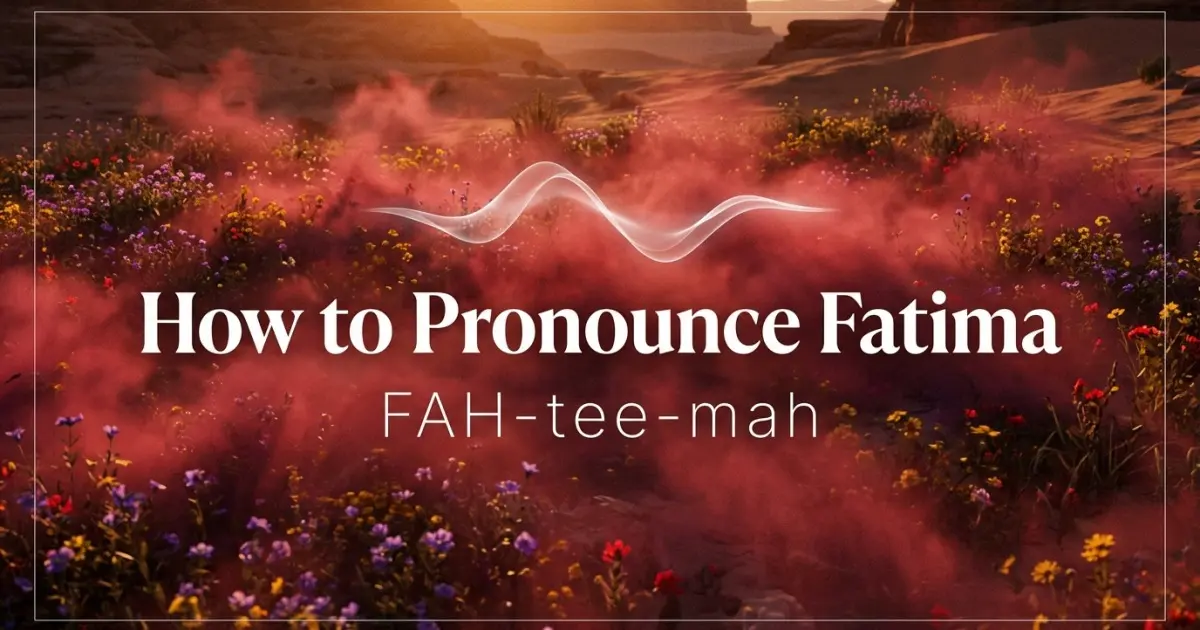
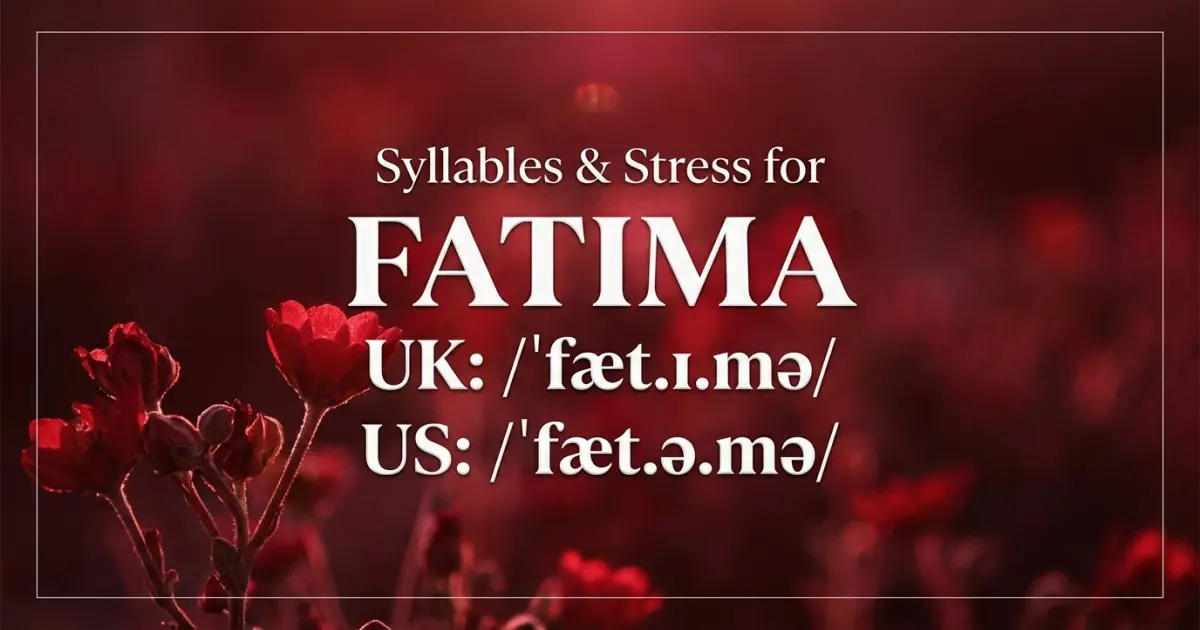
In everyday American English, Fatima is commonly said FAT-ee-muh. Official pronunciation guidance supports the same basic pattern in both U.S. and U.K. notation: /ˈfætɪmə/. That matters because it means the name’s spoken form is stable across major English-speaking settings. Fatima carries history and reverence, but its pronunciation is not fragile. It begins firmly, moves through a clear middle syllable, and ends in a soft relaxed finish. The result is a name that sounds grounded rather than ornate, which is one reason it travels so well in daily life.
What Fatima is actually telling the ear when it is spoken aloud
| Element | Phonetic Detail | Quick Tip |
|---|---|---|
| Everyday pronunciation | FAT-ee-muh | Think of three clean beats, with the first one strongest. |
| IPA (US) | /ˈfætɪmə/ | The opening uses the short a sound from “cat,” not a broader or longer vowel. |
| IPA (UK) | /ˈfætɪmə/ | The U.K. form matches the U.S. form closely, which makes the name highly portable. |
| Syllable count | 3 syllables | Say it as Fat | ee | muh, not as a rushed two-syllable blur. |
| Primary stress | First syllable | If the opening does not carry the weight, the whole name starts sounding less stable. |
| Opening consonant | /f/ fricative | The name begins with breath and edge, which gives it clarity right away. |
| Final syllable | /mə/ schwa ending | Keep the end light and natural rather than over-pronouncing it. |
| Most common issue | Changing the first vowel or over-emphasizing the middle | The safest anchor is the strong opening FAT. |
How Fatima gets its strength from a simple, stable rhythm
Fatima sounds clear because its rhythm is clean. The first syllable is stressed, the second is bright but lighter, and the final syllable relaxes into a schwa. That creates a very usable English shape: firm opening, easy middle, soft landing. A name does not need elaborate vowel music to sound elegant. Sometimes clarity itself is the elegance. Pronunciation lands more fully when the name’s roots and history are already in view, so begin with Fatima meaning.
Why the first syllable does most of the work
The opening FAT is the anchor of the name. Linguistically, it begins with /f/, a fricative consonant, which means the sound is made by pushing air through a narrow space. Fricatives often give names definition because they arrive with a little breath and edge. In Fatima, that edge is balanced by the short /æ/ vowel, the same basic vowel heard in “cat.” Together they create an opening that feels direct and memorable.
Because the first syllable is stressed, English speakers usually grasp the name quickly. First-syllable stress tends to sound stable and dependable in English, and Fatima benefits from that. The name does not drift into its meaning or its rhythm. It announces itself immediately.
Why the ending keeps Fatima warm
After that strong start, the name softens. The middle ee syllable adds brightness, then the last syllable falls into muh, a relaxed schwa ending. That soft finish matters. Without it, Fatima might sound too clipped or too severe. Instead, the name closes in a way that feels human and approachable. Because the strongest energy lands early, the shorter forms often grow from the opening of the name, and that pattern is easier to see in Fatima nicknames.
This is part of why Fatima remains so usable in everyday life. The name has strength at the front, but not hardness all the way through. It begins with definition and ends with warmth. That kind of balance is one reason names remain easy to live with across generations.
Where Fatima gets misheard, and why the errors are usually visual
Fatima is not a difficult name, but it does sometimes get misread by people who encounter it first in writing. Most pronunciation mistakes come not from the sound itself, but from visual guessing. People see a familiar-looking three-syllable structure and import patterns from other names they already know.
When speakers shift the first vowel away from “FAT”
The most common problem is changing the opening vowel. Some speakers drift toward a broader or softer first syllable because they are aiming for elegance rather than accuracy. But Fatima works best when the opening stays short and firm: FAT, not a drawn-out or overly softened alternative. Once that first syllable changes, the whole name starts to lose its grounded quality.
A useful memory trick is simple: start with the same vowel shape you would use in “fat,” then continue into ee-muh. That instantly restores the name’s intended balance.
When the middle gets too much emphasis
The second common issue is over-lifting the middle syllable. Because the ee sound is bright, some speakers let it dominate. But the name’s stress does not belong there. The middle should be clear, yes, but not central. If the ee takes over, the name begins to sound less compact and more sing-song than it should.
Fatima sounds best when the first syllable carries the identity and the second simply helps the name move. That is the difference between a strong three-beat name and one that feels oddly reshaped in speech.
Fatima across accents changes in color more than structure
One of Fatima’s practical strengths is that it remains remarkably stable across accents. The official U.S. and U.K. IPA forms are the same, which is not always the case with names that travel widely. In real speech, of course, speakers will still color the vowels differently depending on region. But those differences are usually small enough that the name remains unmistakably itself.
What may shift from speaker to speaker
The short a in the first syllable may sound a touch broader or tighter depending on accent. The final schwa may be more reduced in fast speech. Some speakers may clip the middle vowel slightly. These are normal accent effects, not changes to the structure of the name. The basic architecture remains constant: strong first syllable, bright middle, soft close.
This makes Fatima an unusually portable name. It can move through multilingual or multicultural settings without becoming unstable. That is a major advantage for families who want a name that keeps its identity in different social worlds.
Practicing Fatima is easier than overthinking it
The simplest way to learn Fatima is to feel the rhythm rather than stare at the spelling: FAT | ee | muh. Three beats. First one strongest. Last one relaxed. Once that pattern is clear, the pronunciation tends to settle immediately.
Practice lines that make Fatima sound natural
Try the name inside ordinary sentences: “Fatima is here.” “Can Fatima come in?” “I saved this for Fatima.” Spoken in real phrases, the stress becomes easier to hear because the name drops into normal English movement. This is often how people truly learn a name—not by reading a phonetic breakdown once, but by hearing the name live inside actual speech.
How to remember Fatima when you first see it written down
If you are meeting the name in print, anchor yourself to two things. First, the opening is FAT with a short a. Second, the ending is muh, not a strongly pronounced final syllable. Everything in the middle is there to connect those points smoothly.
That is what makes Fatima such a durable spoken name. It does not depend on exoticism, complication, or theatrical delivery. It sounds strong because the rhythm is strong. It sounds warm because the ending relaxes naturally. And it sounds memorable because the opening lands cleanly. In practical terms, that means Fatima keeps its dignity not only in history or on paper, but in the ordinary spoken life where names really have to work.
Fatima Pronunciation FAQ
How do you pronounce Fatima correctly?
Fatima is commonly pronounced FAT-ee-muh, with the strongest stress on the first syllable.
What is the IPA pronunciation of Fatima?
The standard IPA form is /ˈfætɪmə/ in both U.S. and U.K. usage. That reflects a strong first syllable, a clear middle vowel, and a soft schwa ending.
What pronunciation mistake happens most often with Fatima?
The most common problem is changing the opening vowel or shifting too much emphasis onto the middle syllable. The name sounds best when the opening FAT remains the clear anchor.
Is Fatima hard for English speakers to pronounce?
No. Fatima is compact, rhythmically clear, and stable across accents. Most English speakers can pronounce it comfortably after one hearing, and many will get very close immediately.