
Ellie Pronunciation: Easy Breakdown and Speaking Tips
The real test of a name’s pronunciation is rarely the birth announcement. It happens later, in ordinary public moments: a teacher pausing over a class list, a nurse calling a child from the waiting room, a coach reading a roster, a receptionist repeating the name back over the phone. Ellie succeeds in those moments because it is almost instantly sayable. It looks exactly like the kind of name most English speakers know how to handle, and that practical ease is one reason it has such wide appeal. Parents do not need to worry that it will be admired on paper but constantly corrected in real life.
That does not mean pronunciation is irrelevant. In a short name, small shifts matter more. A name with only two syllables has nowhere to hide a weak stress pattern or a muddy vowel. Ellie sounds best when it is clean and bright: EL-ee. The first syllable should carry the weight, and the second should release lightly. That is what gives the name its characteristic warmth. Say it too flatly and it loses some of its sparkle. Say it too sharply and it can sound clipped instead of friendly. The good news is that Ellie is easy to learn because its rhythm is simple and stable.
What This Clears Up About How Ellie Is Really Said
| Element | Phonetic Detail | Quick Tip |
|---|---|---|
| Standard pronunciation | EL-ee | Keep the stress on the first syllable. The second should sound lighter and quicker. |
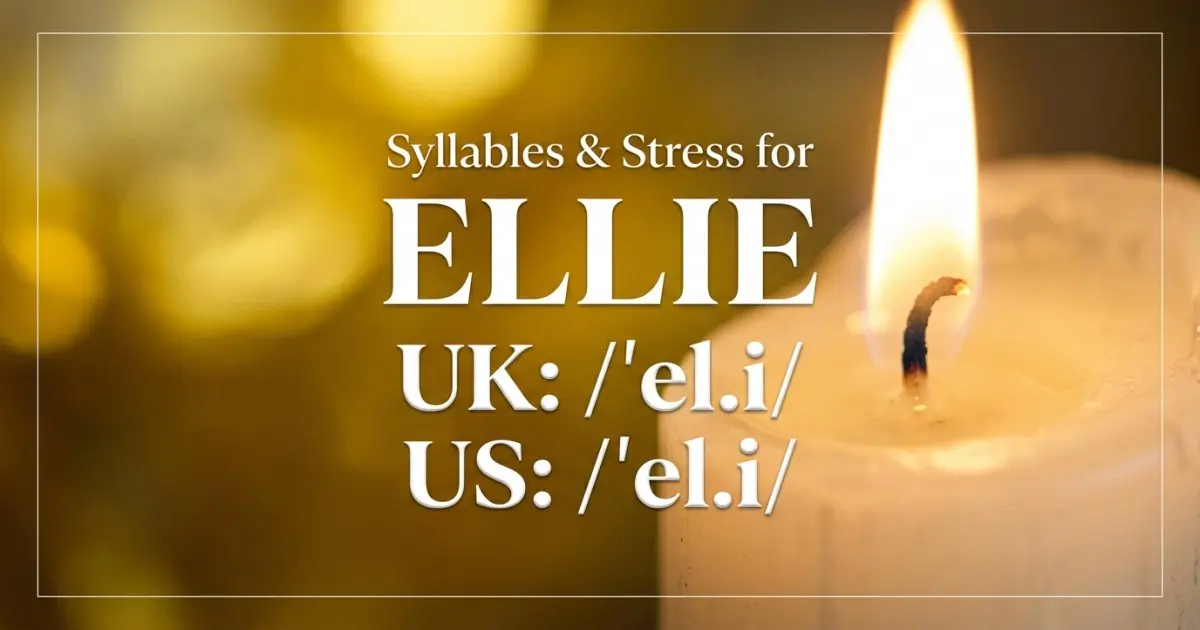
| IPA (US) | /ˈɛli/ | The opening vowel is like the “e” in bet, not the “ay” in day. |
| IPA (UK) | /ˈɛli/ | The British reference form matches the American one closely, which makes Ellie unusually stable across accents. |
| Syllable count | 2 syllables | Think of it as a neat two-beat pattern: EL | ee. |
| Primary stress | First syllable | If both syllables get equal weight, the name can sound flatter than it should. |
| Final sound | Long “ee” ending | Let the ending stay bright and clear rather than swallowing it into a dull “ih.” |
| Speech texture | Short front vowel + liquid consonant + open ending | The l helps the name glide. It should feel smooth, not choppy. |
Why Ellie Sounds So Easy—and Why That Matters
Ellie has one of the clearest stress patterns in modern use
Ellie is a two-syllable name with a very direct structure. The stress falls on the first syllable, so the name naturally opens strong and finishes light: EL-ee. This pattern is one of the easiest for English speakers to recognize because it appears in many familiar words and names. There is no hidden syllable, no uncertain emphasis, and no vowel sequence that encourages people to improvise. Before focusing only on syllables and stress, it helps to step back into the fuller frame of Ellie meaning.
That stability matters in daily life. Some names are attractive but live under constant pronunciation drift because speakers from different regions stress them differently. Ellie largely avoids that problem. Once heard once, it tends to stay fixed in memory.
The sound pattern keeps Ellie bright
Linguistically, Ellie works because its sounds cooperate with its meaning. The first syllable begins with a short open vowel, followed by a liquid consonant, the l, which lets the name flow rather than stop abruptly. The final -ee ending keeps the name light and clear. Together, these parts make Ellie sound bright, approachable, and energetic without becoming sharp or shrill.
That final ee is especially important. It gives the name lift. Without it, Ellie would feel heavier and more closed. With it, the name finishes in a way that sounds youthful but still usable. This is one reason Ellie remains wearable across ages: the sound is cheerful, but not flimsy.
Where Ellie Can Go Wrong in Real-Life Speech
The most common mistake is not dramatic—it is flattening
Because Ellie is so familiar-looking, people rarely misread it badly. The more common issue is flattening the rhythm so that both syllables sound equally weighted. That produces something more mechanical than natural. Ellie should not sound like two equal pieces laid side by side. The first syllable should lead, and the second should follow.
A good mental cue is this: say the name like a smile, not like a list item. That keeps the stress where it belongs.
The first vowel should stay “eh,” not drift toward “ay”
Another occasional mistake is starting the name with too much of an ay sound, making it drift closer to something like “Aylie.” That is not the standard form. The opening vowel in Ellie is the e of bed or best, represented in IPA as /ɛ/. It is short, open, and clean. Once that first vowel is right, the rest of the name usually falls into place.
The ending should stay bright, not mumbled
In fast speech, some speakers can reduce the second syllable too much, so the name begins to sound rushed or slightly muffled. Ellie needs a real ending. It is light, but it should still be audible. If the final ee disappears, the name loses some of its clarity and brightness. The way the name resolves at the end often decides which short forms feel natural in speech, and that becomes clearer in nicknames for Ellie.
Ellie Across Accents and Neighbor Names
US and UK English agree more than they differ
One of Ellie’s practical advantages is that the reference pronunciation is the same in both American and British transcription: /ˈɛli/. Of course, no two accents sound identical in real life. Some speakers may make the first vowel a touch narrower or the final ee slightly tenser. But the overall structure stays the same: first-syllable stress, short opening vowel, bright ending.
That kind of cross-accent consistency is valuable. It means Ellie does not ask much of speakers when it travels between regions or countries. The name stays recognizably itself.
Ellie sits near other El-names but keeps a distinct contour
Ellie shares sound territory with names like Ella, Elle, Ellie-May, and even longer relatives such as Eleanor or Eliana when used with a nickname. But its spoken shape is distinct because of the final ee. Ella falls away more softly. Elle closes abruptly. Ellie stays bright at the end, and that brightness is the trait most worth preserving in pronunciation.
This also helps explain why the name sounds familiar but never empty. It belongs to a known family of sounds, yet it has its own finish.
How to Practice Ellie Until It Sounds Effortless
Use the two-beat method
The simplest way to teach or check Ellie is to split it once into two beats: EL | ee. That reminds the speaker where the stress belongs and prevents the name from flattening. Once the pattern is clear, it can be spoken at normal speed without effort.
Practice Ellie in ordinary sentences
Short names often sound fine in isolation but reveal awkwardness in real speech if the rhythm is off. A good way to test Ellie is to use it in everyday lines:
Ellie is ready.
Can Ellie come over later?
I made this for Ellie.
These are useful because they place the name in the sort of phrasing where it will actually live. When spoken naturally, Ellie should sound clean, warm, and immediate.
What good pronunciation of Ellie should feel like
When Ellie is said well, it should feel quick but not rushed, bright but not squeaky, and soft but not vague. The name should open clearly, glide through the l, and finish with a light, audible ee. If that happens, the name sounds exactly as it should: simple, luminous, and easy to carry.