
How to Pronounce Edward: Syllable Guide and Easy Stress Tips
Edward is the kind of name that often reveals itself in a public room before anyone thinks about phonetic symbols. Picture a head teacher reading a prize list, a grandfather introducing a newborn to visiting relatives, or a receptionist calling the next patient from a waiting room. Some names look stately on paper and then sound stiff or overformal when spoken aloud. Edward usually does something better. It keeps its dignity, but the sound softens just enough in ordinary speech to feel lived in rather than ceremonial. That is one reason it has lasted so well. It sounds serious, but not brittle.
Its pronunciation matters because a large part of Edward’s appeal lies in that balance. The name means “wealthy guardian,” and the sound supports that idea unusually well. The opening is clear and grounded. The middle moves quickly. The ending relaxes rather than strikes. Said correctly, Edward sounds like authority that has been civilized. It has enough firmness to feel traditional and enough softness to remain human. That balance is what makes the name work across childhood, adulthood, and formal life without ever sounding trapped inside one role.
How Edward is actually said when everyday speech takes over
Before accent shifts and common mistakes come into view, it helps to pin down the core spoken pattern that keeps Edward recognizable and so widely usable.
| Element | Phonetic Detail | Quick Tip |
|---|---|---|
| Common pronunciation | ED-wuhrd | Say it in two clear beats, with the strongest stress on the first syllable. |
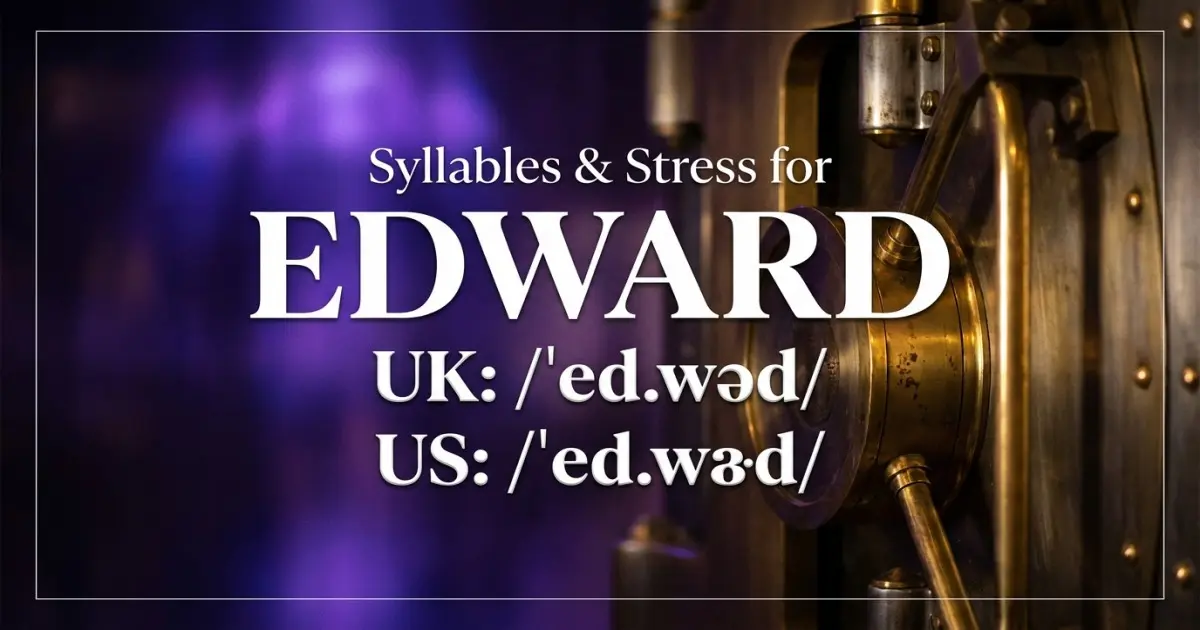
| U.S. IPA | /ˈɛdwərd/ | The second syllable often reduces to a soft wərd, not a fully pronounced “ward.” |
| U.K. IPA | /ˈɛdwəd/ | In many British pronunciations, the ending is lighter and less rhotic, closer to wəd. |
| Syllable count | 2 syllables | Edward sounds strongest when both syllables remain audible, even if the second is softened. |
| Stress pattern | First syllable stressed | The main emphasis belongs on ED; the second syllable should be lighter and quicker. |
| Opening consonants | /ɛd/ followed by a glide /w/ | The opening should feel firm and clear, then move smoothly into the second half. |
| Vowel reduction | Schwa in the second syllable | The second vowel is usually relaxed, not fully pronounced like the vowel in “war.” |
| Ending texture | Soft final /d/ in U.K.; fuller /rd/ feel in U.S. | The ending should close neatly, but it should not sound barked or overenunciated. |
Why Edward sounds formal but never has to sound stiff
Edward works because its phonetic shape mirrors its social character. The name begins with a grounded, uncomplicated first syllable, then softens into a more relaxed second syllable. That shift is what keeps the name from becoming too hard. It sounds established, but it does not sound armored. The sound matters more once you know what the name is meant to carry, which is why the wider frame starts in Edward meaning.
The first syllable gives Edward its backbone
The opening Ed- is short, direct, and easy to hear. The vowel /ɛ/ is the same family of sound heard in words like “bed” or “red,” which gives the name immediate clarity. The final d in that first syllable adds a little firmness before the sound moves onward. This is why Edward enters the ear with more authority than many softer classics. It begins cleanly and decisively.
That strong opening also explains why the name can carry so much dignity without extra effort. Edward does not need flourish. The first beat is already doing enough work.
The second syllable keeps Edward human
The real secret of Edward is the second syllable. In both American and British pronunciation, the second half is usually softened. In the United States it tends toward wərd. In Britain it often moves closer to wəd. In both cases, the vowel is reduced toward a schwa, the neutral unstressed vowel sound heard in many everyday English words. That reduction matters. It is what prevents Edward from sounding too rigidly formal.
Put more simply, the name starts with structure and ends with ease. That is why it sounds gentlemanly rather than severe. The second syllable lets the name settle.
Edward in American and British speech: same name, different finish
The fact packet gives two very close pronunciations: /ˈɛdwərd/ in the United States and /ˈɛdwəd/ in the United Kingdom. The difference is real, but it does not create a different identity. It changes texture more than meaning.
How American Edward carries a fuller ending
In many American accents, Edward ends with more audible rhotic color, which means the r is heard more clearly. That makes the second syllable sound slightly fuller: wərd. The result is a name that feels a touch more grounded and complete at the end. It keeps some extra weight in the closing sound. The way the name resolves at the end often decides which short forms feel natural in speech, and that becomes clearer in Edward nicknames.
This fuller ending can make Edward sound a bit more substantial in American speech, especially when spoken carefully. But even then, the second syllable is still lighter than the first. It should not become the main event.
Why British Edward sounds lighter but not weaker
In many British accents, the ending loses that pronounced r and relaxes into something closer to wəd. This gives the name a slightly lighter finish. It can sound a little more fluid and a little less heavy than the American version. But it does not sound weaker. It simply sounds more streamlined.
This kind of variation is one of Edward’s strengths. The name adapts gently across accents without losing its essential character. It remains recognizably Edward everywhere.
Where Edward usually gets misheard or overcorrected
Edward is familiar, but that familiarity can lead speakers into a few predictable mistakes. Most of them come from either overformalizing the name or flattening it too much.
Turning the second syllable into a heavy “ward”
The most common overcorrection is pronouncing Edward as though the second syllable were a strongly stressed, fully articulated “ward.” That makes the name sound more rigid than it usually is in real life. Edward is not typically Ed-WARD. The second half should be lighter, softer, and more reduced than that.
Swallowing the second syllable too much
The opposite problem is reducing the name so aggressively that the second syllable nearly disappears. In fast speech, that can happen. But in clear pronunciation, Edward still needs two audible beats. If the second syllable vanishes completely, the name loses some of its elegance and can begin to sound compressed.
Making the whole name sound overly clipped
Because Edward has such a compact first syllable, some speakers clip the whole name too hard. That can make it sound stern or impatient. Edward works best when the opening is clear but the movement into the second syllable stays smooth. The name should sound measured, not snapped.
How Edward sounds beside Edmund, Edwin, and Eddie
One of the easiest ways to hear Edward accurately is to place it next to nearby names that share some sounds but create different rhythms and impressions.
Edward and Edmund prove how much the second syllable matters
Edward vs. Edmund: both begin with the same strong Ed- opening, but Edmund has a heavier, more closed second syllable. That gives it a slightly denser, more old-world sound. Edward feels more fluid because the second syllable reduces more easily.
Edward and Edwin separate polish from briskness
Edward vs. Edwin: Edwin is brisker and lighter overall. Edward carries more social formality because the second syllable feels more settled and less clipped. Even though both are two syllables, Edward sounds more ceremonially complete.
Edward and Eddie show the difference between formal and familiar speech
Edward vs. Eddie: Eddie keeps the strong Ed- front but replaces Edward’s softened formal ending with a much more obviously affectionate one. Hearing the two side by side makes it clear how much Edward’s dignity lives in that softened second syllable rather than in sheer hardness.
How to practice Edward until it sounds natural, not overly formal
Edward is easiest to hear correctly in full sentences, where the name can settle into ordinary speech rather than sounding like a dictionary entry.
Three useful practice lines for Edward
Edward is waiting by the door.
I saw Edward after lunch.
Edward left his coat on the chair.
What to listen for in your own voice
Listen for a clear, grounded Ed- at the start, then a smooth slide into a lighter second syllable. The name should feel formal, but not overannounced. If it sounds steady, civilized, and easy to repeat, you are very close to the natural pronunciation.
Why Edward still sounds distinguished in motion
Edward is a strong example of how a formal name can remain fully usable in daily speech. The name begins with authority, then relaxes into a softer ending that keeps it from sounding too severe. That phonetic design is one of the reasons the name has remained alive for so long. It is dignified, but it is not trapped behind dignity.
Said correctly, Edward sounds exactly like what many parents hope it will be: serious, kind, and steady. That is not a flashy achievement, but it is a lasting one. The name does not need to raise its voice to sound important.
Common Questions About How Edward Sounds
How do you pronounce Edward correctly?
Edward is commonly pronounced ED-wuhrd, with two syllables and the strongest stress on the first.
What is the IPA pronunciation of Edward?
The pronunciation given here is /ˈɛdwərd/ in U.S. English and /ˈɛdwəd/ in U.K. English.
How many syllables does Edward have?
Edward has two syllables. The first is stronger, while the second is softer and more reduced in natural speech.
What pronunciation mistake happens most often with Edward?
The most common mistake is making the second syllable too heavy, as though it were a fully stressed “ward.” In most natural speech, the ending is lighter and more relaxed than that.
Does Edward sound different in American and British English?
Yes, slightly. American English usually keeps more audible r color in the second syllable, while British English often gives the name a lighter, less rhotic ending. The core identity of the name stays the same in both.