
Chloe Pronunciation: A Confidence-First Guide to Saying It
The real pronunciation test for a name rarely happens in a dictionary. It happens at a pediatrician’s office, in a kindergarten classroom, at a graduation ceremony, or across a crowded park when someone calls a child back from the swings. Chloe passes that test unusually well. It is a name most English speakers recognize on sight, and that public familiarity matters. Official data shows Chloe remained a highly visible girls’ name in the United States in 2024, which helps explain why its spoken form now feels natural in ordinary life rather than specialized or fragile.
Even so, Chloe is not boring from a sound perspective. It contains one of the most common small surprises in English naming: the letters ch do not produce the sound heard in words like chair. Instead, Chloe begins with a hard k sound. That one detail tells you nearly everything important about the name’s pronunciation style. Chloe sounds polished because it starts cleanly, opens into a rounded stressed vowel, and ends in a light second syllable. It is simple enough for daily use, but still structured enough to reward careful listening.
What Chloe Clarifies the Moment You Hear It
| Element | Phonetic Detail | Quick Tip |
|---|---|---|
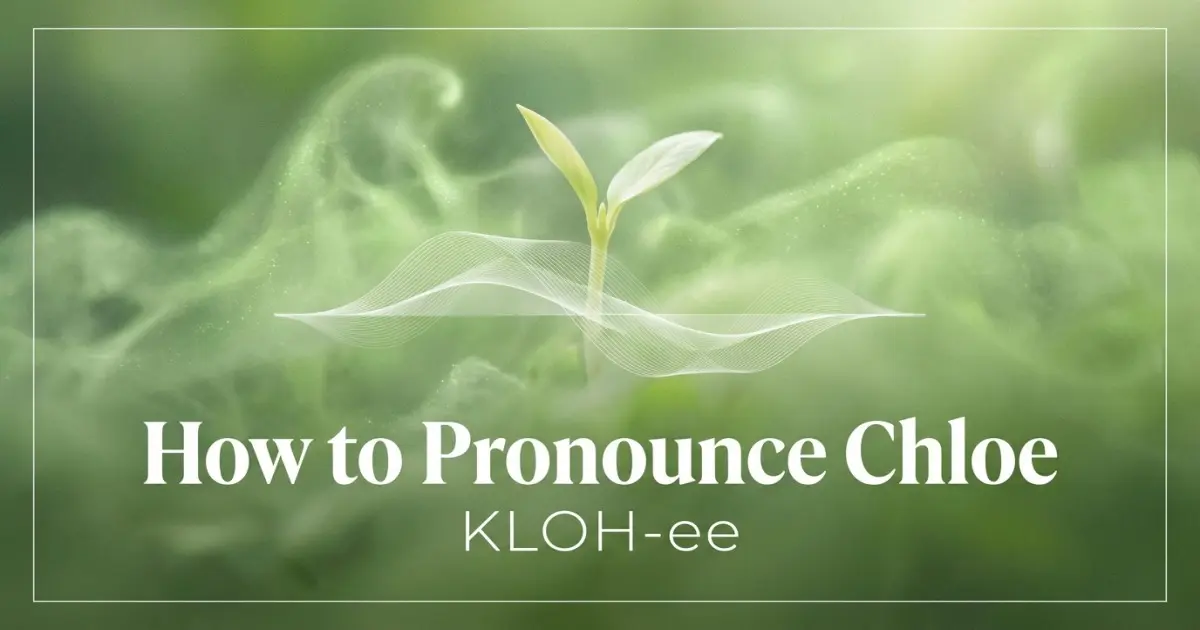
| Everyday pronunciation | KLOH-ee | Say it as two clean beats, with the first one stronger than the second. |
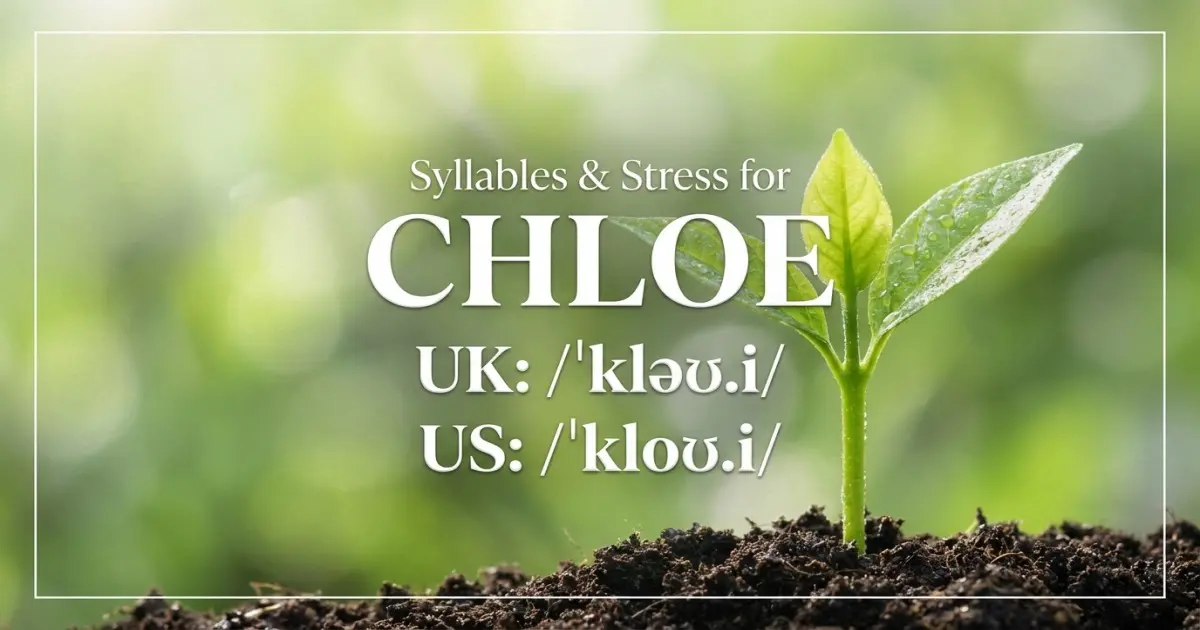
| US IPA | /ˈkloʊi/ | The middle vowel glides like the sound in go or show. |
| UK IPA | /ˈkləʊi/ | The British vowel starts a little more centrally, but the name still sounds very close to the U.S. version. |
| Syllable count | 2 syllables | Think of it as KLOH + ee, not one rushed blur. |
| Stress pattern | Stress on the first syllable | The emphasis belongs on KLOH, which gives the name its clarity and confidence. |
| Opening consonant | /k/ followed by a liquid /l/ | Start firmly with the hard k, then let the l soften the transition. |
| Most common confusion | Reading ch as /tʃ/ | If you are unsure, remember Chloe begins like clover, not like chewy. |
How Chloe Actually Lands in the Ear
Chloe works because each part of the name has a clear job. The opening consonant is a hard /k/, which gives the name crispness. Immediately after that comes /l/, a liquid consonant. Linguists call /l/ a liquid because it allows the voice to move smoothly rather than stopping sharply. In Chloe, that smoothness matters. It prevents the name from sounding blunt. The result is a beginning that feels precise but not harsh. Pronunciation lands more fully when the name’s roots and history are already in view, so begin with Chloe meaning.
Why the first syllable carries the whole shape
The first syllable, KLOH, holds the stress. That is what gives the name its center of gravity. If the stress were moved later, the name would sound unstable or unfamiliar. In ordinary speech, English speakers naturally place the emphasis up front, and that front-loaded stress is one reason Chloe sounds so efficient. The listener gets the important information early.
The vowel in this stressed syllable is a glide rather than a flat, fixed sound. In the U.S. pronunciation /ˈkloʊi/, the middle resembles the vowel in go. In the U.K. version /ˈkləʊi/, the starting point is slightly different, but the effect to most listeners remains very close. In both varieties, the name opens outward rather than closing down.
Why the ending keeps Chloe light
The final ee sound gives Chloe its lift. Without it, the name would stop on a heavier note. With it, the name feels finished but not weighted down. That second syllable is short and unstressed, so it should not be overperformed. Say it lightly. The danger is not usually mispronouncing it entirely, but lingering on it too much and making the name feel theatrical. Chloe sounds best when the ending is clear, quick, and bright.
Put together, these sound parts explain the name’s lasting popularity. Chloe is phonetic in the practical sense: once someone has heard it correctly, it is easy to repeat. It has enough shape to be memorable and enough simplicity to stay friendly.
Where Chloe Shifts Across Accents Without Losing Itself
One of Chloe’s strengths is that it travels well. Some names change dramatically across English accents, but Chloe stays remarkably stable. The main variation lies in the stressed vowel, not in the overall structure. That means parents do not need to worry that the name becomes unrecognizable between American and British speech. It does not.
US and UK differences that matter only a little
In the U.S., Chloe is usually heard as /ˈkloʊi/. In the U.K., it is commonly /ˈkləʊi/. For most listeners, this is a fine-grain distinction rather than a practical obstacle. Both forms still sound like KLOH-ee in everyday approximation. The stress remains on the first syllable, the opening remains a hard /k/, and the final ee remains light.
This kind of difference is normal in international English. It belongs to accent texture, not to identity change. Parents choosing Chloe therefore get one useful advantage: the name preserves its core across regions without requiring constant correction.
Why Chloe still sounds polished in fast speech
Some two-syllable names become muddy when spoken quickly. Chloe usually does not. The consonant cluster at the front keeps the name defined, while the final vowel keeps it open. Even when said casually, the name tends to hold its outline. That makes it practical in classrooms, on phone calls, and in public introductions.
It also helps that Chloe has no difficult fricatives or unstable consonant endings. A fricative is a sound made by forcing air through a narrow gap, like /f/ or /s/. Chloe avoids that kind of hiss or friction. Its movement is cleaner: hard consonant, liquid consonant, rounded vowel, light finish. This is part of why the name feels easy to say without becoming flat.
Why Chloe Gets Misread on Paper More Than It Gets Misheard
The most common mistake with Chloe happens before anyone speaks. It happens at the spelling stage. English readers often associate ch with the sound /tʃ/, as in chair or cherry. Chloe does not follow that pattern. Instead, the opening is /k/. Historically, English contains several Greek-derived words and names where ch signals a hard k sound, and Chloe belongs to that broader pattern.
Mistake pattern one: saying “Cho-ee” or “Chlow-ee”
This happens when the reader treats the opening like the usual English ch. Once corrected, the issue rarely persists, because KLOH-ee feels immediately familiar in the ear. The easiest fix is simple association: Chloe begins more like clover than like chocolate.
Mistake pattern two: flattening the two syllables into one rush
Another minor issue is speed. Because Chloe is short, some speakers can compress it too much, letting the second syllable disappear. The name should still have two audible parts. The second syllable does not need emphasis, but it should remain present. Think clean finish, not swallowed ending.
Sound neighbors that help people get Chloe right
If someone is learning the name by ear, it can help to compare it loosely to familiar sound shapes. The first syllable resembles the opening of words like close or clover, minus the final consonant. Then add a quick ee. That produces the right contour without overcomplicating the explanation. Once the sound pattern is clear, some shortenings stop feeling optional and start feeling natural, and the clearest map is in nicknames for Chloe.
It is also useful to remember what Chloe is not. It is not CHOH-ee. It is not CLAW-ee. It is not KLOH-ay. Keeping those near-misses in mind can make the correct version more secure.
Practice Lines That Let Chloe Settle Naturally in the Mouth
The best practice for a name is not isolated repetition forever. It is hearing the name inside real sentences. Chloe benefits from this because its rhythm becomes obvious once it is placed in ordinary speech.
Simple practice lines
Try these aloud:
- Chloe is waiting by the door.
- Did Chloe already call back?
- Chloe will be here at noon.
- I saved a seat for Chloe.
In each sentence, the first syllable naturally carries the weight. That is the pronunciation pattern you want to preserve. Do not overlengthen the second syllable. Let it trail lightly.
How to know you are saying Chloe well
You are probably pronouncing Chloe correctly if three things happen at once: the opening sounds like a hard k, the first syllable is clearly stronger, and the final ee remains audible but light. Once those three features are in place, the name settles into its natural shape very quickly.
That is ultimately the charm of Chloe as a spoken name. It contains one small spelling surprise, but almost no spoken difficulty. After the first correction, if one is needed at all, it becomes one of those names people say with ease. And that ease is part of its elegance. Chloe does not ask for performance. It asks only for clarity.