
How to Say Charles Correctly: A Clearer Way to Understand the Sounds
The most revealing place to hear Charles pronounced correctly is not a dictionary recording but a room where the name has to work immediately: a teacher pausing over attendance, a receptionist calling a client forward, a grandparent saying it once with affection and no hesitation. In those moments, Charles succeeds because it sounds exactly as a formal classic should sound—compact, full, and settled. It is only one syllable, yet it carries more weight than many longer names. That is part of its staying power. Charles sounds established before anyone explains its history.
That everyday stability matters because Charles is a name with unusually large associations. It can evoke monarchy, tradition, or public dignity, but its spoken form is not stiff. It begins with a clear ch sound, opens into a broad vowel, and finishes with a dense consonant ending that gives it real substance. The result is a name that feels grounded rather than ornate. Charles does not drift. It lands.
How Charles is actually said when people say it naturally
| Element | Phonetic Detail | Quick Tip |
|---|---|---|
| Common pronunciation | CHAHRLZ | Say it as one full syllable, not as two parts pushed together. |
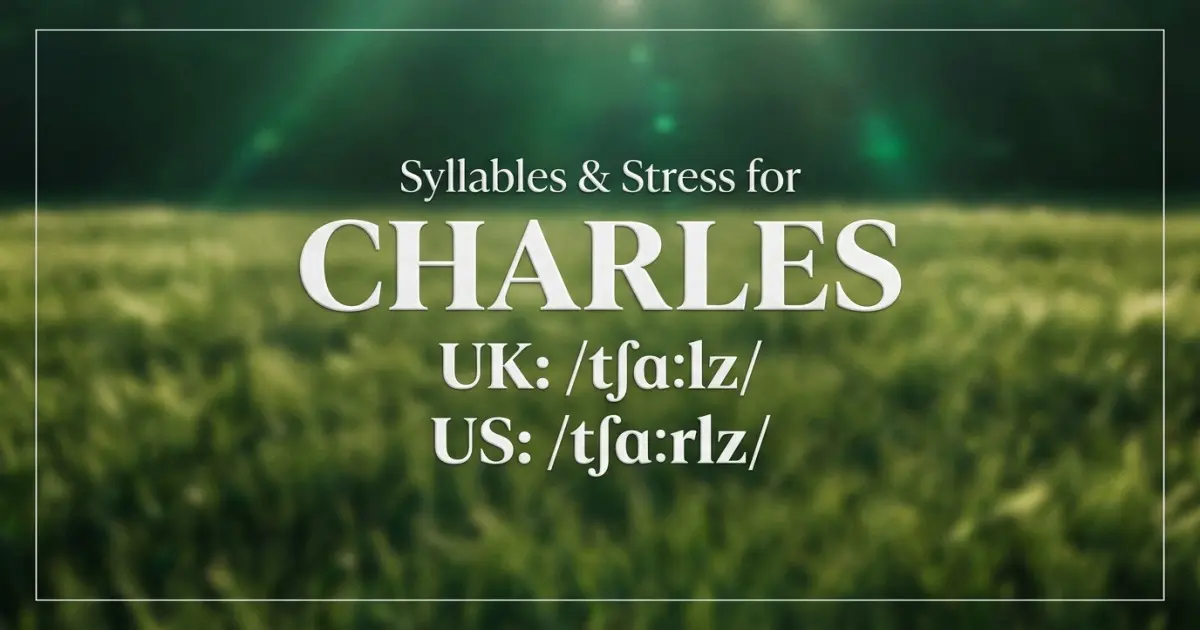
| IPA (US) | /tʃɑːrlz/ | In American speech, the r is usually heard clearly, which gives the middle more texture. |
| IPA (UK) | /tʃɑːlz/ | In many British accents, the r is not pronounced, so the name sounds smoother through the middle. |
| Syllable count | 1 syllable | Even though the spelling looks layered, Charles is normally spoken as a single beat. |
| Stress pattern | Single stressed syllable | The whole name carries one unified stress, which is why it sounds firm and self-contained. |
| Opening sound | /tʃ/ affricate | Use the same opening sound you hear in “chair” or “child.” |
| Ending sound | Final /lz/ cluster | Do not drop the ending entirely. That closing cluster is what gives Charles much of its authority. |
Why Charles sounds heavier than most one-syllable names
Charles is a good example of how a short name can still sound substantial. The reason is its internal structure. It opens with the ch sound, which is an affricate—a consonant that combines a stop and a fricative into one smooth unit. In plain terms, it begins with a sound that is both clear and energetic. That opening prevents the name from sounding flat. The sound matters more once you know what the name is meant to carry, which is why the wider frame starts in Charles meaning.
After that, the broad vowel gives the name body. This is not a clipped sound. It is open and resonant, which allows Charles to feel fuller than a name such as Jack or Trent even though it is just as short in syllable count. Then comes the liquid r in American speech, or a smoother transition in many British accents, followed by the final lz cluster. That ending matters enormously. It keeps the name from sounding airy or unfinished.
Why the middle of Charles should not be rushed
Because Charles is short, some speakers rush through it and flatten the middle. But the name sounds best when the vowel has enough room to breathe. If you say it too quickly, it can lose the roundness that gives it dignity. Charles should feel compact, but not pinched.
Why the final consonants give Charles its authority
The closing lz is the reason Charles sounds grounded. Without that firm ending, the name would feel much lighter. It is also what separates Charles from names that are visually similar but acoustically softer. The end should not be exaggerated, but it should be present. That final cluster is part of the name’s character.
Where Charles gets softened, flattened, or misheard
Charles is familiar, which usually helps pronunciation. But familiar names can still be misheard because people assume they know them before they fully say them. With Charles, the most common issues come from swallowing the ending, over-smoothing the middle, or trying to break the name into more parts than natural speech requires.
Common mistake patterns with Charles
- CHAR-uls: turning the name into two distinct syllables makes it sound heavier and less natural in standard modern English speech.
- Chawz with the ending mostly dropped: understandable in very fast or highly reduced speech, but it loses the firmness that makes Charles sound complete.
- Sharles: replacing the opening ch with a soft sh changes the identity of the name.
- Char-ulz with too much emphasis in the middle: a common overcorrection that makes the name sound more labored than elegant.
Why Charles should not be treated like two separate words
The spelling can tempt people to divide the name into visible pieces, but the spoken form is tighter than that. Charles is not meant to sound like char plus les. It is one cohesive syllable. Once you let it stay whole, the name immediately sounds more natural.
A useful rule is to think of Charles as a single polished unit. If you hear yourself adding a noticeable extra vowel in the middle, you are probably overpronouncing it.
Charles in American and British speech: one name, two textures
Charles is very stable across English accents, but the internal texture does change slightly. In American English, the usual form is /tʃɑːrlz/, with the r clearly pronounced. This makes the name sound thicker through the middle. In many British accents, the form is /tʃɑːlz/, without a pronounced r, which makes the name smoother and a little more streamlined.
What stays the same in both versions of Charles
The opening ch remains the same. The name stays one syllable. The broad vowel still gives it weight. And the final consonants still provide a firm close. In other words, the identity of Charles does not change. Only the texture does.
Charles and its closest sound neighbors
Charles can occasionally be heard near names like Carl, Charl, or even Chaz in quick casual speech, but it remains distinct because of its combination of opening affricate and final cluster. It is more layered than Carl, more formal than Chaz, and more complete than shortened variants like Charlie or Chuck. That is one reason it remains such a strong formal anchor even in families that use nicknames every day. Once the sound pattern is clear, some shortenings stop feeling optional and start feeling natural, and the clearest map is in nicknames for Charles.
How to practice Charles until it sounds effortless
The simplest way to practice Charles is to think of it as one held syllable with a firm finish. Start with the clear Ch sound, let the vowel open fully, move smoothly through the middle, and close the name with the final lz. Do not break it apart. Do not rush the middle. And do not drop the ending.
Quick practice lines for Charles
Try these aloud:
- Charles is here.
- Come on, Charles.
- Charles and Henry.
- This is Charles Bennett.
These work well because they place the name inside normal spoken English rather than isolating it unnaturally. A good pronunciation should feel natural in motion, not only in repetition drills.
A final spoken check for Charles
If you want one easy test, listen for fullness and finish. The name should open clearly, feel broad through the center, and close firmly. When those three things are in place, Charles sounds exactly the way it should—formal, compact, and quietly powerful.