
How to Pronounce Catherine: The Practical Guide to Saying It Right
The pronunciation test for a name like Catherine does not usually happen in a quiet living room after the baby is born. It happens later, in public, when someone else has to say it first. A teacher reading attendance on the first day of school. A receptionist calling a patient from a waiting room. A graduation announcer glancing down, seeing a classic spelling, and deciding whether the name will come out with confidence or hesitation. Catherine tends to do well in those moments because it is deeply familiar, but it also carries just enough historical variation to make people aware that there may be more than one possible way to say it. That is exactly why the pronunciation page matters. Familiar names are often the ones people stop checking carefully.
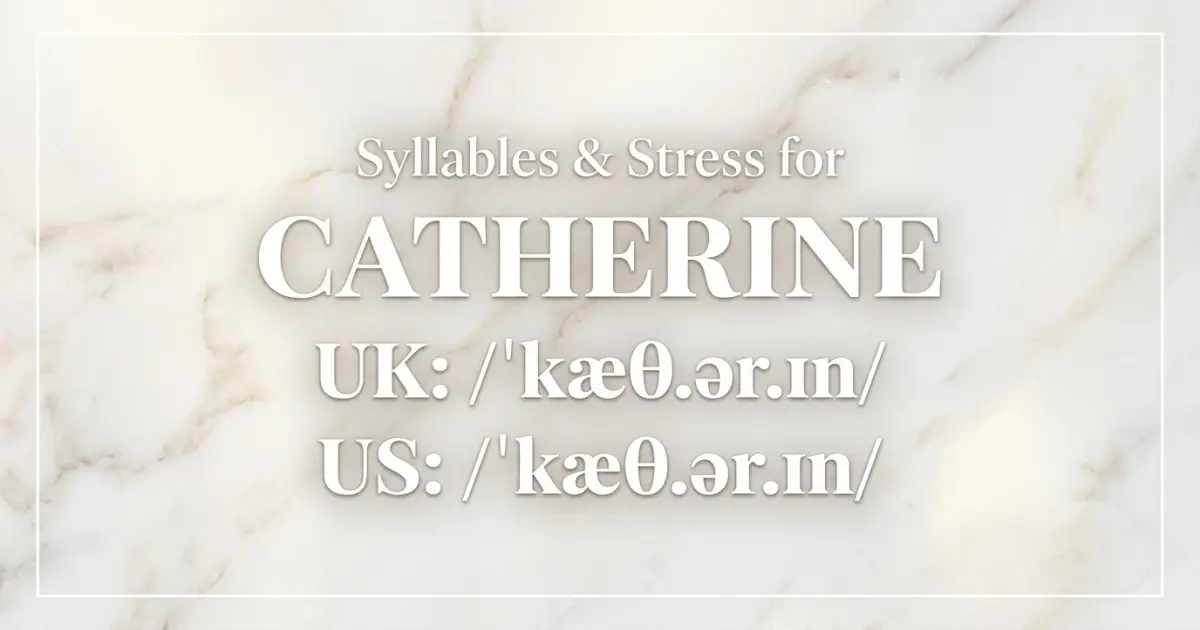
In the form given here, Catherine is pronounced KATH-er-in. Official phonetic guidance supports the same core pronunciation in both U.S. and U.K. notation: /ˈkæθrɪn/. That makes this version of Catherine especially stable in modern English-speaking use. The name is only two syllables, but it does not sound slight. It begins with a firm consonant, moves through the textured th, and lands in a quick, clean second syllable. The result is one of the great practical strengths of Catherine: it sounds classical without sounding fussy, and strong without sounding severe.
What Catherine is clarifying the moment it is spoken aloud
| Element | Phonetic Detail | Quick Tip |
|---|---|---|
| Everyday pronunciation | KATH-er-in | Think of a strong first beat followed by a lighter second syllable. |
| IPA (US) | /ˈkæθrɪn/ | The first vowel matches the “a” in “cat,” and the second syllable stays quick. |
| IPA (UK) | /ˈkæθrɪn/ | The British notation is the same here, which reinforces how stable this form is. |
| Syllable count | 2 syllables | Catherine works best as a clean two-beat name rather than a slow three-part reading. |
| Primary stress | First syllable | The opening KATH carries the weight. If that weakens, the name loses some of its authority. |
| Opening consonants | /k/ + /θ/ | The hard start plus the soft fricative gives Catherine both firmness and refinement. |
| Ending shape | /rɪn/ | The second syllable should stay light and quick, not stretched into a separate dramatic finish. |
| Most common issue | Blending in alternate traditional pronunciations | The safest guide is to keep this version compact: KATH-er-in. |
Why Catherine sounds strong because of its first syllable, not despite it
Catherine’s sound begins with control. The first syllable, KATH, does most of the structural work. In phonetic terms, the name starts with a voiceless velar stop, the k sound, and moves immediately into the th, a fricative. That pairing matters. The k gives the name edge and clarity. The th then softens the transition without blurring it. This is one reason Catherine sounds so balanced. It is not merely hard or merely gentle. It combines precision with breath. Before focusing only on syllables and stress, it helps to step back into the fuller frame of Catherine meaning.
Why the opening of Catherine feels authoritative
Names with strong first-syllable stress often sound dependable in English, and Catherine is a prime example. The first beat arrives clearly, which makes the name easy to catch in speech and easy to repeat once heard. The short vowel in KATH also helps. It does not drift or trail. It lands. That directness is one reason Catherine sounds so adult even in childhood. The name does not need extra ornament to hold its ground. Because the strongest energy lands early, the shorter forms often grow from the opening of the name, and that pattern is easier to see in Catherine nicknames.
Why the second syllable should stay lighter than people expect
The second syllable, er-in, is where some speakers accidentally overwork the name. Because Catherine has a visibly classical spelling, people sometimes pronounce the latter half too carefully, as if every letter must be fully unpacked. In ordinary English speech, that usually makes the name sound stiffer than necessary. This version of Catherine works best when the second syllable is present, clear, and compact. The name’s dignity comes from its proportion, not from theatrical over-enunciation.
That lighter ending is important socially as well as phonetically. It keeps Catherine from sounding severe. The first syllable establishes authority; the second prevents the authority from hardening into rigidity.
Catherine in real life: where pronunciation drifts and why
Catherine is a classic, and classics accumulate variants. That is where most pronunciation uncertainty comes from. The issue is rarely that the letters are impossible. It is that the name has lived in enough languages and enough centuries that speakers remember cousins of Catherine and sometimes pull those sounds into the current form. The attached naming guides themselves reflect this wider family, noting English and French versions and a broader network of related forms.
When Catherine gets stretched toward other traditional forms
Some speakers instinctively drift toward fuller or more historical variants, especially if they know forms like kah-TREEN, KATH-eh-ren, or KATH-ren from other traditions or other spellings. Those variants have real historical life in the larger Catherine family, but they are not the target pronunciation here. This page is anchored to the form KATH-er-in, which keeps the name compact and current in English use.
That distinction matters because Catherine is one of those names whose broad tradition can tempt people into overgeneralizing. The safest approach is always to follow the chosen pronunciation of the specific bearer. In this case, that means a clean first syllable, a clear but light second, and no extra syllabic expansion.
When the middle of Catherine gets swallowed
The other common issue is the opposite: instead of stretching the name, some speakers rush it and almost swallow the second syllable. That can make Catherine sound clipped or mumbled. The name should still feel like two beats, not one and a half. The second syllable is lighter, but not disposable. If it disappears, the name loses some of the grace that balances its strong start.
Catherine across accents stays remarkably stable
One of Catherine’s advantages is how little the pronunciation shifts across major English-speaking accents in this particular form. The fact packet gives the same IPA for U.S. and U.K. usage: /ˈkæθrɪn/. That does not mean every speaker sounds identical. Real accents always color vowels and consonants slightly. But the underlying structure remains the same. Catherine is still two syllables. The first syllable still bears the stress. The th still gives the middle of the name its distinctive texture.
What may vary from speaker to speaker
A speaker in one region may make the final vowel a little tighter or lighter. Another may articulate the r more strongly, especially in rhotic accents. But these are small color differences, not structural changes. They do not interfere with recognition. That is why Catherine remains such a dependable formal name. It does not become unstable when it crosses borders or dialects.
Why Catherine is easier to say than some people fear
The spelling looks classical, which can make some people nervous at first glance. But the actual sound is simpler than the visual form suggests. There are no dense consonant clusters, no uncertain stress pattern, and no highly variable final vowel. In practice, Catherine is easier than many newer or more stylized names precisely because its structure has been tested for centuries.
How to practice Catherine until it sounds natural
The easiest way to practice Catherine is not to stare at the spelling but to feel the two-beat rhythm: KATH | er-in. The first beat should be strongest. The second should be lighter and faster. Once that relationship is clear, the name usually falls into place.
Practice lines that make Catherine sound real
Use the name in ordinary sentences rather than in isolation. “Catherine is here.” “Can Catherine come in?” “I saved this seat for Catherine.” In connected speech, the proportion becomes easier to hear. The strong first beat and the lighter second beat naturally rebalance themselves inside real language. That is how most people truly learn names: not from phonetic symbols alone, but from hearing them move through life.
How to remember Catherine at first glance
If you want the quickest reliable cue, remember this: start with KATH like “Kath,” then let the rest move quickly as er-in. Do not expand it into a longer dramatic form, and do not collapse it into something mumbled. Catherine sounds best when it is treated as the well-made classic it is—clear, balanced, and confident without strain.
That may be the most useful thing to know about pronouncing Catherine. The name does not ask for showmanship. It asks for proportion. Its beauty comes from the tension between firmness and restraint: a strong opening, a textured middle, and a quick, unforced finish. That is why Catherine still sounds like Catherine no matter how many generations have spoken it. The structure is simply that good.
Common Questions About Pronouncing Catherine
How do you pronounce Catherine correctly?
Catherine is pronounced KATH-er-in. The first syllable carries the main stress, and the second stays lighter and quicker.
What is the IPA pronunciation of Catherine?
The standard IPA form here is /ˈkæθrɪn/ in both U.S. and U.K. usage. That reflects a strong first syllable and a compact second syllable.
Why do some people pronounce Catherine differently?
Catherine belongs to a large historical family of related forms across languages, and some of those traditions preserve different rhythms. The form used here stays compact and English-facing: KATH-er-in.
Is Catherine hard for English speakers to pronounce?
No. Although the name has historical variants, this form is very stable and widely understood in English-speaking settings. Most people can pronounce it correctly once they know where the stress belongs.