
How to Pronounce Capri: How to Hear the Stress More Clearly
Capri is the kind of name that gets tested in public before anyone thinks to analyze it. It appears on a school roster, a nurse calls it from a waiting-room list, a barista repeats it back over café noise, or an announcer meets it for the first time at graduation and has only a second to decide where the stress belongs. That is where pronunciation becomes real. A name either survives those ordinary public moments cleanly or it starts gathering corrections. Capri usually survives them well, but only because its shape is more precise than it first appears.
The crucial detail is that Capri does not begin where the ear expects the emphasis to land. The first syllable is light and almost passing. The second does the real work. That gives the name its distinctive modern lift. Instead of sounding broad and settled at the start, Capri moves forward and then clicks into place. Once you hear that pattern clearly, the whole name makes sense: the soft opening, the firm consonant cluster in the middle, the bright final vowel, and the overall feeling of a name that is sleek but not slippery.
What Capri’s spoken shape is actually telling you
| Element | Phonetic Detail | Quick Tip |
|---|---|---|
| Everyday pronunciation | kuh-PREE | Let the first syllable stay light and put the emphasis firmly on the second. |
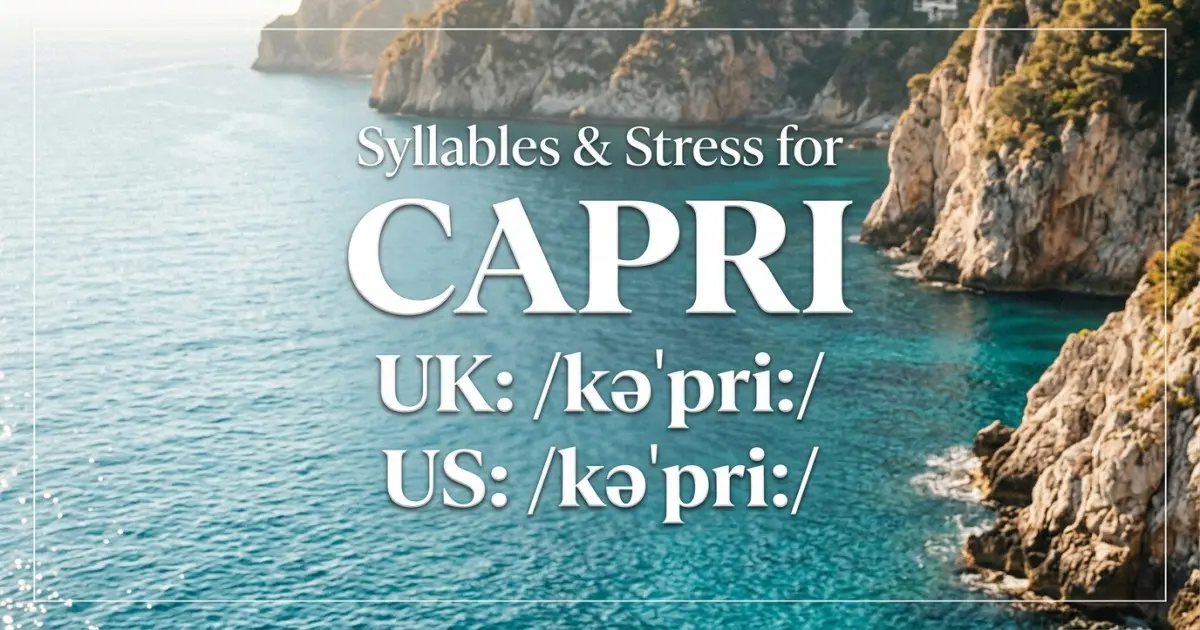
| IPA (US) | /kəˈpriː/ | The stress mark before the second syllable shows where the name truly lands. |
| IPA (UK) | /kəˈpriː/ | The standard U.S. and U.K. forms match, which makes Capri unusually travel-friendly. |
| Syllable count | 2 syllables | Think of it as kuh + PREE, not CAP-ree and not one long blended unit. |
| Stress pattern | Weak-strong | The first syllable sets up the name; the second is where the identity arrives. |
| Opening vowel | Schwa /ə/ | The first vowel is neutral and quick, like the first sound in “about.” |
| Middle consonant cluster | /pr/ | The p gives crispness and the r, a liquid consonant, keeps the name flowing. |
| Final vowel | Long /iː/ sound | End clearly with “pree,” as in “free,” not with a shorter or flatter sound. |
How Capri works in ordinary speech
In everyday English, Capri is pronounced kuh-PREE. The first syllable is reduced. The second is stressed. That pattern is the whole key to the name. If you understand nothing else, understand that Capri is not front-heavy. It leans forward and lands late. Before focusing only on syllables and stress, it helps to step back into the fuller frame of Capri meaning.
Capri begins with a reduced syllable, not a dramatic one
The first syllable contains a schwa, the neutral vowel sound /ə/. This is one of the most common sounds in English speech. It appears in unstressed syllables all the time, and its job is not to shine but to get you to the stressed part smoothly. In Capri, that means the opening should feel quick and almost understated: kuh, not CAP.
That reduced start is one reason Capri sounds refined. It does not arrive with a heavy first beat. It glides into the name’s center of gravity. If the first syllable is pronounced too boldly, the name loses its natural contour and starts sounding blunter than intended.
The stressed second syllable is where Capri gets its style
The second syllable, PREE, carries the stress and therefore the personality. It contains the consonant cluster /pr/, followed by the long vowel /iː/. The p is a stop consonant, giving the name a clean point of contact. The r is a liquid consonant, which helps the sound move rather than break. Together they create a crisp but fluid middle. Then the long ee vowel lifts the whole name into a bright finish.
This combination explains why Capri feels modern and polished. There is no lingering fricative such as f or s to blur the edges. The sounds are clean. The name opens lightly, grips in the middle, and releases brightly.
Why Capri’s stress pattern matters more than people think
Many pronunciation problems with apparently easy names are really stress problems. Capri is a perfect example. The spelling looks simple, but if a speaker guesses the wrong syllable to emphasize, the whole name changes character. Reference pronunciation in both American and British English places the stress on the second syllable: /kəˈpriː/. That weak-strong pattern is what gives the name its real shape.
Why CAP-ree sounds wrong even when the letters look tempting
English readers often instinctively test a name with first-syllable stress because so many common English names behave that way. But Capri is not one of them. CAP-ree makes the name sound flatter and more abrupt. It also weakens the sophistication built into the late-stress rhythm. In effect, it turns a sleek name into a blunter one.
When the stress moves to the second syllable, the name suddenly feels more accurate and more natural: kuh-PREE. The opening stops trying to carry the whole word. The final syllable takes over, as it should.
Weak-strong names often sound more directional
This is one reason Capri feels stylish in speech. Weak-strong names often create a sense of movement because the ear is carried toward the end. That gives them a slightly forward-driving quality. Capri benefits from that immensely. Its sound does not sit heavily in the mouth. It travels.
That rhythm also helps explain why Capri can feel more contemporary than some similarly short names. The modern energy is not just cultural. It is rhythmic. You can hear it in the stress pattern itself.
Where Capri stays stable across accents, and where small variations can appear
One advantage of Capri is that standard U.S. and U.K. pronunciations match. Both are commonly given as /kəˈpriː/. That makes the name unusually stable across major English-speaking contexts. It does not require one pronunciation at home and another abroad. In most cases, people on both sides of the Atlantic are aiming at the same target.
What usually stays the same in both the U.S. and the U.K.
The reduced first syllable stays reduced. The second syllable stays stressed. The final vowel remains long and bright. Those are the big pieces, and they do not usually move. Because of that, Capri travels well through schools, workplaces, airports, and everyday conversation in English-speaking settings.
What tiny accent differences may still show up
Even when the official form matches, real speech can still vary in texture. In some American accents, the schwa in the first syllable may sound a touch fuller or more colored by the surrounding consonants. In some British accents, the r may be less pronounced unless it comes before a following vowel in connected speech. But these are accent textures inside the same pronunciation, not truly different versions of the name.
So the practical answer is simple: say kuh-PREE, keep the opening light, and let local accent details take care of themselves.
What people mishear in Capri, and how to keep it clear
Capri is not especially hard to pronounce, but it can be misread when someone relies too heavily on spelling or guesses before hearing it spoken. Most of the likely mistakes come from stress placement, not from exotic sounds.
The most common error is over-stressing the first syllable
The predictable mistake is CAP-ree. That version sounds more English in the wrong way: too front-loaded, too literal, and less refined. Once the listener hears kuh-PREE, the intended structure becomes obvious. But if no one corrects it, the wrong stress can stick because the letters themselves seem deceptively simple.
Sound neighbors can also pull the ear off course
Names and words nearby in sound can interfere. The beginning may tempt some people toward names like Cami or Callie, where the first syllable matters more. Others may hear the place-name association and overperform the pronunciation, as though it needs extra flourish. It does not. Capri works best when spoken plainly and accurately, not theatrically. When the stress sits in the center, the nickname logic often follows that same center of gravity, which is why nicknames for Capri is the natural next step.
Another small issue is compression. In fast speech, some people may blur the first syllable and make the name sound almost one-and-a-half beats long. Clarity improves when the speaker gives a clean but light opening: kuh, then PREE.
Practice lines for getting Capri right
The easiest practice is contextual speech. Say the name in ordinary lines: “Capri is here.” “Have you met Capri?” “Capri, your order is ready.” “Thank you, Capri.” These phrases help the stress settle naturally. You can also contrast it with a deliberately wrong version once or twice—CAP-ree versus kuh-PREE—to hear exactly where the shape changes.
A good mouth-feel guide is this: begin with a quick neutral vowel, release a crisp p, glide through the liquid r, and end on a long bright ee. The result should feel lean, smooth, and precise.