
August Pronunciation: Sound Breakdown for Confident Speech
The most revealing pronunciation test for August usually happens in a room where no one has time for a second try: a teacher taking attendance on the first day of school, a doctor stepping into a waiting room, a barista reading a cup label, a coach scanning a roster and calling names out at speed. August tends to pass that test cleanly. People may pause for a fraction of a second because the name carries both a personal-name life and a month-word life, but once it is spoken, the pattern is stable and memorable. That is one of the reasons the name has grown so comfortably in modern use. It sounds more straightforward in the mouth than its history might suggest.
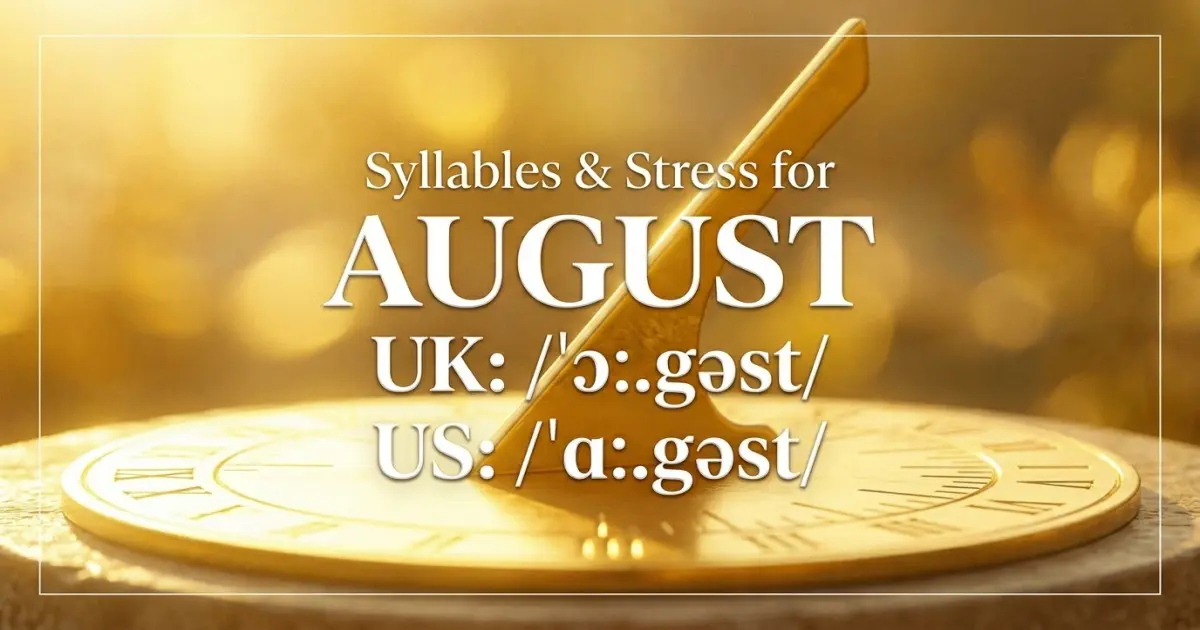
In everyday English, August is pronounced AW-gust. The stress lands on the first syllable, and the second syllable follows more lightly. Official phonetic notation gives the same overall shape in both American and British English: /ˈɔːɡəst/. That consistency matters. It means August is not one of those names whose sound changes drastically from one region to another. Whatever grandeur the meaning carries, the spoken name remains calm, practical, and highly usable. It feels settled.
How August is actually said when people use it naturally
| Element | Phonetic Detail | Quick Tip |
|---|---|---|
| Everyday pronunciation | AW-gust | Say it in two beats, with the emphasis clearly on the first syllable. |
| IPA (US) | /ˈɔːɡəst/ | The opening vowel sounds like the aw in “law” or “saw,” not like the a in “cat.” |
| IPA (UK) | /ˈɔːɡəst/ | British English keeps essentially the same rhythm and vowel pattern. |
| Syllable count | 2 syllables | Think of it as AW + gust, not as a longer or more elaborate classical name. |
| Stress pattern | First syllable stressed | If the second syllable takes too much weight, the name starts sounding unnatural or overperformed. |
| Opening consonant | Vowel-led start with /ɔː/ | Let the first syllable open fully; that rounded opening gives August much of its calm authority. |
| Middle consonant | /ɡ/ | Keep the hard g of “go,” not a soft j sound. |
| Ending sound | /əst/ | The final syllable should be lighter and quicker than the first, not equally heavy. |
August places its weight up front, and that is why it sounds composed
Why the first syllable matters so much
The easiest way to say August correctly is to hear where the name puts its weight. It puts that weight immediately on Aw-. That first syllable carries the full dignity of the name. It is broad, open, and rounded, which helps explain why August sounds calm rather than sharp. Names that begin with a bright or narrow vowel can feel brisk. August begins with a darker, fuller vowel, and that fuller opening gives the name its sense of quiet gravity. Pronunciation lands more fully when the name’s roots and history are already in view, so begin with August meaning.
There is also a practical point here. Because the first syllable is so acoustically important, speakers should not rush it. If the opening collapses into something too short or flat, the name can lose much of its identity. The cleanest version lets that first syllable breathe: AW, then gust. It is simple, but that simplicity is doing real work.
Why the second syllable should stay modest
The second syllable, -gust, finishes the name but does not compete with the first. This is one of the reasons August feels elegant. It does not rise twice. It opens with breadth and then settles. The final vowel in the second syllable is a schwa, the soft neutral sound heard in many unstressed English syllables. That neutral vowel is part of what keeps the name from sounding theatrical. It quietly tapers the line.
The consonants in that second syllable also help. The hard g gives structure, and the final st closes the name neatly. There is no liquid consonant like l or r to melt the ending. August ends with more firmness than names such as Oliver or Theodore, but because the stress has already been spent, the finish still feels controlled rather than blunt.
Where August gets misread and why the mistakes are easy to fix
The most common confusion is over-emphasis, not the basic sound
August is not usually a name people fail to pronounce. It is a name people occasionally overthink. The most common issue is giving too much weight to the second syllable, as though the name needs a more dramatic finish than it actually does. That can make August sound stiff or overannounced. In natural speech, the second syllable should be lighter.
Another occasional issue is flattening the first vowel, especially in fast speech. If the opening becomes too clipped, the name can lose its characteristic breadth. The right version remains very simple: AW-gust, not a rushed or narrowed variant.
Month-word familiarity helps more than it hurts
One advantage August has is that most English speakers already know the month word. That means the pronunciation is not being learned from scratch. In many cases, the month acts as a built-in pronunciation guide. This is helpful because it lowers the risk of wild variation. A listener may not know the name’s Latin background, but the everyday calendar word already teaches the correct shape.
This familiarity can also create a slight visual hesitation, since people may briefly register the month before the person. But in spoken life that hesitation is usually tiny and temporary. The sound itself is already deeply familiar.
What August is not
It can help to say what August is not. It is not uh-GUST, with stress pushed forward into the second syllable. It is not a name with a soft g. It is not a three-syllable classical form disguised as a short name. And it is not a name that needs over-enunciation to feel noble. In fact, August sounds best when it is spoken plainly. That plainness is part of the charm.
August across accents stays steady, which adds to its strength
American and British English are very close here
One reassuring feature of August is that American and British English do not meaningfully pull it apart. Both commonly use /ˈɔːɡəst/. Accent will always color the exact texture of a vowel slightly, but the pattern remains the same: strong first syllable, lighter second, hard g, and a firm but not exaggerated ending. That stability makes the name unusually portable.
It also means August does not carry much pronunciation anxiety in multilingual or mobile families who move across English-speaking regions. The name may sound a little rounder in one accent and a little leaner in another, but it remains recognizably itself.
Sound neighbors help explain August’s tone
August sits near several other names and words in the ear, but it still keeps a distinct profile. It shares some gravitas with names like Arthur and Oscar because of the open first vowel and firm consonants. It shares some classical atmosphere with Augustus and Augustine, though it is much lighter and less ceremonious than either. And because it also exists as a month name, it carries a layer of softness that many old Latin-rooted masculine names do not. That combination—history plus everyday familiarity—is part of why the pronunciation feels so balanced. The way the name resolves at the end often decides which short forms feel natural in speech, and that becomes clearer in nicknames for August.
Phonetically, August is a name with breadth at the front and discipline at the back. That is an elegant structure for a name that means “magnificent; venerable.”
How to practice August until it feels completely natural
Use short phrase practice, not isolated repetition
The quickest way to make a name feel natural is to practice it inside real sentence frames rather than saying it as a disconnected word. That helps the stress settle into ordinary speech. With August, a few short phrases usually do the work:
“This is August.”
“August is here.”
“Can you help August?”
“I’m calling for August.”
These lines let the first syllable land properly and keep the second syllable from becoming too heavy. They also help parents hear how the name behaves next to the planned surname, which is often the most important pronunciation test of all.
The simplest memory guide
If someone needs a quick reminder, “Aw like saw, then gust” is usually enough. There is no need for a complicated explanation because the name is already so close to a familiar English word. Once heard, it tends to stay fixed.
That is the deeper pronunciation story of August. It is a name with ancient dignity and a very ordinary spoken life. The sound is stable, the stress is easy, the accent differences are minimal, and the overall effect is calmer than the meaning might lead you to expect. August sounds exactly the way a modern classic should sound: assured, clear, and human-sized.
August Stress and Sound FAQ
How do you pronounce August in everyday English?
August is pronounced AW-gust, with the emphasis on the first syllable and a lighter second syllable.
Is August pronounced differently in American and British English?
Usually no. American and British English commonly use the same overall pronunciation pattern, shown as /ˈɔːɡəst/.
What is the most common pronunciation mistake with August?
The most common issue is putting too much emphasis on the second syllable or rushing the first vowel. The clearest version remains AW-gust.
Why does August sound easier than its history suggests?
Because the spoken form is compact and familiar. Even though the name has a grand Latin background, its modern English pronunciation is short, stable, and easy to recognize thanks in part to the everyday month word.