
Arlo Pronunciation: Easy Breakdown and Speaking Tips
Arlo is the kind of name that tends to survive first contact beautifully. Picture a preschool teacher reading a new class list in September, or a barista calling out a name that has to cut cleanly through café noise. Some names lose shape when spoken quickly. Arlo usually does not. It lands in two clear beats, opens with a broad vowel, and ends with a rounded softness that makes it sound friendly rather than abrupt. That real-life usability is one of the reasons the name has moved so strongly into modern circulation.
What makes Arlo especially interesting is that its pronunciation sounds lighter than its meaning might lead you to expect. “Fortified hill” is an image of structure, height, and defense. But the spoken name does not sound armored. It sounds open. The first syllable carries confidence, and the second releases it gently. That balance is part of the name’s appeal. Arlo sounds modern and approachable not because it is vague, but because its phonetic shape turns strength into ease.
How Arlo is actually said when people say it naturally
Before getting into accent differences or common mistakes, it helps to pin down the spoken pattern that makes Arlo so recognizable in everyday life. Because the strongest energy lands early, the shorter forms often grow from the opening of the name, and that pattern is easier to see in Arlo nicknames.
| Element | Phonetic Detail | Quick Tip |
|---|---|---|
| Common pronunciation | AR-loh | Say it in two clean beats, with the first syllable carrying the stronger stress. |
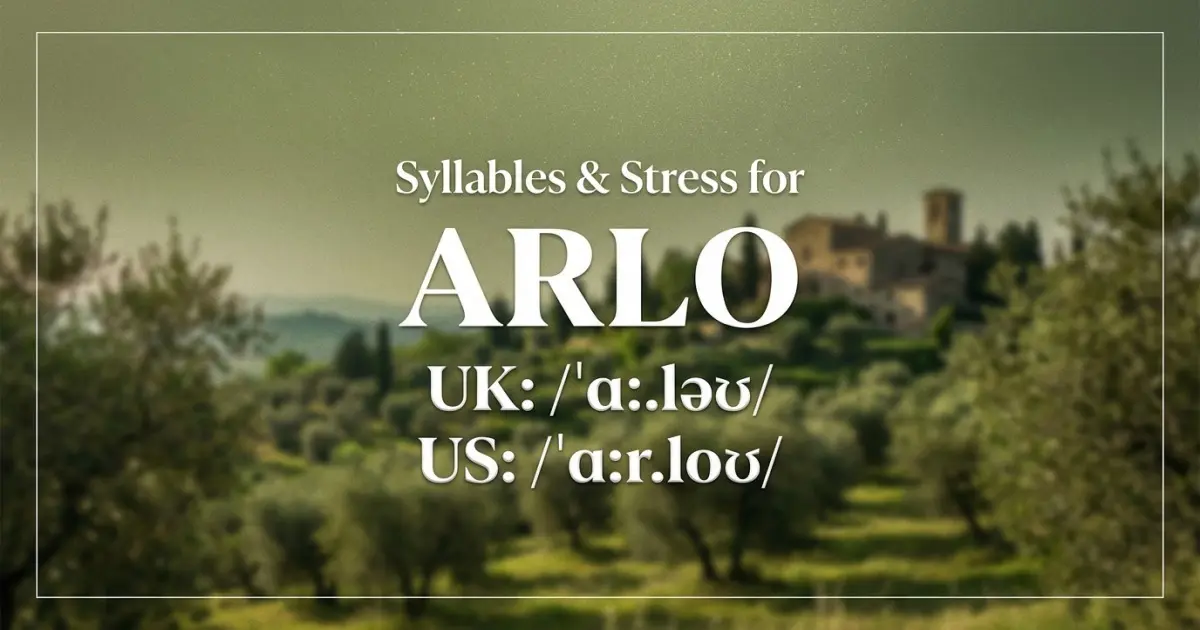
| U.S. IPA | /ˈɑːrloʊ/ | The American form keeps a clear r and ends with a rounded oh sound. |
| U.K. IPA | /ˈɑːləʊ/ | In many British accents, the r is softened or not pronounced, but the overall shape remains the same. |
| Syllable count | 2 syllables | Do not blur Arlo into one long sound. The two-beat rhythm is part of its charm. |
| Stress pattern | First syllable stressed | The emphasis belongs on AR, while the second syllable should feel lighter and more relaxed. |
| Opening consonant | /r/ following the initial vowel | The r helps the name feel grounded in American speech, even though the name still sounds soft overall. |
| Main vowel | /ɑː/ broad open vowel | Think of the first sound in “father,” not the flatter vowel in “cat.” |
| Final syllable | /loʊ/ or /ləʊ/ rounded ending | The last syllable should open out gently rather than snapping shut. |
Why Arlo feels easy in the mouth
Arlo sounds simple, but its ease comes from a very specific sound pattern. The name opens on a broad vowel, moves through a liquid consonant, and ends on another rounded vowel. In practical terms, that means almost nothing in the name is fighting the speaker. It is open at the start and open at the end. That is one reason Arlo can sound stylish without sounding forced. Before focusing only on syllables and stress, it helps to step back into the fuller frame of Arlo meaning.
Arlo begins with space, not pressure
The first syllable of Arlo is the whole emotional center of the name. It carries the stress, and it uses a wide vowel sound, written in the IPA as /ɑː/. This is a sound with room in it. It does not feel clipped or tight. Names built from broader vowels often sound more relaxed and confident, and Arlo benefits from that.
The r also matters. In phonetic terms, it is a liquid consonant, which means it helps the name move instead of stop sharply. That is why Arlo does not sound blunt even though it is short. The sound glides through the center rather than snapping into the second syllable.
The ending keeps Arlo from sounding hard
The second syllable, loh, is where Arlo softens itself. It does not close on a stop consonant like k, t, or d. Instead, it opens out on a rounded vowel. That finish makes the name feel approachable and a little artistic. It is part of the reason Arlo sounds less severe than some other short boys’ names.
This is also why the name ages well. On a child, the rounded ending feels warm and lively. On an adult, it keeps the name from becoming too abrupt or aggressively minimal. Arlo sounds modern, but it does not sound stripped down to the point of harshness.
Arlo across U.S. and U.K. speech stays recognizably Arlo
One practical advantage of Arlo is that the name holds together well across major English accents. The fact packet gives slightly different IPA forms for the United States and the United Kingdom, but the underlying identity of the name remains very stable.
American Arlo keeps the r more clearly
In most American accents, Arlo is pronounced with an audible r in the first syllable: /ˈɑːrloʊ/. That gives the name a little more internal structure. The first syllable sounds slightly fuller, and the transition into the second syllable feels more anchored.
British Arlo usually sounds a little smoother
In many British accents, the name moves toward /ˈɑːləʊ/, where the r is less prominent or absent in speech. This makes the name feel slightly softer and more fluid. But the two-syllable shape, the first-syllable stress, and the rounded ending all remain intact. That means the name still sounds unmistakably like Arlo.
This is useful for families who care about portability. Arlo does not radically change character when it crosses accents. It may sound a touch firmer in one place and a touch smoother in another, but it remains easy to recognize and easy to repeat.
Where people most often get Arlo slightly wrong
Arlo is not a difficult name, so mistakes are usually small rather than dramatic. But small pronunciation shifts can still change the personality of the name.
Flattening the first vowel too much
The most common problem is using a flatter or shorter first vowel than the one the name wants. Arlo needs that open AR sound. If the first syllable becomes too clipped, the name can lose some of its warmth and begin to sound less stable.
Rushing the second syllable into blur
Another frequent issue is swallowing the final loh so quickly that the name feels unfinished. Arlo should move quickly, but the second syllable still needs to be heard. The rounded ending is a big part of what makes the name feel friendly instead of sharp.
Making Arlo sound too ornamental
Because the name is stylish, some speakers over-pronounce it in careful speech, almost as if it were trying to be more elaborate than it is. But Arlo works best when it sounds natural. It should not feel theatrical. It should feel easy.
Arlo beside Harlow, Carlo, and Milo
Sometimes the clearest way to hear a name correctly is to compare it with neighboring sounds. Arlo becomes especially distinct when placed beside names that share some of its texture.
Arlo vs. Harlow: Harlow is longer and has more visual and phonetic weight at the front. Arlo feels cleaner and less styled. Both names share the open ending, but Arlo lands faster and more lightly.
Arlo vs. Carlo: Carlo begins with a harder consonant and often feels more formal or more strongly tied to specific cultural traditions. Arlo is softer at the front and more relaxed in tone.
Arlo vs. Milo: Milo is brighter and sweeter in the middle, while Arlo feels earthier and more grounded. Both are easy two-syllable names, but Arlo has a broader, steadier opening.
These comparisons help explain why Arlo sounds the way it does. It keeps the accessibility of current short names, but its vowel pattern gives it more calm than sparkle.
How to practice Arlo until it sounds effortless
Arlo is not a hard name to pronounce, but it helps to hear its rhythm in ordinary sentences rather than in isolation.
Three simple practice lines for Arlo
Arlo is waiting by the door.
I met Arlo after class.
Arlo left his hat on the chair.
What to listen for in your own voice
Listen for a broad, confident first syllable and a lighter, rounded second one. The name should feel open at both ends, not clipped in the middle or swallowed at the finish. If it sounds easy, balanced, and slightly warm, you are very close to the natural pronunciation.
Why Arlo sounds softer than its meaning suggests
Arlo is a good example of how sound can reshape meaning. The fact packet gives it the meaning “fortified hill,” which is solid, elevated, and defensive in image. But the pronunciation makes that meaning feel more humane. The broad first vowel gives the name confidence, the liquid movement keeps it fluid, and the rounded ending softens the close. The result is strength translated into approachability.
That is why Arlo works so well in modern life. It is easy to say, easy to hear, and stable across accents, but it still carries a little more depth than many short trendy names. Said correctly, Arlo sounds open, grounded, and unmistakably alive.
Common Questions About Saying Arlo
How do you pronounce Arlo correctly?
Arlo is commonly pronounced AR-loh, with two syllables and the stress on the first.
What is the IPA pronunciation of Arlo?
The pronunciation given here is /ˈɑːrloʊ/ in U.S. English and /ˈɑːləʊ/ in U.K. English.
How many syllables does Arlo have?
Arlo has two syllables. The first is stronger, and the second should feel lighter and more rounded.
Does Arlo sound different in the U.K. and the U.S.?
Only slightly. American speech usually keeps the r more clearly, while many British accents soften it. The overall rhythm and identity of the name stay very similar.
What pronunciation mistake happens most often with Arlo?
The most common issue is flattening the first vowel or rushing the final syllable too much. Arlo should begin broadly and finish with a clearly heard loh.