
How to Pronounce Apollo: Syllables, Stress, and Common Mistakes
Imagine Apollo being read aloud from a birth announcement, called across a museum courtyard, or introduced in a classroom where the name’s classical weight arrives before anyone knows the child behind it. The spelling looks grand, but the pronunciation is smoother than its mythology might suggest: uh-POL-oh. The first syllable is light, the second carries the stress, and the final oh releases the name with warmth rather than force.
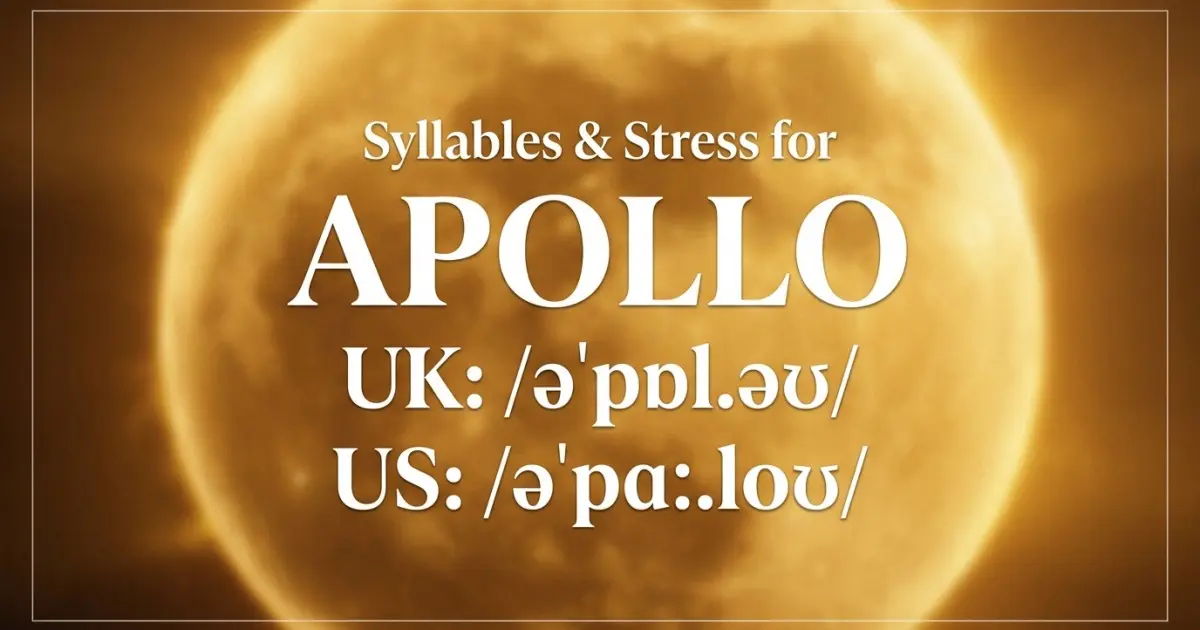
Apollo has Greek origin and means “sun; strength,” and the pronunciation helps make that meaning wearable. The name does not begin with a heavy impact. It rises. The sound starts softly, lifts into the strong middle syllable, and opens at the end, almost like light spreading outward. Official 2024 U.S. data places Apollo at rank 414 for boys, showing that this once-mythic-feeling name is now active in modern use. The U.S. IPA is /əˈpɑːloʊ/, while the U.K. IPA is /əˈpɒləʊ/. In everyday speech, the clearest guide is uh-POL-oh: three syllables, middle stress, and a rounded final vowel.
How Apollo Is Actually Said When POL Carries the Light
| Element | Phonetic Detail | Quick Tip |
|---|---|---|
| Standard pronunciation | uh-POL-oh | Say it in three syllables, with the strongest emphasis on POL. |
| Syllable count | 3 syllables | Break it as uh + POL + oh. |
| Stress pattern | Middle syllable stressed | Do not stress the opening A or the final oh. |
| U.S. IPA | /əˈpɑːloʊ/ | The U.S. guide has a broad ah-colored stressed vowel in the middle. |
| U.K. IPA | /əˈpɒləʊ/ | The U.K. guide keeps the same rhythm but uses a different accent color in the stressed vowel. |
| Opening sound | uh | Start lightly; the first syllable should not sound like a hard AP. |
| Middle sound | POL | This is the anchor of the name, where the voice should rise and settle. |
| Ending sound | oh | Finish with a rounded oh, not a clipped uh. |
Apollo Depends on Middle Stress, Not First-Syllable Force
The most important pronunciation rule for Apollo is stress. The name is uh-POL-oh, not AP-uh-loh and not uh-puh-LOH. The middle syllable carries the weight. That middle stress gives Apollo its lifted, classical rhythm and keeps the name from sounding flat. Pronunciation lands more fully when the name’s roots and history are already in view, so begin with Apollo meaning.
This matters because Apollo has a large cultural presence. If the first syllable is over-stressed, the name can sound abrupt. If the final syllable is over-stressed, it can sound theatrical. The best pronunciation sits in the center: light beginning, strong middle, open ending. That pattern lets Apollo feel grand without becoming stiff.
The opening should stay light
The first syllable is a relaxed uh. It prepares the name rather than dominating it. Say it softly, then move into the stronger POL.
The center gives Apollo its shape
The middle syllable is the name’s anchor. In uh-POL-oh, this is where the voice should be clearest and strongest. The name rises into that center, then releases. Once the sound pattern is clear, some shortenings stop feeling optional and start feeling natural, and the clearest map is in Apollo nicknames.
The A, P, L, and O Sounds Give Apollo Its Open Classical Shape
Apollo begins with a reduced vowel, which keeps the opening gentle. The p in the middle is a stop consonant, meaning the airflow closes briefly before release. That gives the stressed syllable a clean, firm entrance. The l that follows is a liquid consonant, so it lets the sound flow instead of ending sharply.
The final oh is part of Apollo’s warmth. Instead of closing with a hard consonant, the name opens outward. This is one reason Apollo feels luminous rather than harsh. The sound pattern moves from soft to strong to open: uh, POL, oh. That movement mirrors the meaning “sun; strength” because the name seems to gather force and then radiate.
The P should be clear but not punched
The p in Apollo should be audible, but it does not need to be exaggerated. A clean release is enough. Over-punching it can make the name sound less graceful.
The final O keeps Apollo warm
The ending should sound rounded and open. Avoid turning Apollo into uh-POL-uh unless a regional accent naturally softens the final vowel. The everyday guide remains uh-POL-oh.
American and British Apollo Share the Same Rhythm With Different Vowel Color
The U.S. pronunciation of Apollo is represented as /əˈpɑːloʊ/, while the U.K. pronunciation is /əˈpɒləʊ/. The difference is mainly the color of the stressed vowel. In many American accents, the middle vowel sounds broader, closer to PAH. In many British accents, it is shorter and rounder.
Even with that vowel difference, the essential structure stays the same. Apollo has three syllables, stress on the middle, a light opening, and a rounded final vowel. Parents do not need to offer two completely different pronunciation guides. The practical form is still uh-POL-oh.
American English pattern
In American English, Apollo often sounds like uh-PAH-loh inside the stressed syllable, though the everyday spelling guide uh-POL-oh remains clear and useful.
British English pattern
In British English, the stressed vowel may sound closer to a rounded o quality. The rhythm remains unchanged: the middle syllable leads.
The Most Common Apollo Mistakes Come From Stress Shifts
Apollo is recognizable, but its grand visual impression can make speakers overthink it. The simplest correction is: uh-POL-oh, with the middle syllable strongest.
Do not say AP-uh-loh
The first syllable should not carry the stress. Apollo does not begin like apple. Start lightly and let the name rise into POL.
Do not say uh-puh-LOH
The ending should not become the strongest part of the name. The final oh is rounded and clear, but it should not take over.
Do not flatten the middle syllable
The name needs the strong center. If POL becomes too weak, Apollo loses its graceful lift and begins to sound rushed.
Do not compress the name into two syllables
Apollo has three syllables. Avoid turning it into POL-oh or uh-PLOH. The opening syllable may be light, but it should still be present.
Practice Lines Help Apollo Keep Its Lift and Warmth
The best way to practice Apollo is to let the name rise naturally. Keep the opening light, give the middle strength, and let the final vowel open gently.
Slow practice
Apollo.
uh-POL-oh.
Three syllables: uh + POL + oh.
Everyday practice
Good morning, Apollo.
This is Apollo.
Please welcome Apollo to the class.
Full-name practice
Apollo James.
Apollo Gabriel.
Apollo Reid.
Apollo Alexander Cole.
When testing Apollo with middle names and surnames, listen carefully to the transition after the final oh. Consonant-starting middle names such as James, Thomas, Gabriel, Reid, Jude, or Grant often create a clean boundary. Vowel-starting middle names such as Alexander, Elias, Augustine, or Orion can also work, but the full name should be spoken aloud so the open ending of Apollo does not blur into the next name.
How to Pronounce Apollo: FAQ
How do you pronounce Apollo?
Apollo is pronounced uh-POL-oh. It has three syllables, with the stress on the middle syllable.
What is the IPA pronunciation of Apollo?
The U.S. IPA pronunciation of Apollo is /əˈpɑːloʊ/, and the U.K. IPA pronunciation is /əˈpɒləʊ/.
Is Apollo pronounced AP-uh-loh or uh-POL-oh?
Apollo is pronounced uh-POL-oh, with emphasis on the middle syllable. It should not be pronounced AP-uh-loh.
What pronunciation mistakes happen with Apollo?
The most common mistakes are stressing the first syllable, over-stressing the final oh, weakening the middle syllable, or compressing the name into two syllables. The clearest guide is uh-POL-oh.