
Angus Name Meaning: Classic Roots and a Calm, Refined Feel
In an old Gaelic story set around Brú na Bóinne, the monumental landscape that includes Newgrange, a young divine figure sets out to claim the home that should have been his inheritance. He does not conquer it through a display of force. Instead, he asks to possess it for “a day and a night.” When that period ends, he refuses to leave, reasoning that the world itself is measured in days and nights. Through language, timing, and self-knowledge, Óengus gains the place that belongs to him.
That story offers an unusually precise lens through which to understand Angus. The Scottish name means “one strength”, but its strength is not simply physical power. It is strength gathered into a single purpose: the ability to know who you are, hold your ground, and act with intelligence rather than noise. Angus is compact, unmistakably traditional, and rooted in a Gaelic world where identity, ancestry, place, and story were closely bound together. Its history is ancient, yet its shape is remarkably usable for a child born today.
Angus's U.S. popularity rank over time, 1880–2024
Popularity statistics are based on official data from the Social Security Administration baby name records.
Angus: A Wise and Noble Heritage Classic
Angus presents a chart pattern of a broader past with a clearer present, reflecting older style cycles that now offer the name renewed force. Reaching a record peak for boys in recent years, its current rise suggests “revival energy” as parents look for heritage favorites that feel both warm and noble.
The absence of crossover usage reinforced its singular public identity. Meaning “one strength,” its simple two-syllable rhythm provides a sense of permanent resonance that remains durable across style families.
Why Angus Carries More Than a Simple Idea of Strength
Angus combines a direct modern form with a much older cultural inheritance. The essentials are easy to understand, but each fact opens onto a larger story about how the name sounds, what it communicates, and why it remains distinctive.
| Key Facts | Information | Quick Insight |
|---|---|---|
| Name | Angus | A short, established form that feels complete without needing a nickname. |
| Primary gender usage | Male | Its masculine history is clear, but its strength comes from cultural depth rather than exaggerated toughness. |
| Primary origin | Scottish | Angus carries a recognizable Scottish identity while belonging to the wider Gaelic family of Aonghas, Aonghus, and Óengus. |
| Meaning | One strength | The meaning suggests unity, steadiness, and concentrated purpose rather than strength scattered in many directions. |
| Pronunciation | ANG-guss | The first syllable gives the name weight, while the softer ending keeps it approachable. |
| IPA | /ˈæŋɡəs/ | The initial stressed vowel and linked “ng-g” sound create a firm, memorable center. |
| Syllable count | 2 | Its compact rhythm works easily in conversation and leaves room for a longer middle or surname. |
| Historic name family | Aonghas, Aonghus, Óengus | The modern spelling offers accessibility without erasing the name’s Gaelic ancestry. |
| U.S. boys’ rank (2024) | No. 2149 | Angus is genuinely uncommon in current American use, yet it is established enough not to feel newly invented. |
The Meaning of Angus Is Strength Gathered Into One
Many boys’ names are described as strong, but Angus is unusual because strength is not merely an impression created by its sound. The idea is built into the name’s inherited meaning. “One strength” can be read as force made unified: courage, judgment, endurance, and loyalty working together instead of competing with one another. To discover related options in this naming space, explore related boy name ideas.
One idea does not make Angus one-dimensional
The word one may initially seem limiting, but within the name it suggests integrity. A person with “one strength” is not necessarily defined by a single talent. The phrase can instead evoke someone whose qualities are aligned—someone whose decisions, values, and actions come from the same center.
This interpretation gives Angus a quieter moral weight. It does not promise invincibility or dominance. It points toward consistency: the strength to remain dependable, to protect what matters, and to act without constantly needing recognition. For parents drawn to virtue meanings but wary of names that sound like direct instructions—such as Valor, Brave, or Legend—Angus offers the same thematic substance within a traditional personal name.
Strength without spectacle
Angus also separates firmness from aggression. Its old stories do contain conflict, inheritance, and supernatural power, yet their most memorable moments often depend on insight, persuasion, protection, or persistence. This makes the meaning more flexible across a lifetime. “One strength” can suit the determined toddler, the thoughtful student, the loyal friend, and the adult whose authority comes from steadiness rather than volume.
There is also something reassuring about the modest scale of the name. Angus does not announce its meaning to everyone who hears it. The significance is held beneath the surface, available to the family and eventually to the child. That privacy can make the meaning feel more personal: less like a public claim and more like an inheritance to grow into.
Angus Began in the Older Gaelic World of Aonghas and Óengus
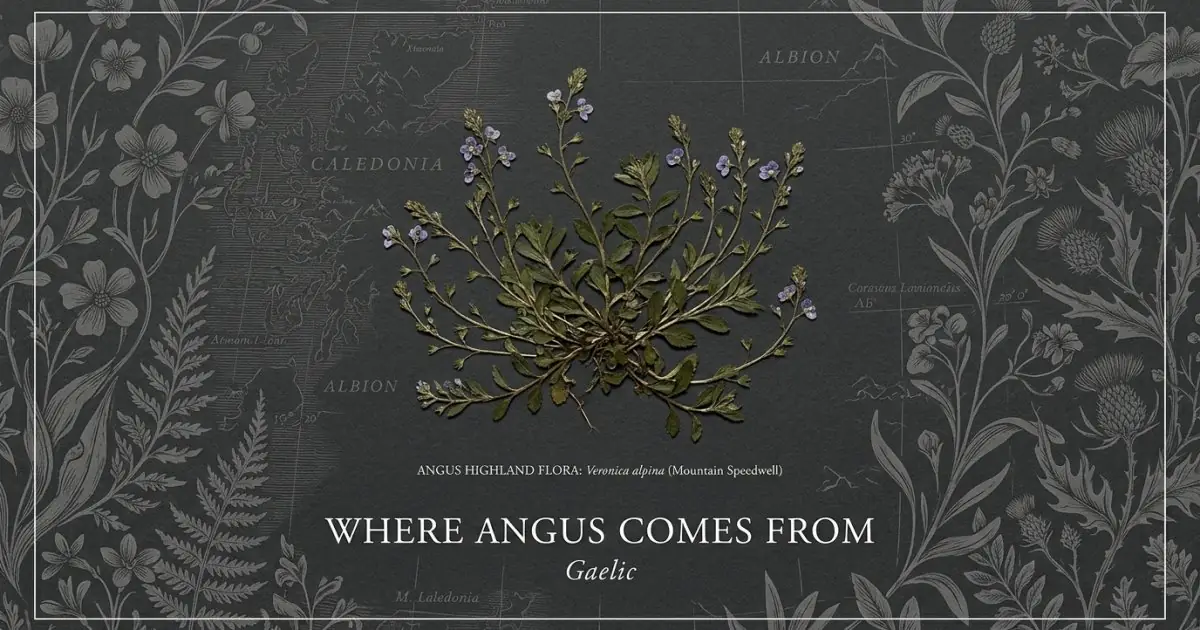
Angus is primarily recognized as a Scottish name, particularly as an accessible English-language form of Scottish Gaelic Aonghas. Across the Gaelic cultural and linguistic world, it is related to Irish Aonghus and the earlier form Óengus. These are not random spelling variations created to modernize the name. They preserve different stages and regional expressions of a very old personal name.
The Scottish form keeps the history usable
Traditional Gaelic spellings can carry important cultural precision, but they may also require explanation in communities unfamiliar with Gaelic pronunciation. Angus solves that practical problem without becoming culturally empty. Its spelling is concise, its pronunciation is usually recoverable at first sight, and its link to Aonghas remains visible once the history is known. For related names from the same origin family, see browse Scottish baby names.
That balance is one reason Angus can work well for families with Scottish heritage who want a name that travels easily. It can acknowledge ancestry without placing the daily burden of correction entirely on the child. At the same time, parents who prefer the more explicitly Gaelic form may find Aonghas or Aonghus better suited to their linguistic or family context. Angus is not the only authentic option; it is the most internationally streamlined member of the family.
From “true vigor” to “one strength”
Older interpretations of Óengus include ideas such as “true strength” or “true vigor,” while the controlling modern meaning of Angus is “one strength.” These readings are closely related in spirit. Both emphasize concentrated vitality rather than temporary force. The older phrase gives the name an active pulse; the modern phrase gives it unity.
This continuity matters because meanings often become oversimplified as names move between languages. In Angus, the simplified English form still preserves the central idea. The name has changed its clothing more than its character. Whether encountered as Óengus in an early narrative, Aonghas in Scottish Gaelic, or Angus on a modern birth certificate, it continues to carry an image of essential, coherent strength.
At Newgrange, the Angus Story Becomes a Story of Inheritance
The deepest narrative associated with the name belongs to Óengus, a youthful figure among the Tuatha Dé Danann, the divine race of medieval Irish tradition. His father was the Dagda, a principal deity, and his mother was Bóinn, whose name is connected with the River Boyne. Óengus was associated with Brú na Bóinne, the great ceremonial landscape centered on the prehistoric monument of Newgrange in County Meath.
The setting gives the name an extraordinary historical atmosphere. Newgrange was already ancient when medieval writers recorded stories about Óengus. By placing him there, tradition joined a named character to a landscape whose original builders and rituals belonged to a far earlier world. Angus therefore inherits not only a mythological figure but also a sense of deep time—the idea that names can outlive kingdoms, languages, and changing explanations of the places around them.
The child who had to discover his own identity
In the old account, Óengus does not begin life securely established in his rightful household. He is fostered by Midir and grows up away from the full truth of his parentage. During his youth, an argument reveals that the story he has been given about himself is incomplete. He confronts that uncertainty, asks questions, and seeks acknowledgment from the figures who know his origin.
This detail gives the name a more human dimension. Before Óengus claims a home, he must claim his history. His strength begins in the desire to understand where he comes from. That sequence—identity before inheritance—makes the story especially relevant to a personal name. A child receives Angus at birth, but the meaning of the name may deepen later as he learns the family stories, places, and decisions that led his parents to choose it.
The day-and-night claim turns strength into intelligence
When Óengus seeks possession of Brú na Bóinne, the decisive act is a negotiation. He requests the dwelling for a day and a night. Afterward, he argues that all existence is spent in days and nights, converting a temporary grant into an enduring claim. The episode has the logic of a riddle, and it makes verbal precision the instrument of victory.
This is where “one strength” becomes richer than a conventional warrior meaning. Óengus succeeds because he understands how language frames reality. His power lies in concentration, timing, and interpretation. He does not simply seize the Brú; he makes a case for belonging there.
The story also avoids reducing him to cruelty. After gaining the dwelling, he provides nearby land for the displaced Ealcmhar. The arrangement is not free of conflict, but the ending introduces restraint. Authority is paired with accommodation, suggesting that strength can establish boundaries without requiring total humiliation of another person.
Angus Proves That Strength Can Be Protective, Not Performative
Later literature moved Óengus into stories associated with the Fianna, where he became a protector of the young lover Diarmaid. This development is important because it changes the direction of his strength. The youthful god who once sought his own place becomes a figure who offers shelter and support to someone else.
Protection is a particularly durable interpretation of Angus. It avoids the narrow expectation that a strong boy must always be fearless, competitive, or physically dominant. Protective strength may look like loyalty, fairness, emotional courage, or the willingness to stand beside another person when doing so is difficult. It is strength used in relationship rather than strength displayed for status.
This literary role also softens the name’s otherwise rugged public image. Angus can sound earthy and solid, but the deeper tradition includes youth, love, kinship, and guardianship. That combination makes the name more emotionally spacious than it first appears. It can suit a family that wants a recognizably masculine name without choosing one that feels harsh or militaristic.
Why Angus Feels Both Ancient and Immediate
Angus is one of those rare names whose age does not make it complicated. It comes from an old naming tradition, yet its modern form contains only five letters and two syllables. There are no silent letters to decode, no elaborate ending, and no need to shorten it for everyday use.
A firm opening followed by a softer landing
Pronounced ANG-guss, Angus begins with a strongly stressed syllable. The linked nasal and hard consonant sounds in the center give it density, while the unstressed second syllable releases that tension. The result is sturdy without being abrupt.
Its rhythm also gives it versatility with surnames. Angus can provide substance before a light or vowel-rich surname, while its short length prevents it from overwhelming a longer family name. The main practical point to test is repetition: surnames beginning with a strong “G” sound or ending in “-gus” may create more echo than some parents prefer. Saying the full name aloud remains more useful than judging Angus in isolation.
Angus belongs beside classics, not inventions
Stylistically, Angus sits naturally near Scottish and Celtic choices such as Malcolm, Duncan, Fergus, Callum, Ewan, Hamish, and Lachlan. Like those names, it offers visible heritage without functioning only as a historical artifact. It also shares qualities with compact traditional names such as Arthur, Hugo, Oscar, and Felix: recognizable structure, strong consonants, and enough history to feel grounded.
What distinguishes Angus from these neighbors is its particular combination of rarity and familiarity. Many people have encountered the name, even when they have never personally known an Angus. That gives it a useful middle position. It is less expected than broadly used classics, but it does not ask others to learn an entirely new naming pattern.
The name also ages convincingly. Angus has enough warmth for childhood and enough weight for adulthood. “Baby Angus” sounds affectionate, yet the full name can move unchanged onto a school roster, creative portfolio, trade qualification, university record, or professional title. It does not depend on a youthful ending that must later be abandoned.
Angus in the 2024 American Naming Landscape
Official 2024 data places Angus at No. 2149 for boys in the United States. That position makes it an uncommon choice in contemporary American naming. A child called Angus is unlikely to meet several others with the same name in one classroom, but the name remains historically established and easy to explain.
The rank should not be mistaken for proof of either decline or revival. A single year shows current position, not long-term direction. What it does reveal is that Angus offers real distinctiveness. Parents are not choosing a familiar top-ranking name and merely hoping it will feel unusual in their local community.
Its rarity also comes without experimental spelling. Angus is already the streamlined form. Changing it to make it more distinctive would likely weaken one of its greatest advantages: the confidence of a name that knows exactly what it is. The standard spelling carries the history, supports the expected pronunciation, and allows the child’s individuality to come from the person rather than from constant orthographic correction.
Three Paths Beyond the Meaning of Angus
The meaning provides the center of the name, but a final decision usually depends on how Angus behaves inside a complete name and in ordinary family life. Three practical questions extend the story.
Middle Names for Angus Can Change Its Entire Register
Because Angus is short, grounded, and consonant-rich, a middle name can introduce elegance, brightness, family continuity, or a more contemporary rhythm. Longer choices can make Angus feel stately, while another compact name creates a brisk, memorable combination. The best pairing will also account for the surname, repeated sounds, initials, and the balance between heritage and individuality. If you want the full pairing logic behind that contrast, see middle names for Angus.
Nicknames for Angus Reveal Its Social Flexibility
Angus is already concise, so it does not require shortening. Even so, families and friends often create affectionate forms through sound, initials, personality, or private stories. Considering those possibilities helps parents decide whether they prefer the full name to remain dominant or are comfortable with informal alternatives emerging naturally. To see how those different moods shorten in real life, explore nicknames for Angus.
Pronouncing Angus Is Simple Once the Stress Is Clear
The name has two syllables, with stress firmly on the first: ANG-guss. Its central consonant connection can look more complicated on the page than it sounds in speech. A closer pronunciation guide can clarify the vowel, the linked “ng-g” transition, and how Angus differs from its Gaelic relatives. If you want the full sound pattern behind that rhythm, read how to pronounce Angus.
The Lasting Case for Angus
Angus endures because its simplicity is not empty. Behind five letters stands a chain of Gaelic forms, a prehistoric landscape, a youthful figure seeking the truth of his birth, and a contest won through the intelligent use of language. The name’s history does not merely decorate its meaning; it demonstrates it.
“One strength” becomes, in that history, the strength of coherence. Óengus learns who he is, claims the place connected to his inheritance, and later appears as a protector in the stories of others. His power is directed by identity and relationship. That is a more generous legacy than brute force.
For a modern child, Angus offers room rather than a script. It can honor Scottish roots, express a preference for traditional names, or simply appeal through its compact sound and uncommon status. It does not demand that its bearer become a hero from an old tale. It gives him something quieter: a name shaped by the idea that the strongest life is not necessarily the loudest one, but the one whose parts hold together.