
How to Pronounce Amy: How to Say It with More Confidence
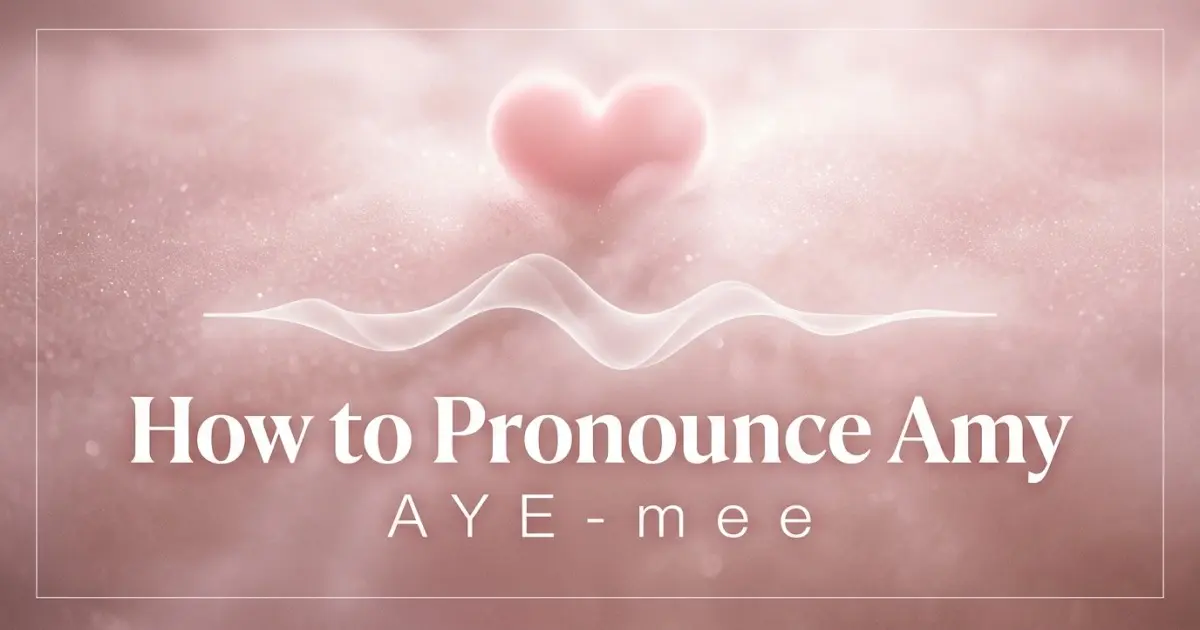
You can hear the real pronunciation of Amy in places where names have to work instantly: a teacher calling attendance without hesitation, a receptionist checking in a patient, a friend introducing someone across a noisy table, a graduation announcer moving quickly but still trying to get every name right. Amy belongs to that rare group of names that almost always lands cleanly the first time. It looks simple on the page, and in speech it really is simple—but not in a flat or forgettable way. Its sound is bright, quick, and emotionally open, which is one reason the name has remained so durable across generations.
That ease comes from structure. Amy begins with a clear stressed syllable and closes with a soft, familiar ending. There is no hidden consonant cluster, no unstable vowel, no accent-dependent twist that changes the identity of the name. It is easy to say, but it is not blunt. The opening sound has lift, and the ending gives it warmth. In practical terms, Amy succeeds because it is pronounceable in the most human sense: it sounds natural when spoken kindly, casually, formally, or in a hurry.
What Amy is actually asking the voice to do
| Element | Phonetic Detail | Quick Tip |
|---|---|---|
| Everyday pronunciation | AY-mee | Let the first syllable open clearly, then keep the second syllable lighter and smooth. |
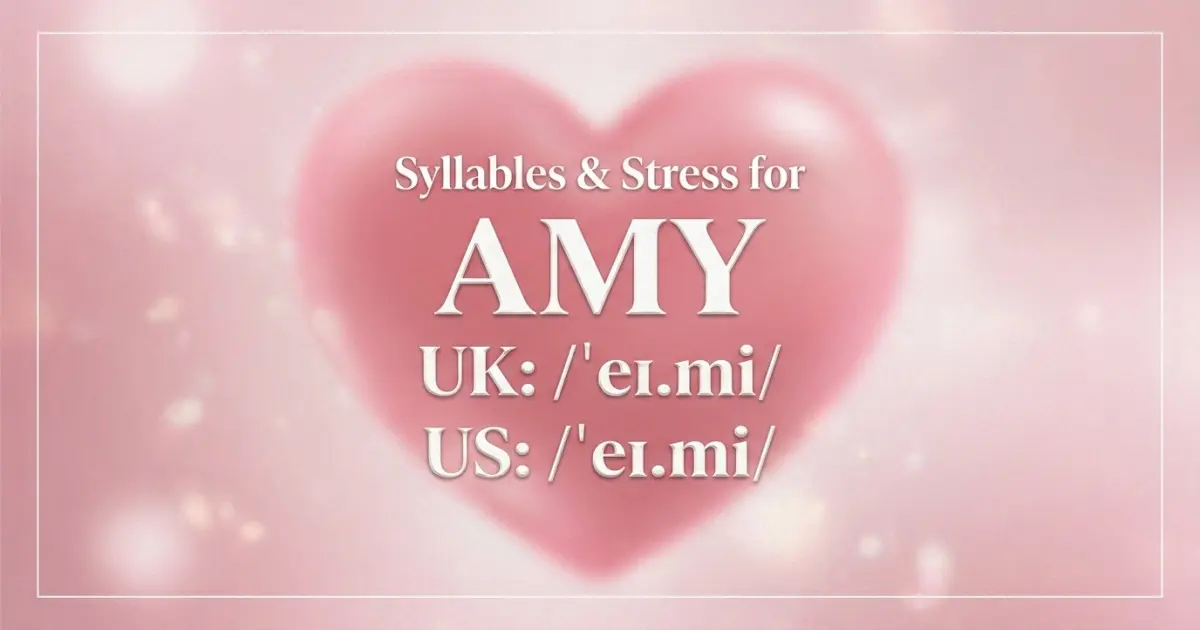
| US IPA | /ˈeɪmi/ | The American form is straightforward: one strong opening beat followed by a soft ending. |
| UK IPA | /ˈeɪmi/ | The British form is effectively the same, which makes Amy unusually stable across accents. |
| Syllable count | 2 syllables | Think of Amy as one bright syllable plus one gentle finish. |
| Stress pattern | Primary stress on the first syllable | If the first syllable is weak, the name loses its natural confidence. |
| Opening vowel | Long a sound /eɪ/ | Say the opening like the ay in “day,” not like the short vowel in “am.” |
| Middle consonant | Nasal /m/ | The m should feel soft and connected, not clipped or overemphasized. |
| Ending | Long ee sound /i/ | Let the final syllable sound clean and light, not exaggerated or sing-song. |
Amy works because the stress arrives immediately
The first syllable carries the whole name
The most important feature of Amy is its opening stress. The first syllable, AY, does nearly all the structural work. It uses the long vowel sound heard in words like “day” or “say,” which gives the name immediate brightness. Because the name is only two syllables long, the ear expects a clear anchor, and Amy provides one immediately. There is no ambiguity about where to listen. The voice lands, and the name is already recognizable. Pronunciation lands more fully when the name’s roots and history are already in view, so begin with Amy meaning.
This is one reason Amy feels so easy in public speech. Names that put stress early are often quicker for listeners to process, especially in noisy or fast-moving settings. Amy benefits from that pattern. You hear the important sound first, and the rest of the name simply completes it.
The second syllable finishes without competing
After the bright opening, Amy relaxes into -mee. That second syllable is fully audible, but it is not where the emotional weight sits. It softens the name and gives it warmth. This matters because the name could easily have sounded too sharp if the ending were clipped. Instead, the nasal m and the long ee create a gentle landing. The result is a name that sounds friendly without sounding flimsy.
From a phonetic point of view, the m is doing quiet emotional work. It is a nasal consonant, which means the sound resonates softly rather than striking hard. That makes Amy feel smoother in the mouth than a name with a sharper middle consonant might. It is one of the reasons the name sounds kind without needing extra syllables to manufacture softness.
Amy stays remarkably stable across English accents
American and British Amy are almost identical
Some names shift noticeably between American and British English, but Amy generally does not. Both are commonly represented as /ˈeɪmi/. That is a practical advantage. It means the name travels cleanly across English-speaking settings without needing correction or adaptation. Parents often value that more than they realize, especially if they want a name that feels internationally easy without sounding generic.
Of course, no two speakers sound exactly alike. A British speaker may soften the overall rhythm slightly, while an American speaker may give the opening a little more brightness. But these are texture differences, not identity differences. The name remains clearly Amy in both contexts.
Why Amy avoids pronunciation drift
Amy is helped by the fact that both of its vowels are highly familiar in English. The long a at the beginning and the long ee at the end are among the most stable sounds in everyday speech. There is very little room for the name to wander into multiple accepted pronunciations. That kind of stability is not glamorous, but it is one of the main reasons certain names remain easy to live with over time.
The name also avoids the consonant problems that often trigger accent variation. There is no th, no hidden r, no shifting final consonant cluster. Amy is phonetically simple in the best sense: it keeps its identity even when accents change around it.
Where Amy gets misread, overpronounced, or confused with neighbors
The most common mistake patterns
Amy is not a difficult name, but speakers can still make small errors if they overthink it. The most common is shortening the first vowel too much, producing something closer to Ammy than Amy. That changes the whole feel of the name. The first syllable should be open and long: AY, not A as in “cat.”
Another mistake is over-sweetening the ending. Because Amy is already a gentle name, some speakers stretch the final -mee too much, making it sound more sing-song than natural. Amy works best when the second syllable is light and clean. The name is affectionate enough on its own. It does not need extra emphasis to sound warm.
Sound neighbors can pull the ear sideways
Amy sits near a few familiar sound neighbors: Aimee, Amie, Annie, Emmy, and even names like Jamie in fast conversation. In most cases the confusion is brief, because the opening vowel in Amy is distinctive. Still, these neighboring forms can influence how people read the name on paper. That is another reason the simple pronunciation guide helps: Amy begins with AY, not Eh, not Ah, and not a reduced unstressed opening. The way the name resolves at the end often decides which short forms feel natural in speech, and that becomes clearer in Amy nicknames.
In writing, alternate spellings such as Aimee and Amie may encourage people to wonder whether the pronunciation changes. In normal English use, it generally does not. Amy remains the plainest and most immediately readable version, which is one reason it has stayed so practical.
Amy becomes effortless once you hear it as one bright syllable and one soft one
Practice Amy as contrast, not as equal beats
The easiest way to practice Amy is to think of contrast. Start with a bright, open AY. Then close with a softer mee. The two syllables are not equal in force. The first leads; the second finishes. That small contrast is what gives the name its natural shape.
Practice lines for real speech
It helps to say Amy in the kinds of phrases where names are actually used:
“Amy is here.”
“I’m looking for Amy.”
“Amy, your table is ready.”
“This is Amy Claire.”
If the name sounds smooth and unforced in these phrases, the pronunciation is working. The goal is not to dramatize the two syllables. It is to let the first open clearly and the second follow naturally.
That is part of why Amy lasts. It is easy to pronounce in the ordinary settings that make up most of life. The sound does not get in the way of the person. It supports the person quietly, which is one of the great achievements of a well-made name.