
How to Say Adeline Correctly: Where the Stress Falls and Why
Adeline is one of those names that often looks more fragile on the page than it feels in a real room. You see it on a classroom list, a recital program, a pediatric check-in form, or the place card at a family wedding, and for a split second it seems as if the name might require explanation. Then someone says it aloud, and the uncertainty usually disappears. That moment matters. A name can be elegant in print and still fail in ordinary speech. Adeline does not fail there. It has enough softness to sound graceful, but enough structure to hold its shape when spoken quickly.
The everyday spoken guide here is AD-uh-lyn. That is the practical version parents, teachers, and relatives can carry into normal conversation. The stress sits at the front, the middle syllable stays light, and the ending keeps the name from floating away. That opening stress is what gives Adeline its poise. Without it, the name can sound vague or over-delicate. With it, Adeline feels clear, warm, and surprisingly sturdy for a name with such a romantic surface.
What Adeline pronunciation is really clearing up
| Element | Phonetic Detail | Quick Tip |
|---|---|---|
| Everyday pronunciation | AD-uh-lyn | Let the first syllable do the main work and keep the middle syllable light. |
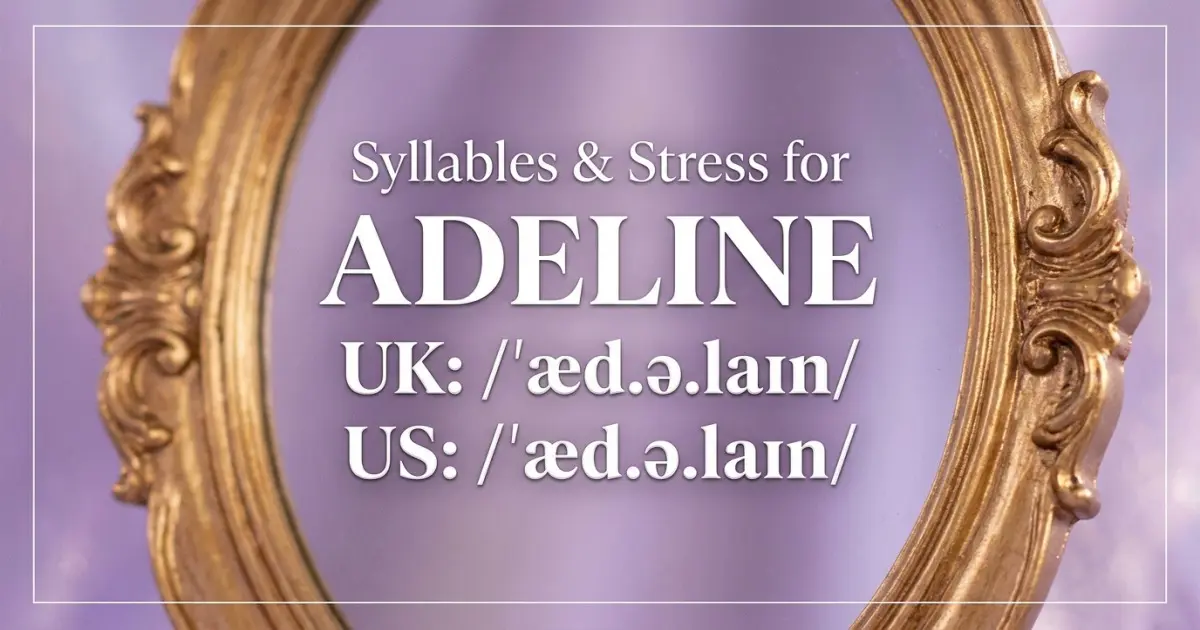
| IPA (US) | /ˈædəˌlaɪn/ | The stress mark shows the opening carries the main emphasis, even though the ending still needs to stay clear. |
| IPA (UK) | /ˈædəˌlaɪn/ | The supplied U.K. form matches the U.S. structure closely, which keeps the name highly portable. |
| Syllable count | 3 syllables | Think in three beats rather than letting the middle disappear into a blur. |
| Primary stress | First syllable | If the opening is weak, the name loses the crispness that makes it sound so usable. |
| Ending texture | Light final syllable in the spoken guide; clear final vowel sequence in the supplied IPA | Keep the ending audible rather than swallowed, but avoid making it sound stiff or overperformed. |
| Sound profile | Open first vowel, relaxed middle, softened ending | The name sounds graceful because each syllable does a different job instead of carrying equal weight. |
How Adeline moves in everyday speech
Adeline works because it opens firmly and then relaxes. The first syllable, AD, gives the name its outline. The middle syllable, uh, keeps the line moving without adding weight. The final syllable gives the name its softness and finish. This pattern is one reason Adeline feels more socially easy than some other elegant three-syllable girls’ names. The name has musicality, but it does not require elaborate effort to pronounce. Before focusing only on syllables and stress, it helps to step back into the fuller frame of Adeline meaning.
The first syllable is where Adeline finds its spine
If you want Adeline to sound confident, the opening needs to be settled. AD should be clearly stressed, not punched aggressively but definitely placed in front. That is what keeps the name from drifting into something overly breathy. In practice, this first syllable is what makes Adeline feel more grounded than its romantic image might suggest.
This is also why the name tends to sound stronger than people expect. The elegance is real, but it rests on a clean front edge. That front edge keeps Adeline from sounding overdecorated in ordinary conversation.
The middle syllable should pass quickly, not disappear
The middle uh is light, but it should still be heard. When names are familiar-looking, speakers often rush them. With Adeline, rushing can turn the middle into almost nothing, which makes the name sound flatter. A little room in the center helps the full name stay graceful. You do not need to over-articulate it. You just need to let it exist.
The ending is where Adeline becomes soft rather than stiff
The end of Adeline is what gives the name its emotional tone. In the everyday spoken guide, -lyn gives the name a softer landing and helps explain why Adeline feels intimate as well as elegant. The supplied IPA form gives the ending more visible shape. What matters in both cases is that the ending should remain clear. If it is swallowed, the name loses polish. If it is exaggerated, the name starts to sound too formal for ordinary life.
Adeline in IPA, accent, and real-life variation
The supplied U.S. and U.K. IPA forms are both /ˈædəˌlaɪn/. For many parents, the most useful part of that notation is not every symbol but the stress pattern it confirms. The first syllable carries the main emphasis. The rest of the name follows from that. In real life, however, families often rely on a simpler spoken guide because names live in conversation, not in phonetic transcription alone.
Accent changes the color more than the structure
Adeline is the kind of name that remains recognizable across major English-speaking accents. An American speaker and a British speaker may color the vowels slightly differently, but the basic architecture stays stable: strong opening, lighter center, soft finish. That stability matters. It means the name travels well across schools, workplaces, and family branches without requiring constant correction.
In practice, listeners usually hear Adeline as an elegant name with a familiar rhythm, even if the exact vowel quality shifts a little from one region to another. That makes the name socially easier than some other vintage-leaning choices whose pronunciations divide more dramatically.
Why Adeline sounds romantic without becoming fussy
Some names sound “romantic” because they are airy to the point of looseness. Adeline does not do that. The name has enough clarity in the first syllable to support the softer sounds later on. Linguistically, you can think of it as a name with a stable front and a gentler back half. That balance is what keeps it from sounding too precious.
Adeline also avoids harsh clusters or difficult consonant jumps. Nothing in the name asks the mouth to work too hard. That ease is part of why the name remains so appealing in modern use. It sounds graceful, but it behaves politely in speech.
Where people usually get Adeline wrong
Most pronunciation issues with Adeline come from uncertainty about the ending, not the beginning. The first syllable is usually easy. The question is how much shape the end of the name should carry.
Swallowing the middle makes Adeline sound flatter
One common mistake is rushing from the first syllable straight into the end. When the middle disappears completely, the name loses some of its elegance. Adeline is not difficult, but it does need three audible beats to sound finished.
Overperforming the ending makes the name sound less natural
Another mistake is giving the ending too much theatrical attention. Names that look literary sometimes tempt speakers to over-style them. Adeline does not need that. It works best when spoken with calm, natural confidence rather than as if it were being read from a period drama script.
Flattening all three syllables weakens the name
When all syllables are given equal weight, Adeline can sound mechanical. The name needs a clear first stress and then a lighter fall forward. That is what gives it both elegance and usability.
Adeline beside its sound neighbors
It helps to hear Adeline next to nearby names. Adaline is the closest visual cousin, and many speakers will assume similar rhythm even when the spelling changes. Adelaide sounds grander and more architectural. Adele is shorter and cooler, with less built-in softness. Madeline shares the same general romantic lane, but its sound pattern feels slightly more familiar to many English speakers because of long-standing cultural exposure. Once the sound pattern is clear, some shortenings stop feeling optional and start feeling natural, and the clearest map is in Adeline nicknames.
What makes Adeline distinct is the balance between front-end clarity and softer finish. It is less stately than Adelaide, less concentrated than Adele, and often gentler in feeling than Madeline. That blend is why so many parents find it persuasive: it sounds polished, but not overfamiliar.
How to practice Adeline until it sounds natural
The best way to settle Adeline in the mouth is to use it in normal sentences rather than in isolation. Names become easier when they are spoken the way they will actually be heard in real life.
Three useful practice lines for Adeline
Adeline is here.
Adeline Claire Morgan.
Hello, Adeline.
These lines let you hear the name in greeting, in a full-name combination, and in direct address. If the first syllable stays clear, the middle does not vanish, and the ending lands lightly, the pronunciation is doing its job.
The simplest memory cue for Adeline
If you want one practical guide, keep this: AD-uh-lyn. Start firmly, move lightly, and let the end soften. That is the version that makes the name sound both elegant and fully usable in everyday life.