
Adeline Name Meaning: Meaning, Mood, and Why It Endures

Adeline is one of those names that performs a quiet social miracle. It carries the old and serious idea of nobility, yet almost no one hears it as stiff. The meaning sits deep in the structure, but the sound arrives as light, lyrical, and unmistakably warm. That contrast is the key to understanding why the name has lasted. Many names with aristocratic or elevated meanings drift into severity. Adeline does the opposite. It takes an ancient idea of rank and turns it into a name that sounds personal, companionable, and modern enough to live comfortably in an ordinary American classroom.
That is what makes Adeline more interesting than it first appears. It belongs to a long Germanic family of names built around the root for nobility, and naming guides repeatedly connect it to Adele and Adelaide. Historically, then, it comes from the language of inheritance, standing, and social distinction. But in actual use, Adeline feels less like a title than like a softened inheritance. It sounds like nobility translated into affection, like dignity that has learned how to speak gently. The central thread of the name is not grandeur alone. It is refinement made human.
Adeline's U.S. popularity rank over time, 1880–2024
Popularity statistics are based on official data from the Social Security Administration baby name records.
Adeline: A Noble Classic with Revival Energy
Adeline functions as a name with one unmistakable center of gravity, sustained by a clear identity in the girls’ lane. Its position at a record peak in 2024 likely suggests it fits a broader taste for “heritage classics” that feel polished and carry a sense of “noble” character .
The lack of a secondary track reinforces its firm, traditional feminine identity. Originally Germanic, its rhythmic three-syllable structure provides a sense of durability that has stood the test of time.
Adeline in one clear, graceful frame
| Key Facts | Information | Quick Insight |
|---|---|---|
| Name | Adeline | It feels romantic and polished, but still readable and socially easy in current use. |
| Primary gender use | Female | The name reads clearly feminine without relying on overly delicate styling. |
| Origin | Germanic | Its deeper root in the Germanic “adel” family gives the name historical substance beneath its soft sound. |
| Core meaning | Noble | The meaning gives the name dignity, but the form keeps that dignity warm rather than distant. |
| Pronunciation | AD-uh-lyn | The spoken rhythm makes the name feel more intimate and current than its old-world lineage might suggest. |
| IPA | US/UK: /ˈædəˌlaɪn/ | The stable pronunciation across major English-speaking settings helps the name travel easily. |
| Syllable count | 3 | Three syllables give Adeline elegance and movement, while still leaving room for familiar short forms. |
| U.S. girls’ rank (2024) | No. 58 | Official data shows Adeline is firmly current, but still selective enough to feel considered rather than default. |

Why Adeline makes “noble” sound gentle
The meaning of Adeline is direct: noble. That kind of meaning can be difficult for a modern name to carry well. Noble names often risk sounding too grand, too antique, or too clearly tied to status. Adeline succeeds because the sound does not overplay the meaning. The first syllable is clear and grounded, the middle relaxes, and the final syllable lifts lightly. The name moves forward instead of sitting heavily on the page. In practical social terms, it sounds less like a declaration of rank than like a polished, affectionate inheritance.
Nobility without distance
This is where Adeline becomes especially useful to contemporary parents. The name offers one of the most attractive traditional meanings available, but it does so in a form that remains welcoming. It does not sound ceremonial in the way some courtly names do. It does not sound stern. Instead, it feels bright and approachable. That is a rare combination. Many names can deliver dignity; fewer can deliver dignity without emotional distance.
What people often hear in Adeline is not hierarchy, but grace. The meaning stays in the background as tone rather than marching out front as a claim. That makes the name easier to love in ordinary life. A child called Adeline is not being asked to sound aristocratic every time her name is spoken. She is simply carrying a name whose roots imply worth, esteem, and inherited distinction.
The sound pattern does the social work
Phonetically, Adeline benefits from softness without vagueness. The opening stress keeps the name clear. The internal vowels keep it fluid. The final -line sound gives it a faintly romantic finish, but not a theatrical one. This is one reason the name often feels more modern than some of its close relatives. It has enough melodic movement to sound pretty, but enough structure to sound capable.
The emotional result is important. Adeline sounds refined, but not fragile. It sounds feminine, but not overornamented. That is likely a large part of why it has performed so well in the current revival of elegant girls’ names. Modern parents often want softness with backbone, beauty with clarity, and tradition without stiffness. Adeline fits that wish almost exactly.
There is also a deeper reason the meaning works. “Noble” in naming culture does not only refer to class or rank. It can also imply character: honorable bearing, graciousness, steadiness, self-command. When a name carries that meaning quietly rather than flamboyantly, it becomes easier to imagine across a lifetime. Adeline does that. It sounds like a name a child can grow into because it does not require performance. It simply suggests poise.
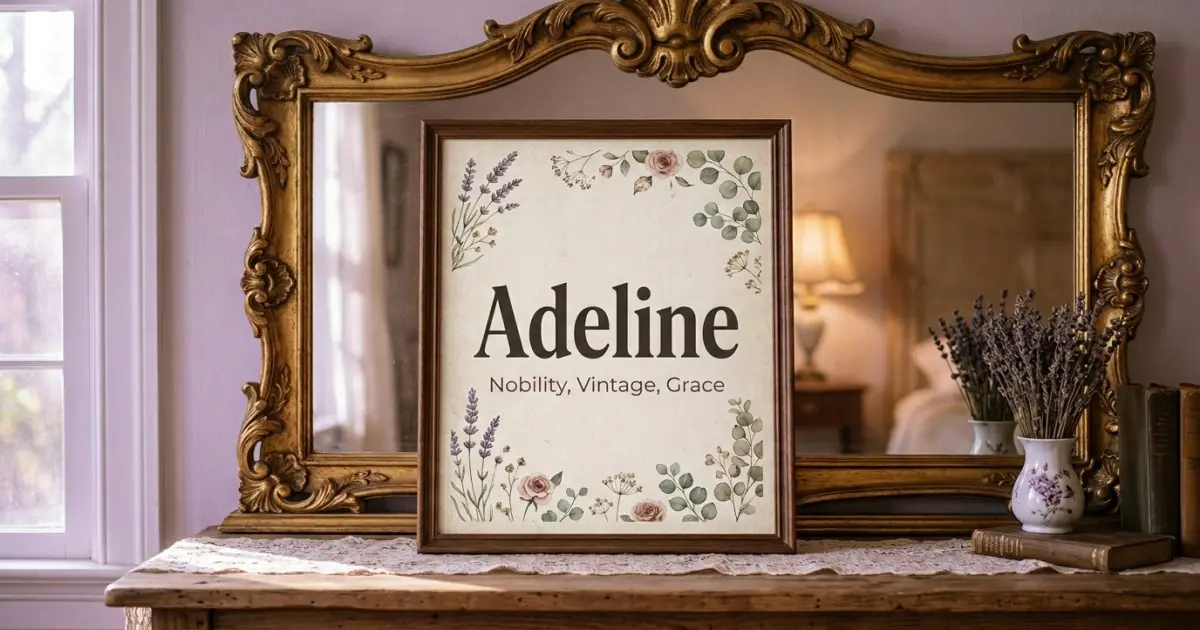
Adeline belongs to a much older family than it first appears
One of the most useful ways to understand Adeline is to place it inside its wider name family. The project’s naming references consistently connect it to Adele and Adelaide, and that connection is essential. Adeline is not an isolated invention and not merely a modern pretty choice with a vintage sheen. It belongs to a large European line of names shaped by the Germanic element associated with nobility. That root gives the name its backbone. The surrounding forms give it cultural range.

From Adele and Adelaide to Adeline
The connection to Adele is especially revealing. Some guides describe Adeline directly as a French form or a version of Adele. Others connect it back through Adelaide. Together, those references tell a clear story: Adeline belongs to a noble-name cluster that has moved across languages and centuries while keeping the same central idea. That matters because it explains why the name feels so historically grounded even when it sounds fresh.
Adelaide tends to sound grander, more architectural, and more explicitly antique. Adele is shorter, more concentrated, and cooler in profile. Adeline sits between them. It preserves much of Adelaide’s grace while borrowing some of Adele’s neatness. That middle position is one of the reasons it has become so effective in present-day naming. It takes the nobility of the whole family and turns it into a form that sounds softened, social, and current.
How French influence reshaped the tone
Even though the root is Germanic, the project books repeatedly place Adeline within French naming space. One guide explicitly lists it among French female names, and another labels it as a French form of Adele. That French shaping matters because it influences what people hear. The Germanic root gives the name seriousness. The French layer gives it elegance. Together they create a name that feels polished but not cold. To continue browsing names with a similar gender identity, see girl naming ideas.
This combination is one of Adeline’s strongest assets. It is sturdy underneath and graceful on the surface. Parents often respond to that balance intuitively even if they have never studied the name’s etymology. They hear that Adeline is not flimsy. They also hear that it is not severe. The history and the sound agree with each other in a very useful way. For more names shaped by the same tradition, explore a wider list of Germanic names.
That wider family network also explains why Adeline has so many stylistic cousins: Adaline, Adelina, Adele, Adelaide, and related noble-name forms. The presence of those cousins makes Adeline feel rich rather than isolated. It is part of a long conversation across languages about how a name can sound distinguished without becoming formal to the point of distance.
Adeline sounds literary because it already comes with a room around it
Some names feel literary because they belong to famous characters. Others feel literary because they sound as if they were designed for the page: names that carry atmosphere, shape, and memory even before any single bearer defines them. Adeline belongs to the second group. It arrives already surrounded by a certain emotional architecture. The name feels like it lives in a room with curtains, sheet music, letters, and polished wood. That may sound abstract, but it explains a lot about how the name is perceived.
Why “Sweet Adeline” still matters as a cultural echo
One of the project references points to “Sweet Adeline,” the famous barbershop standard. That is a useful cultural anchor because it shows how long the name has lived in public sentimental memory. Even people who could not place the song precisely may still feel the echo of it. The phrase helped shape Adeline as a name associated with melody, nostalgia, and affectionate idealization. It gave the name a cultural afterglow beyond strict etymology.
That does not mean Adeline is trapped in a sentimental past. It means the name has already spent time in the wider artistic imagination. It has music around it. That can make a name feel more rounded and more emotionally resonant without requiring one dominant famous bearer to carry its whole reputation.
Adeline among today’s romantic classics
In current use, Adeline sits beside names like Madeline, Caroline, Evelyn, Genevieve, and Josephine: names that feel elegant, recognizable, and softly historical. What distinguishes Adeline is that it sounds more obviously romantic than some of them, but less ceremonious than others. It is lighter than Adelaide, less stately than Josephine, and more openly floral in feeling than Adele, even though its meaning is not floral at all.
That difference matters socially. Adeline can sound refined without sounding formal for formality’s sake. It has enough curve to feel beautiful, but it still reads as intelligent and well-kept rather than decorative alone. This is probably one reason official data continues to show strong current use. The name lands in a very attractive middle ground: old enough to feel rooted, soft enough to feel loved, and current enough to sound alive rather than preserved.
There is another modern advantage here. Adeline offers the atmosphere of a vintage revival without requiring that parents choose something far rarer or more stylistically fragile. It feels special, but not difficult. Familiar, but not flat. That is often the sweet spot in naming, and Adeline occupies it with ease.

Where Adeline opens outward into the rest of a child’s identity
No first name stands alone forever. It has to live beside a middle name, interact with nicknames, and survive daily pronunciation. Adeline is especially strong because it has room for all three. Its length gives it elegance, but not so much that it becomes rigid. Its softness invites affectionate short forms without making them necessary. Its pronunciation is graceful, but still straightforward enough for daily life.
Middle names that either ground or sharpen Adeline
Because Adeline already has a lyrical and romantic profile, the middle name often does important balancing work. A crisp middle can give the full combination more authority. A softer or older middle can deepen the name’s antique warmth. The key is deciding whether you want Adeline’s brightness to be steadied or extended. If you want the full pairing logic behind that contrast, see Adeline middle names.
Nicknames that bring Adeline closer to home
One of the name’s strengths is how easily it can move between formal elegance and everyday familiarity. Adeline in full sounds polished. Its shorter forms create intimacy, ease, and different shades of personality. That flexibility is part of what makes the name so livable. To see how those different moods shorten in real life, explore nicknames for Adeline.
Pronunciation that keeps Adeline graceful and clear
AD-uh-lyn is smooth, accessible, and stable in current English use. That matters because a name this graceful could easily have become fussy in practice. Instead, Adeline stays readable and easy to say, which helps preserve its charm outside the page. If you want the full sound pattern behind that rhythm, read how to pronounce Adeline.
Why Adeline still sounds like Adeline
The best names often survive because they resolve a tension instead of choosing one side of it. Adeline resolves several. It is noble, but not pompous. Romantic, but not fragile. Historical, but not dusty. Refined, but not remote. Its Germanic root gives it dignity. Its French shaping gives it elegance. Its modern use gives it ease. All three are necessary. Remove any one of them and the name would lose part of what makes it compelling.
That is why Adeline continues to feel so persuasive. It does not merely sound pretty. It sounds as if it has inherited something worthwhile and learned how to carry it with light hands. The meaning “noble” stays present, but it is translated into warmth instead of ceremony. The history remains visible, but it does not harden into stiffness. In a naming era that often asks parents to choose between antique gravity and modern softness, Adeline offers both at once. It is nobility made conversational, and that is the lasting spell of Adeline.