
How to Pronounce Youssef: The Easy Way to Say It Right
Youssef is the kind of name that may make an English-speaking reader look twice before saying it aloud. On a school roster, a clinic form, or a graduation program, the spelling carries cultural depth; the sound itself is much simpler than the letters may first suggest: YOO-sef. Once heard, the name is easy to repeat. The challenge is not pronunciation difficulty, but spelling expectation.
That everyday moment matters because Youssef is a name with both heritage and portability. It is Arabic in origin, means “God increases,” and has a two-syllable rhythm that works clearly in English. The double letters may invite hesitation, and the ending may be guessed in a few different ways, but the spoken form remains direct: a strong opening YOO, followed by a compact sef. The full name should feel warm, dignified, and cleanly finished.
Youssef is said with a clear YOO and a compact final sef
| Element | Phonetic Detail | Quick Tip |
|---|---|---|
| Everyday pronunciation | YOO-sef | Say it in two beats, with the stronger sound on YOO. |
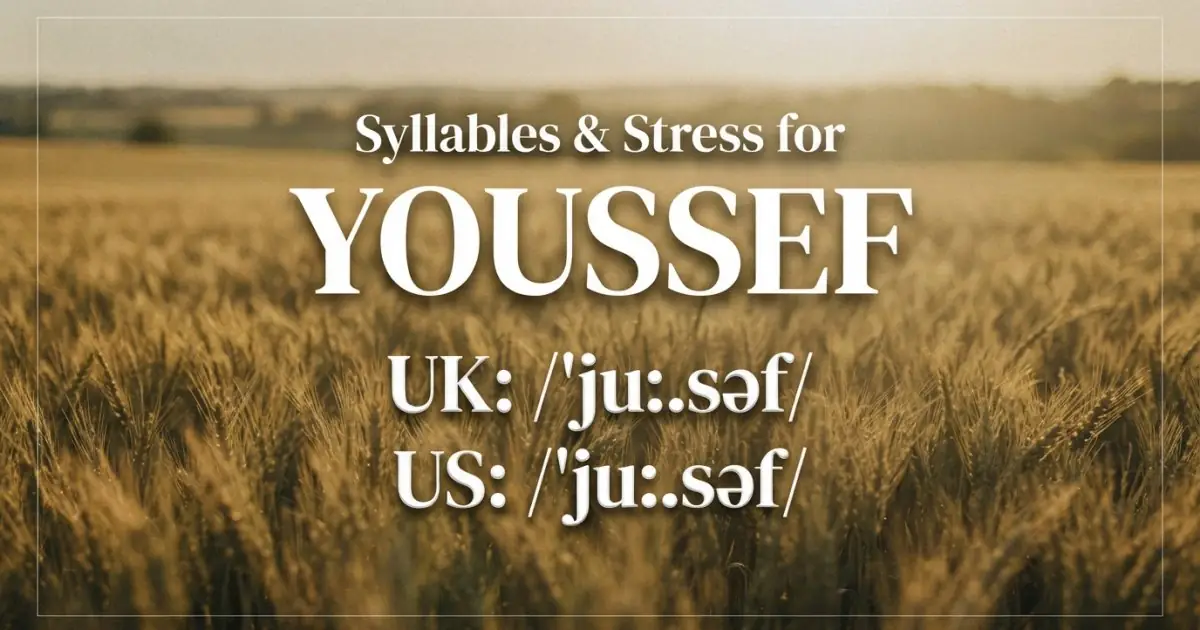
| US IPA | /ˈjuːsɛf/ | The first syllable has the long oo sound, like “you.” |
| UK IPA | /ˈjuːsef/ | The UK form is very close, with a slightly different final vowel quality. |
| Syllable count | 2 syllables | Keep it simple: YOO + sef. |
| Stress pattern | First-syllable stress | Emphasize YOO, then let the second syllable land lightly but clearly. |
| Opening sound | /juː/ | Begin like the English word “you,” not like “yow” or “yuh.” |
| Ending sound | /sɛf/ in US pronunciation | The ending sounds like “sef,” with a crisp final f. |
| Final consonant | Voiceless fricative /f/ | End with breath through the lips and teeth, not a v sound. |
The everyday pronunciation of Youssef is easier than the spelling looks
The simplest guide is YOO-sef. The first syllable sounds like the English word “you.” The second syllable is short and clear, ending in f. The name should not be stretched into three syllables, and the double letters should not be over-pronounced. In daily speech, Youssef moves quickly and smoothly. The sound matters more once you know what the name is meant to carry, which is why the wider frame starts in Youssef meaning.
This is one of the name’s practical strengths. Youssef looks culturally specific, but its pronunciation is not difficult for English speakers once modeled. The name begins with a familiar sound, keeps a straightforward stress pattern, and closes with a consonant that is easy to hear. The most useful correction is short: “Youssef, pronounced YOO-sef.”
The opening YOO gives Youssef its warmth
The opening sound is /juː/, the same sound at the beginning of “you” and “youth.” It starts with a gentle y glide and opens into a long oo vowel. That smooth entrance gives Youssef a warm, approachable quality. Once the sound pattern is clear, some shortenings stop feeling optional and start feeling natural, and the clearest map is in nicknames for Youssef.
A common mistake is making the first syllable too flat or uncertain, as though it were “yuh” or “yow.” The intended sound is cleaner: YOO. Say it confidently, then move into the shorter second syllable.
The final F gives Youssef its clean finish
The final sound in Youssef is /f/, a voiceless fricative. In plain terms, that means the sound is made by letting air pass between the lower lip and upper teeth without vibrating the voice. It is the same ending sound heard in “safe,” “brief,” and “leaf.”
This final f matters because it gives the name definition. Youssef should not end like “YOO-sev.” The final sound is crisp and breathy, not voiced. That clean ending balances the long, open first syllable.
Youssef has two syllables, with the first beat carrying the name
Youssef has two syllables: YOO and sef. The stress falls on the first syllable, so the name should sound like YOO-sef, not yoo-SEF. This first-syllable stress gives the name a familiar English rhythm even though its origin and spelling are Arabic.
The IPA form /ˈjuːsɛf/ in American English shows the same pattern. The stress mark appears before the first syllable, and the long vowel symbol in juː confirms the extended oo sound. The final syllable remains shorter and lighter.
Why Youssef should not become “you-SEF”
Some speakers may place too much weight on the second syllable because the spelling looks unfamiliar. But the correct stress is at the beginning: YOO-sef. The second syllable should be clear, but not dominant.
A helpful practice trick is to say “YOU said” and then shorten the second word into “sef.” That keeps the first syllable strong and prevents the ending from taking over.
Why the spelling should not create extra syllables
Because Youssef includes several vowels and a double s, some readers may wonder whether it has more than two syllables. It does not. The name should not be pronounced “You-se-sef,” “You-oo-sef,” or “Yoo-se-ef.” It is simply YOO-sef.
This is important in real introductions. A child named Youssef should not have to explain a complicated pronunciation. The name’s spelling may be distinctive, but the sound is compact.
Accent differences in Youssef are subtle, not disruptive
The US and UK IPA forms are close: /ˈjuːsɛf/ in American English and /ˈjuːsef/ in UK English. In everyday terms, both keep the same two-syllable structure and first-syllable stress. The difference is mainly in the final vowel quality, not in the overall pronunciation.
American English uses a short “eh” in the second syllable
In American English, the second syllable often sounds like sef, with the vowel heard in “bed,” “red,” and “set.” That gives the name a clear, compact ending: YOO-sef.
American speakers may need help with the spelling more than the sound. Once they hear the name, the pronunciation is usually easy to remember.
British English stays close but may slightly smooth the ending
In British English, the final vowel may sound a little closer to a pure e quality, but the name remains recognizably YOO-sef. The stress still belongs on the first syllable, and the final f remains important.
This makes Youssef fairly portable across English-speaking contexts. It may be spelled carefully, but it does not require a dramatically different pronunciation from one accent to another.
The most common Youssef mistakes come from guessing before hearing it
Youssef is not a hard name to say, but unfamiliar spelling can lead to predictable mistakes. Most are easy to fix with one calm model of the correct pronunciation.
Mistake 1: Saying “YOW-sef”
This mistake changes the first vowel. The opening should sound like “you,” not “yow.” The correct form is YOO-sef.
Mistake 2: Stressing the second syllable
Another mistake is saying yoo-SEF. The stress should come first: YOO-sef. The second syllable is shorter and lighter.
Mistake 3: Ending with a V sound
Some speakers may soften the ending into “YOO-sev.” The intended final sound is f, not v. A quick comparison helps: Youssef should end like “safe,” not “save.”
Mistake 4: Confusing the spelling with other forms
Youssef may be confused with Yusuf, Yousef, Yusef, or Yosef. These forms are related in sound and tradition, but the spelling Youssef has its own visual identity. Pronunciation should still stay simple: YOO-sef.
Practice lines make Youssef easy to carry in everyday speech
Practice helps because names are spoken in real situations: introductions, classroom roll calls, family conversations, and full-name combinations. Youssef becomes natural once the two-beat rhythm is repeated a few times.
Simple pronunciation drills
- Youssef is pronounced YOO-sef.
- This is Youssef.
- Youssef will be here soon.
- We named him Youssef.
- Youssef, your jacket is by the door.
Full-name practice with middle names
Keep the first syllable strong and the final f clear before moving into the middle name:
- Youssef Omar
- Youssef Karim
- Youssef Adam
- Youssef James
- Youssef Gabriel
Friendly correction phrases
These short explanations are useful in classrooms, introductions, or family conversations:
- “It’s Youssef, pronounced YOO-sef.”
- “The first syllable sounds like ‘you.’”
- “It ends with an f sound: YOO-sef.”
Because the pronunciation is compact, correction usually feels simple. Once the listener hears the first syllable and final f, the name becomes easy to remember.
How to Pronounce Youssef: FAQ
How do you pronounce Youssef?
Youssef is pronounced YOO-sef. It has two syllables, with the stress on the first syllable.
How many syllables are in Youssef?
Youssef has two syllables: YOO and sef.
What is the IPA pronunciation of Youssef?
The IPA pronunciation is /ˈjuːsɛf/ in American English and /ˈjuːsef/ in UK English.
Is Youssef pronounced like Yousef?
In everyday English pronunciation, Youssef and Yousef are often said very similarly: YOO-sef. The main difference is spelling.
Is Youssef hard to pronounce?
No. Youssef is easy to pronounce once heard. The main thing is to say the first syllable like “you” and end with a clear f: YOO-sef.