
How to Pronounce Xavi: Common Slips and How to Avoid Them
In everyday American conversation, Xavi often reaches the ear before the spelling has time to explain itself. A teacher reading attendance, a coach calling across a field, or a receptionist glancing at a form may see the initial X and pause for half a second. That pause is the whole story of the name’s pronunciation: Xavi looks compact and modern, but it asks English speakers to remember that not every X begins like the one in Xavier, xylophone, or exit.
The pronunciation is SHAH-vee. Two syllables, stress on the first, and a soft opening sound like the beginning of shy, shape, or shadow. Once that first sound is understood, the rest of the name is easy: a broad first vowel, then a light vee ending. Xavi is short, bright, and quick to say, but its spelling gives it an international edge that makes pronunciation guidance especially useful.
Why Xavi Is Said SHAH-vee, Not EX-ay-vee
| Element | Phonetic Detail | Quick Tip |
|---|---|---|
| Everyday pronunciation | SHAH-vee | Begin with the same sound as sh in show. |
| Syllable count | 2 syllables | Say it as SHAH + vee, not as three parts. |
| Stress pattern | First syllable stressed | The name leans forward: SHAH-vee. |
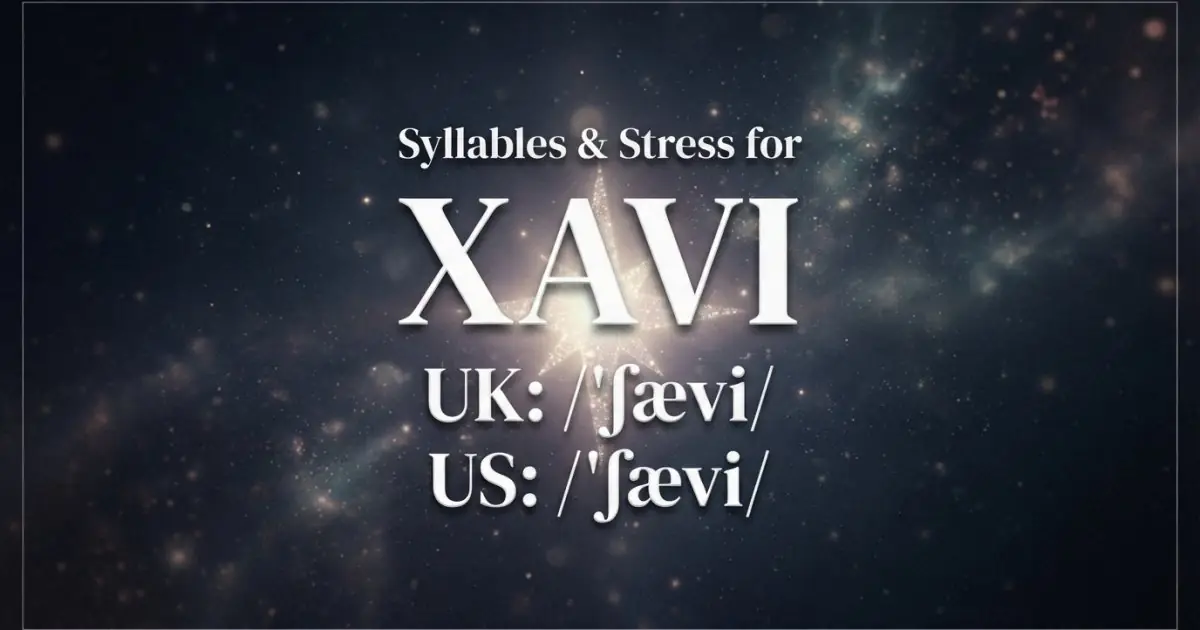
| US IPA | /ˈʃɑːvi/ | The first vowel is broad, close to the vowel in father. |
| UK IPA | /ˈʃævi/ | Some UK speakers may use a slightly flatter first vowel. |
| Opening sound | /ʃ/ | This is a voiceless fricative: air moves softly through the mouth. |
| Ending sound | -vee | Keep the ending clean and light, like the letter V plus ee. |
The First Sound in Xavi Carries the Whole Name
The most important pronunciation detail in Xavi is the first sound. In English, the letter X usually trains people to expect a hard or mixed sound: ks in box, gz in exam, or an initial z-like sound in some names beginning with X. Xavi does something different. Its opening is SH, represented in IPA as /ʃ/. Before focusing only on syllables and stress, it helps to step back into the fuller frame of Xavi meaning.
That /ʃ/ sound is called a voiceless fricative. “Voiceless” means the vocal cords do not buzz at the beginning of the sound. “Fricative” means the sound is made by narrowing the space in the mouth so air passes through with a soft friction. In plain terms, it is the sound at the start of ship, shine, and sure. It gives Xavi a smooth opening rather than a clipped one.
The X in Xavi behaves more like a Catalan sound clue
Because Xavi is Catalan in origin, its spelling does not follow the most familiar English pattern. That is why the name may be misread the first time someone sees it on paper. The correction is simple: tell people, “It’s SHAH-vee, like sh at the start.” Once heard aloud, the name is rarely difficult to repeat.
This is part of Xavi’s appeal. It is visually sleek, almost minimalist, but it carries a sound that is warmer than the spelling might suggest. The letter X gives the name energy on the page; the SH sound gives it softness in speech.
Xavi’s Two-Syllable Rhythm Is Short, Clear, and Front-Stressed
Xavi has two syllables: SHAH-vee. The first syllable receives the stress, so the name should not sound evenly divided or hesitant. It is not shah-VEE, and it is not ex-AH-vee. The natural rhythm is firm first, light second.
This first-syllable stress gives Xavi a decisive shape. Many short boys’ names in English work this way: they begin with a strong beat and then release into a softer ending. In Xavi, that release comes through the -vee ending, which keeps the name approachable and friendly.
How the vowel changes between US and UK speech
In US pronunciation, Xavi is represented as /ˈʃɑːvi/. The first vowel is broad and open, close to the vowel many Americans use in father. This gives SHAH a rounded, spacious feel.
In UK pronunciation, Xavi is represented as /ˈʃævi/. That version may sound a little flatter or shorter in the first vowel, depending on the speaker’s accent. The difference is not usually dramatic in daily life, but it explains why one speaker may make the first syllable sound closer to shah, while another may bring it slightly nearer to sha.
The key point is that both versions keep the same basic structure: SH opening, first-syllable stress, and a vee ending.
Common Mistakes People Make With Xavi
Most mispronunciations of Xavi come from reading the spelling through English habits. The name is short enough that mistakes are easy to fix, but parents may want to know the likely patterns in advance.
“EX-ah-vee” adds a syllable that is not there
The most common error is turning the initial X into its letter name, producing something like EX-ah-vee or EX-ay-vee. That makes the name three syllables instead of two and changes its personality. Xavi should not begin with a separate ex sound. It begins immediately with sh.
“ZAH-vee” follows a different X-name pattern
Some English speakers may guess ZAH-vee, especially if they are used to names where initial X is softened toward Z. That version is understandable, but it is not the pronunciation supplied for Xavi here. The opening should be SH, not Z.
“KSAH-vee” over-pronounces the spelling
A smaller number of speakers may try to pronounce the X as ks, producing something like KSAH-vee. This makes the name sound heavier and more mechanical than intended. Xavi is smoother than that. The name starts with one sound, not a consonant cluster.
Sound Neighbors That Help People Learn Xavi Quickly
When explaining Xavi, comparisons are useful, but they should be chosen carefully. The name does not sound like Xavier in every English-speaking context, because Xavier has several accepted pronunciations. Instead, the clearest teaching route is through simple sound neighbors. Because the strongest energy lands early, the shorter forms often grow from the opening of the name, and that pattern is easier to see in nicknames for Xavi.
Use “sh” words for the opening
For the first sound, compare Xavi to everyday words such as shadow, shark, shape, and shop. The match is not about meaning; it is about mouth position. The lips and tongue move into the same soft sh shape before the vowel opens.
Use “vee” words for the ending
The second syllable is easy: vee. It sounds like the letter V said aloud, or the ending of a name such as Harvey when reduced to its final sound. The v is voiced, meaning the vocal cords vibrate, and the vowel is a clear ee.
Together, those two pieces make the name simple to coach: SH as in show, AH as in father for many US speakers, and vee like the letter V.
Practice Lines for Saying Xavi Naturally
The best way to make Xavi feel natural is to say it in full sentences, not just as an isolated word. Names live in greetings, introductions, classroom moments, sports rosters, family conversations, and formal announcements. Practice should cover both casual and polished settings.
Everyday introductions
- “This is Xavi.”
- “Hi, Xavi, nice to meet you.”
- “Xavi will be joining the group today.”
- “We pronounce it SHAH-vee.”
Family and school settings
- “Xavi, your backpack is by the door.”
- “Can Xavi go first?”
- “Xavi has two syllables: SHAH-vee.”
- “The X sounds like SH.”
Formal and professional use
- “Please welcome Xavi to the stage.”
- “The appointment is under Xavi.”
- “Xavi is spelled X-A-V-I.”
- “Xavi, pronounced SHAH-vee, is here for the interview.”
These practice lines show why the name works well once its first sound is known. It is brief enough for daily life, distinctive enough to be memorable, and clear enough to carry into adult settings without feeling overly casual.
Pronouncing Xavi: Common Questions
How do you pronounce Xavi?
Xavi is pronounced SHAH-vee. It has two syllables, with the stress on the first syllable.
Does the X in Xavi sound like Z?
No. In this pronunciation, the X sounds like SH, as in show or shadow. The name is not pronounced ZAH-vee.
Is Xavi hard for English speakers to say?
Xavi may need one correction the first time someone sees it written, but it is easy to say once heard aloud. The simple guide is: SH + AH + vee.
How many syllables are in Xavi?
Xavi has two syllables: SHAH-vee. It should not be stretched into three syllables like EX-ah-vee.
What is the IPA pronunciation of Xavi?
The US IPA pronunciation is /ˈʃɑːvi/. The UK IPA pronunciation is /ˈʃævi/. Both keep the same first-syllable stress and vee ending.