
How to Pronounce Wyatt: Clear Pronunciation Help for Everyday Use
The most revealing pronunciation test for Wyatt usually happens in a very ordinary place: the teacher taking attendance for the first time, the nurse calling a patient from the waiting room, the coach reading a roster under field lights, the grandparent repeating the name after hearing it once over the phone. Wyatt tends to do well in those moments. It looks a little rugged on the page, and the spelling can make a new reader pause for half a second, but the sound usually resolves quickly. Once people see it, they almost always know where the name wants to go.
That matters because Wyatt has a strong visual identity. It looks brisk, masculine, and slightly old-soul at the same time. Names with that kind of presence can sometimes hide pronunciation traps. Wyatt does not, at least not in standard English use. The name is short, the stress pattern is intuitive, and the vowel in the first syllable carries most of the weight. In daily life, Wyatt is one of those names that sounds tougher and more complex than it actually is to say.
What This Wyatt Sound Guide Clears Up Right Away
| Element | Phonetic Detail | Quick Tip |
|---|---|---|
| Common pronunciation | WY-ut | Put the main emphasis on the first syllable and let the second syllable stay lighter. |
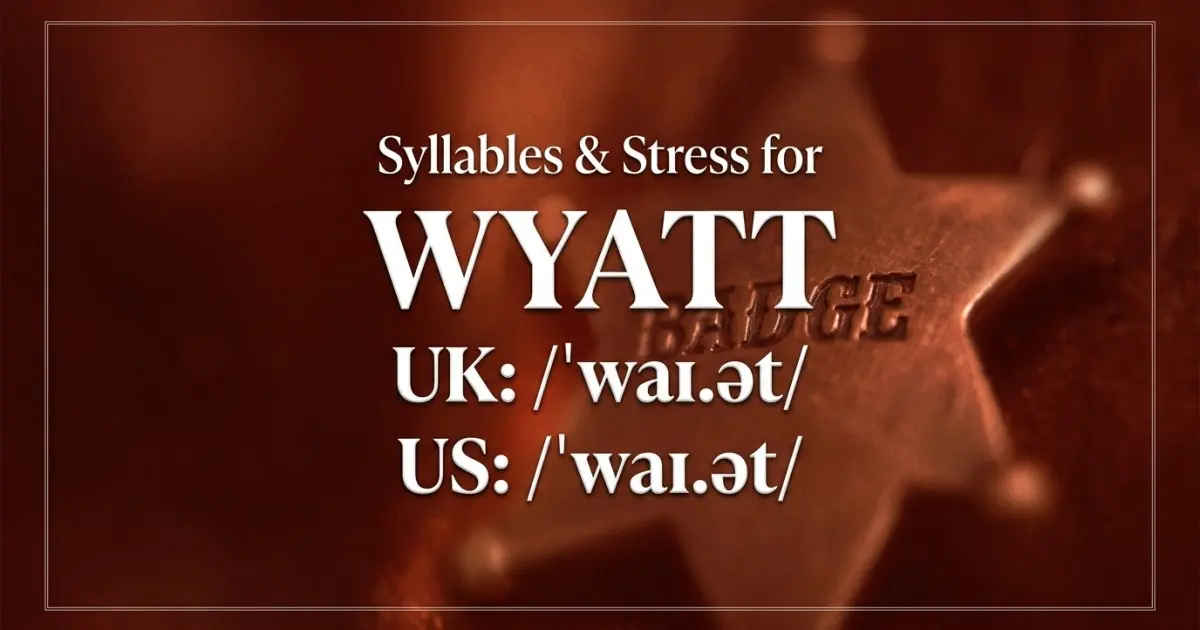
| U.S. IPA | /ˈwaɪət/ | The opening sounds like the word “why,” not “way” or “wee.” |
| U.K. IPA | /ˈwaɪət/ | The standard British form keeps the same stress pattern and vowel movement as American English. |
| Syllable count | 2 syllables | Think of Wyatt as one strong beat followed by one softer release. |
| Primary stress | First syllable | Say WY-ut, not wy-ATT. |
| Opening sound | /w/ + /aɪ/ | Start with the same sound pattern you hear in “wide” or “wire,” but shorter. |
| Second syllable | Light unstressed /ət/ | The ending should be quick and easy, closer to “ut” than to a full, heavy “at.” |
| Overall flow | Bright start, softened finish | Wyatt sounds best when it opens clearly and then relaxes instead of punching both syllables equally. |
Why Wyatt Sounds Firm Even Though the Pronunciation Is Simple
Wyatt gets much of its character from the first syllable. The opening Wy uses a diphthong, which is simply a vowel sound that glides while you say it. In this case, it is the same broad sound heard in “why.” That glide gives the name brightness and motion. It is part of the reason Wyatt sounds alive rather than flat. The sound matters more once you know what the name is meant to carry, which is why the wider frame starts in Wyatt meaning.
The name then resolves into a much lighter second syllable. That contrast matters. If both syllables were equally stressed, Wyatt would sound stiff and overly hammered. Instead, English speakers naturally place the weight up front and let the second syllable taper off. The result is a name that feels strong without sounding overforced.
Why the first syllable does almost all the work
In names like Wyatt, the stressed first syllable carries identity. That is why so many people can shorten the name naturally to Wy in family life without losing the essence of the original. The first syllable is doing the heavy lifting. It is also what makes the name easy to hear across a room. If someone calls “Wyatt,” most of the recognition happens in that first bright beat.
The second syllable should not be overhit
The most common pronunciation issue is not getting the first syllable wrong. It is putting too much force on the second. Wyatt does not want a strong, separate at. It wants a softened, unstressed ending. In normal speech, that second syllable often comes out quickly, almost as if it is tucking itself under the stronger first sound. That is one reason the name feels so compact in conversation.
Wyatt in American and British English Sounds Nearly the Same
Wyatt is a good example of a name that travels well between major English accents. The IPA given here is the same in both U.S. and U.K. forms: /ˈwaɪət/. That means the core structure stays stable. Speakers on both sides of the Atlantic are generally using the same vowel movement and the same stress pattern.
Accent differences are small and mostly about texture
Some speakers may clip the second syllable a bit more sharply. Others may let it breathe a touch more. But those are tiny differences in texture, not in identity. Wyatt does not radically change shape from one English-speaking setting to another. This is a practical advantage for a child who may move across regions or simply encounter many different speakers in ordinary life.
What fast speech does to Wyatt
In quick conversation, Wyatt can compress slightly. The second syllable may grow lighter, and the full name may sound almost like one long motion rather than two neatly separated parts. That is normal. English often reduces unstressed syllables. As long as the opening remains clear and the second syllable is still faintly present, the pronunciation remains perfectly natural.
Where People Mispronounce Wyatt When They Overthink It
Wyatt is generally easy, so most errors come from hesitation or overanalysis. A reader sees the unusual letter combination and assumes there must be something complicated hiding in it. Usually there is not.
The most common mistake patterns
One common error is flattening the opening so that it sounds closer to “way” than “why.” That changes the whole name immediately. Another is putting too much emphasis on the last syllable, almost as if the name were divided into wy-ATT. Standard English pronunciation does not do that. The second syllable is present, but secondary.
A less common issue is overpronouncing every letter as though the name must be decoded from scratch. That can make Wyatt sound stiff and overcareful. In natural English, Wyatt should move briskly. It is a name with clarity, not ceremony.
Why the spelling can create hesitation
The sequence Wy- at the start is not especially difficult, but it is visually distinctive enough to make some readers pause. That brief pause is often about spelling, not sound. Once they commit to the opening “why” sound, the rest of the name usually follows easily. In other words, the spelling looks more uncertain than the pronunciation actually is.
Wyatt Belongs to Familiar English Sound Patterns
Another reason the name is easy to say is that it fits a very normal English stress pattern: strong first syllable, lighter second syllable. English speakers use that pattern constantly, which means Wyatt does not demand a new mouth movement or an unusual rhythm. It feels instinctively pronounceable even to people who have never met a Wyatt before.
The consonants also help. There are no difficult clusters, no unusual fricatives, and no complicated liquids to slow the speaker down. The name begins with a smooth w, moves through a bright diphthong, and ends with a soft unstressed close. It is phonetically efficient, which is part of why it has become such a durable modern choice.
Practicing Wyatt Until It Feels Automatic
Use Wyatt in ordinary spoken lines
The easiest way to practice Wyatt is not to say it in isolation but to place it in the kinds of sentences where it actually lives: The way the name resolves at the end often decides which short forms feel natural in speech, and that becomes clearer in Wyatt nicknames.
“Wyatt, your turn.”
“Have you met Wyatt?”
“Wyatt is here.”
“I asked Wyatt already.”
These lines make the rhythm obvious. The first syllable should carry the name. The second should follow lightly.
Three quick reminders that solve most problems
First, start with the sound “why.” Second, keep the stress on that opening syllable. Third, let the second syllable be shorter and softer. If those three things are in place, Wyatt will sound natural in almost any English-speaking setting.