
Willa Name Meaning: Its Story, Meaning, and Emotional Texture

Some names arrive like decoration, all atmosphere and surface. Others arrive like architecture. Willa belongs to the second kind. On paper it is brief, almost spare: five letters, two syllables, no excess. In the ear it feels gentle and unforced. Yet the idea at its center is not ornamental at all. Willa carries the meaning “resolute protection,” and that phrase explains why the name leaves such a strong afterimage. It does not promise sparkle, sweetness, or softness alone. It suggests steadiness with purpose. It imagines care not as sentiment, but as character.
That balance is a large part of Willa’s appeal in contemporary naming culture. Many parents now want names that feel concise, human, and emotionally clear, but they also want substance. Official Social Security Administration (SSA) data places Willa at No. 423 for girls in the United States in 2024, which puts it in an especially attractive range: familiar enough to be understood immediately, uncommon enough to keep its individuality. Historically, the name belongs to the same family as William and Wilhelmina, but Willa does not feel like a shadow of a longer form. It feels edited, distilled, and modern in its final shape. Willa is what happens when an old backbone survives inside a lighter frame.
Willa's U.S. popularity rank over time, 1880–2024
Popularity statistics are based on official data from the Social Security Administration baby name records.
Willa: A Vintage Classic with Noble Resilience
Willa presents a chart pattern of a broader past with a clearer present, reflecting older style cycles that now offer the name renewed force. Its peak in the early 1930s suggests legacy status, yet its current momentum behaves more like a fresh “vintage revival” .
The lack of crossover helps the name maintain a singular public identity. Meaning “resolute protection,” its simple two-syllable structure remains both durable and widely trusted across generations.
Willa in one clear frame
| Key Facts | Information | Quick Insight |
|---|---|---|
| Name | Willa | Short, direct, and visually clean, with nothing ornate to hide behind. |
| Origin | German | Its background gives the name historical weight even though its modern form feels streamlined. |
| Meaning | Resolute protection | This is a meaning built on loyalty and backbone rather than display, which is why the name feels quietly strong. |
| Pronunciation | WIL-uh | The stress falls early, giving the name firmness before it softens on the final syllable. |
| IPA | US: /ˈwɪlə/; UK: /ˈwɪlə/ | The identical US and UK rendering makes Willa unusually portable across English-speaking settings. |
| Syllable Count | 2 | Two syllables help the name feel nimble and easy to pair with many surnames. |
| Usage | Primarily female | Its current identity feels settled and readable, which gives it clarity in everyday use. |
| U.S. girls’ rank (2024) | No. 423 | Willa sits in the sweet spot between recognition and oversaturation: known, but not overexposed. |
| Name Family | Associated with the William / Wilhelmina line | The name inherits an old protective tradition, but presents it in a much leaner and more contemporary form. |
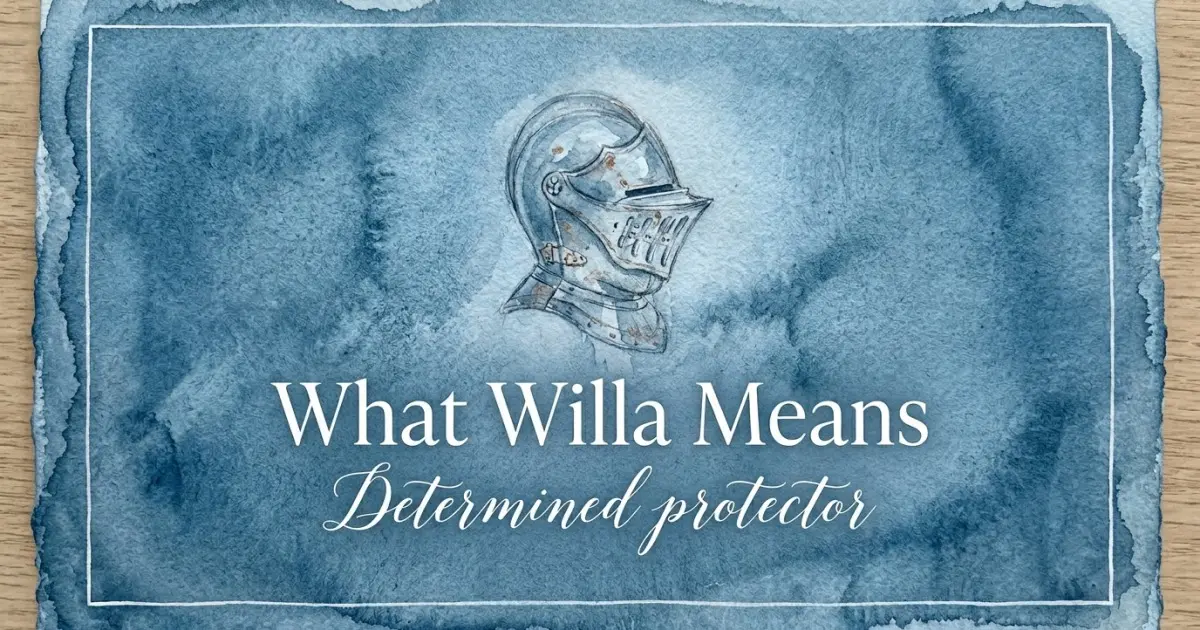
Willa turns protection into character, not armor
The force inside the softness
There is a reason Willa feels different from names that merely sound pretty. The meaning does not rest on beauty, luck, brightness, or charm. It rests on commitment. “Resolute protection” is a phrase with posture inside it. To be resolute is not simply to be strong; it is to remain steady once a decision has been made. To protect is not to dominate; it is to guard, keep, shelter, and stand near. Put together, those two ideas create a name that feels morally active. Willa does not drift. It holds.
That matters because names are often asked to do emotional work before the child is old enough to speak for herself. Families use them as a first piece of language around hope. A name like Willa does that work in a particularly interesting way. It does not project aggression, and it does not romanticize fragility. Instead, it offers a model of strength that is relational. The strength here exists for someone or something. It is not force for spectacle. It is force in service of care.
This is also why Willa avoids one of the common traps in modern naming: sounding so soft that it becomes vague. Plenty of current favorites rely on airy vowels, floral associations, or dreamy imagery. Willa is gentler than many old Germanic names, but it keeps its center of gravity. The meaning gives the sound a hidden frame. Even parents who never discuss etymology aloud often respond to this instinctively. They hear a compact, warm, approachable name. What they feel, whether consciously or not, is that the warmth is not flimsy. For parents interested in this heritage, a good next step is names from this linguistic background.
Why “resolute” changes the whole mood
If Willa meant only “protection,” it would already have a strong appeal. But “resolute” changes the mood of the entire name. It adds will, decision, steadiness, and inward authority. That makes Willa feel less like a shield someone hands you and more like a quality you grow into. The name is not passive protection, not ornamental protection, not ceremonial protection. It is chosen protection. The difference is subtle, but it is what keeps Willa from sounding generic.
In social terms, this gives the name a distinctly modern resonance. Willa fits an era that admires competence, emotional intelligence, and calm authority more than theatrical power. It suggests someone who can be trusted. Not loud, not brittle, not overdesigned. In professional life, the name sounds clear and adult. In childhood, it sounds affectionate without becoming babyish. In family life, it feels warm and usable. Across all of those settings, the same core impression survives: Willa is gentle, but not yielding.
That combination may be the name’s best argument. Parents often worry that strong names can sound severe, while soft names can sound too slight. Willa manages to evade both outcomes. It offers a version of strength that many people now find more persuasive than the older, harder models. This is not the clang of metal. It is the steadiness of someone who means what she says and stays where she is needed. That is what gives Willa its quiet dignity.
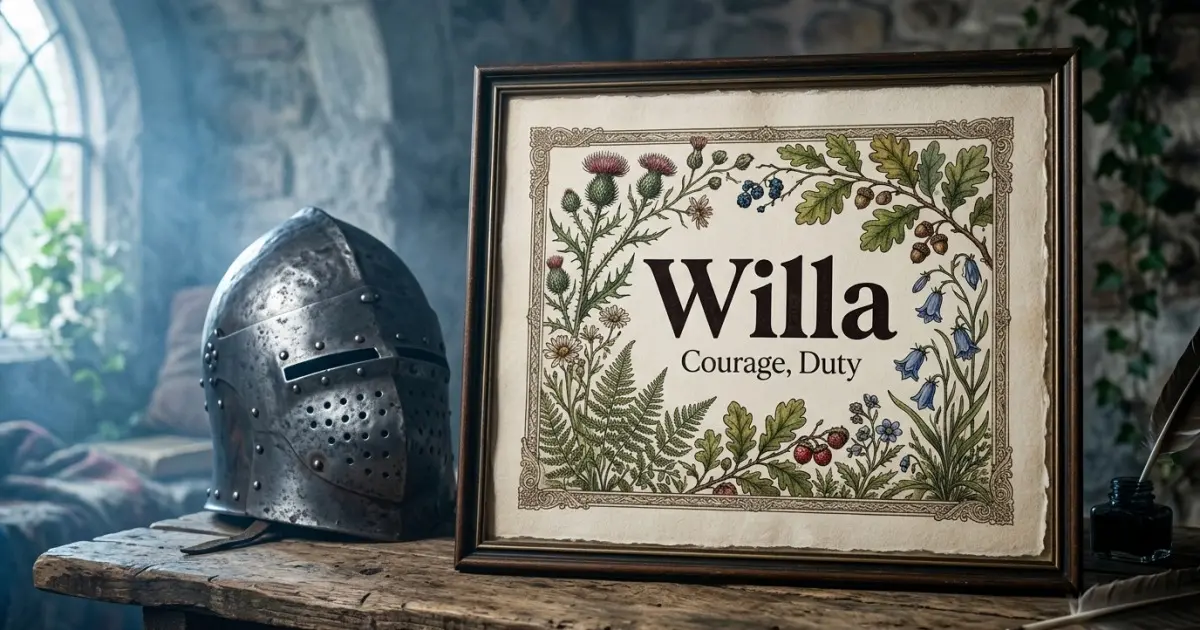
Willa belongs to the William line, but it does not live in anyone’s shadow
From William and Wilhelmina to Willa
Historically, Willa sits within one of the most enduring naming families in Europe. Traditional name dictionaries place it as a feminine form connected to William and also as a shortened form of Wilhelmina. That history matters because it gives Willa inherited structure. It is not a newly minted sound sequence. It comes from a long line of names that have traveled through courts, churches, literature, family trees, and everyday life for centuries.
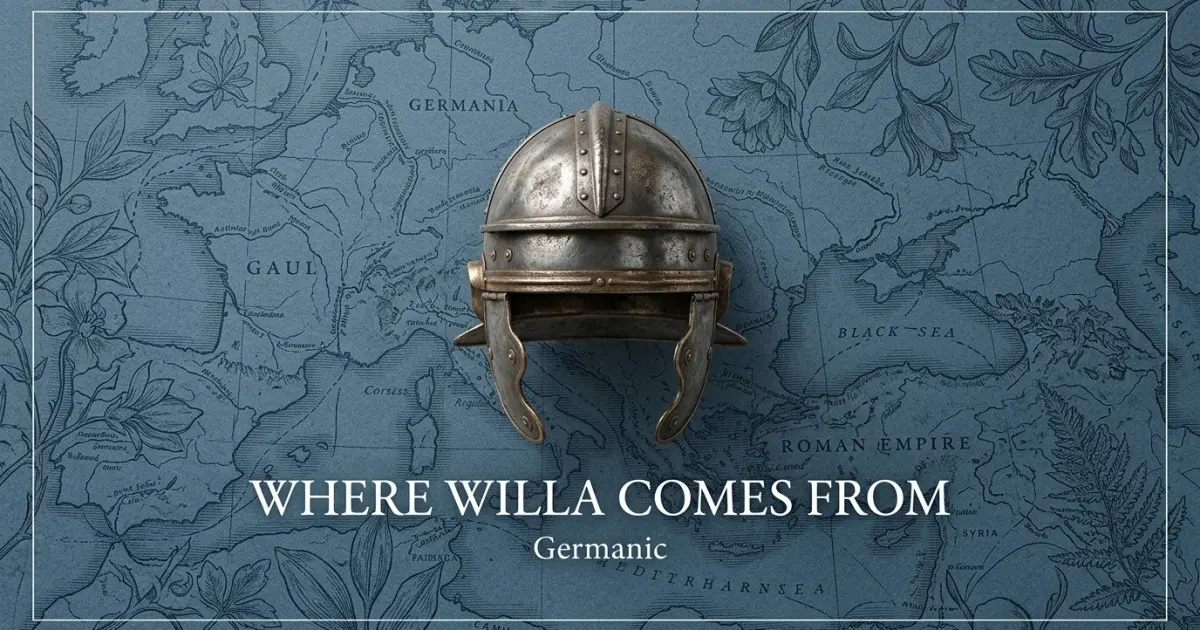
Yet one of the most attractive things about Willa is that you do not have to use the longer versions to justify it. Wilhelmina is grand, elaborate, and unmistakably formal. William is monumental in the English-speaking world, worn by kings, statesmen, writers, and ordinary families alike. Willa takes that long public history and reduces it to something closer to private ease. It keeps the backbone and removes the ceremony.
This is a pattern many modern parents appreciate. Older naming systems often rewarded fullness, visible lineage, and honorific weight. Contemporary taste often prefers compression. A short form can feel more intimate, more breathable, and more adaptable to present-day life. Willa benefits enormously from that shift. It has the authority of an old house name, but the proportions of a modern room.
That also explains why Willa feels more current than some of its cousins. Wilma can sound mid-century. Wilhelmina can sound majestic, eccentric, or heavily antique depending on the context. Willa, by contrast, lands in a narrower and more versatile register. It is recognizably traditional, but it does not ask the child to carry obvious historical costume. The old story is there if you want it. The day-to-day usability is there even if you never mention the story at all.
Why the shortened form became the memorable one
Short forms often survive when they solve several cultural problems at once, and Willa does exactly that. It feels easier to say than Wilhelmina, less expected than William-derived Billie, and more grounded than some of the purely decorative short names that dominate trend cycles. It has room for affection, but it already arrives complete. Nobody hears Willa and assumes they are waiting for the “real” name to appear.
That sense of completion is crucial. Many clipped names feel transitional, as though they belong in a family photo caption but not on a book jacket or a business card. Willa does not have that problem. The double consonant in the middle gives it visual body. The final “a” softens the silhouette without making it flimsy. It looks finished because it is balanced. The eye stops exactly where it should.
The name’s relation to the William family also gives it a subtle advantage in cross-generational appeal. Older relatives often recognize its lineage, even if they have not heard Willa often. Younger parents hear something shorter, warmer, and more editorial. That is not a small achievement. Names that satisfy both memory and taste tend to last longer than names built only for novelty.
So while Willa may once have functioned as a shortened or feminized branch of a larger family tree, in present use it feels like a full identity. Its history strengthens it, but does not contain it. That is often the difference between a name that merely returns and a name that truly lives again.
Willa sounds gentle because it is short; it sounds strong because it closes cleanly
Sound matters as much as meaning in the survival of a name, and Willa is a good example of why. The pronunciation is straightforward: WIL-uh. Stress lands on the first syllable, which gives the name immediate shape. That opening beat is one reason Willa never feels blurry. The name declares itself early.
Then the sound pattern does something clever. It begins with the rounded softness of w, moves into the brief, bright vowel of i, and gathers itself around the l before relaxing into the final schwa. In practical terms, that means Willa starts tenderly, firms up in the middle, and ends without strain. The whole sound lasts only a moment, but it travels through a full emotional arc.
Phonetically, that gives Willa one of the most useful combinations a modern name can have: it is easy to say, but not flat; soft, but not sleepy; feminine, but not frilled. Some names get their memorability from unusual consonants or dramatic length. Willa gets it from internal balance. Nothing in it is difficult. Nothing in it is throwaway either.
This balance is one reason the name travels well across English-speaking settings. The US and UK pronunciation align cleanly, which reduces friction. Teachers, relatives, doctors, friends, and strangers are likely to say it the same way. That kind of stability matters more than people sometimes admit. A beautiful name that must be corrected constantly can become tiring in family life. Willa offers clarity without sacrifice.
It is also worth noting what the sound does not do. It does not shimmer like a fantasy name. It does not crack like a hyper-modern surname name. It does not perform whimsy. The effect is more classical than trendy, even though the name fits contemporary taste. That is often how durable names behave: they sound current without sounding invented for the current moment alone.
What Willa signals in the modern style landscape
Willa among today’s quiet-revival names
Official ranking data places Willa at No. 423 for girls in the United States in 2024. That number tells an important story even without a dramatic trend narrative attached to it. Willa is not buried in obscurity, but it is also nowhere near mass overuse. The result is a name that most people can absorb instantly, while still allowing a child to feel distinct within a classroom, neighborhood, or friend group. To discover related options in this naming space, explore baby girl names and meanings.
That placement suits the name’s style. Willa belongs to a larger family of short, clear, revived names that feel rooted rather than flashy. Parents drawn to names like Nora, Clara, Thea, Ada, or Elsie may find Willa appealing for a related reason: it offers an older sensibility in a compact, contemporary package. But Willa has a slightly different emotional weather. It is less delicate than some of the lace-curtain revival names and less ethereal than the botanical or moonlit favorites that have dominated recent taste. It has more earth in it.
There is also a useful difference between Willa and the more visibly fashionable Willow. Willow leans toward image, atmosphere, and landscape. Willa leans toward personhood. Willow suggests a scene; Willa suggests a voice. Both can be lovely, but they do different kinds of work. Willa is the more contained and arguably the more durable choice for parents who want softness without drift.
Why Willa avoids both fuss and blandness
One of the hardest things for a modern name to do is remain noticeable without becoming noisy. Willa manages this by being clean rather than plain. The double l gives it shape on the page. The final a gives it light. The initial W makes it less common in a field crowded with vowel-heavy girls’ names. As a result, the name stands out gently.
It is also highly adaptable across ages. On a small child, Willa feels affectionate and bright. On a teenager, it retains individuality without strain. On an adult, it sounds composed and self-possessed. That age range is one of the strongest tests of a name’s design. Willa passes it because its form is restrained. There is nothing in it that depends on novelty, cuteness, or shock.
In practical style terms, the name pairs easily with many surnames because it is brief and rhythmically stable. It can sit in front of something long and formal without getting lost, and in front of something short and plain without sounding abrupt. It also works across different family aesthetics. A literary household can love Willa for its cultivated simplicity. A traditional household can appreciate its lineage. A minimalist household can admire its edited feel. A parent who wants a strong name for a daughter can recognize that strength without hearing harshness.
That versatility is probably why Willa feels so current without needing trend theatrics. It does not announce itself as daring. It simply arrives well-made. The name gives the impression that somebody thought carefully, chose cleanly, and stopped before excess. In a naming culture that often swings between ultra-classic and ultra-novel, Willa occupies the more difficult middle ground: distinctive restraint.
The literary afterimage that follows Willa
No modern discussion of Willa is complete without acknowledging the literary aura that accompanies it. For many readers, the name carries an immediate association with Willa Cather. That matters not because every parent chooses the name for literary reasons, but because cultural memory changes how a name feels in the ear. Willa is one of those rare names that can sound both plainspoken and educated at once.
This literary association strengthens the name’s identity rather than pinning it to a single glamorous image. It does not behave like a celebrity surname turned first name, and it does not feel trapped inside one pop-culture character. Instead, it gains a quiet seriousness. It suggests thought, landscape, observation, and independence. Even for people who could not name a specific book, the residue of that association can make Willa feel bookish in the best sense: not fussy, but intelligent.
That is a valuable trait in a personal name. Names tied too tightly to one fashionable reference can age badly once the cultural moment passes. Willa’s literary echo is older, broader, and more dignified than that. It enriches the name without overdefining the child who bears it. In other words, it adds tone, not costume.
Where Willa can lead next
Middle names that widen Willa’s register
Because Willa is compact and decisive, it has room to pair with middle names that are airy, formal, romantic, or family-rooted. The name can support contrast without losing itself, which is one reason it works so well in longer combinations. If you want the full pairing logic behind that contrast, see Willa middle names.
Nicknames that soften or sharpen Willa
Willa is already complete, but its shape still leaves space for affectionate variation. That flexibility is useful because it lets the name remain stable in official life while still becoming intimate inside a family. To see how those different moods shorten in real life, explore nicknames for Willa.
Pronunciation notes that keep Willa effortless
One of Willa’s practical gifts is how little explanation it usually requires. Even so, its clean two-syllable rhythm and early stress deserve a closer look because that sound pattern is a major part of the name’s charm. For the detailed stress pattern, accent notes, and IPA, see how to pronounce Willa.
Why Willa stays with people
In the end, Willa succeeds because it understands proportion. It carries an old protective meaning without dragging old weight behind it. It sounds soft without dissolving into vagueness. It feels literary without becoming precious, feminine without becoming fragile, classic without becoming stiff. Names survive when they offer more than fashion, and Willa does. It offers character.
That is why Willa feels memorable long after first hearing. The name is small, but it is not slight. It stands on a deep historical foundation, then steps into the present with unusual ease. If many modern names try to impress, Willa does something subtler and often more lasting: it convinces. It suggests a person who can be warm and steady in the same breath, protective without posturing, self-possessed without noise. Willa does not need to raise its voice to be heard. Its strength is already inside the form.