
Violet Name Meaning: Cultural Roots and a Distinctive Feel
Violet is one of the few popular flower names that has never belonged only to flowers. It carries bloom, certainly, but it also carries color, atmosphere, and a strange kind of emotional discipline. At its root, Violet means “purple flower,” yet the name does not feel merely decorative. It feels composed. That is the central tension inside Violet, and it is the reason the name has remained so durable. A violet flower is small. The color violet is rich. Put those two images together and you get a name that balances modesty with intensity, softness with concentration, delicacy with a surprisingly serious visual force.
That balance is what makes Violet more than a pretty vintage revival. Many floral names arrive with instant sweetness but less depth. Violet is different. It carries one of the oldest and most symbolically loaded colors in human culture while still sounding like something alive in a garden. It belongs to a child’s name world, but it also belongs to painting, fabric, weather, twilight, and liturgical color. The result is a name that sounds graceful without becoming faint. Violet suggests beauty, but not merely beauty on display. It suggests beauty with shade, structure, and memory behind it.
Violet's U.S. popularity rank over time, 1880–2024
Popularity statistics are based on official data from the Social Security Administration baby name records.
Violet: A Vibrant Floral Favorite
Violet presents a chart pattern of one dominant tradition, where its visibility is concentrated almost entirely on the girls’ side. Its recent ascent likely suggests revival energy, benefiting from a style family that parents trust for being “charming and fresh” while maintaining classical roots .
The trace presence in the boys’ lane from decades past has faded, leaving a clearer present for feminine identity. Its three-syllable rhythm and direct nature association give it a texture that feels both polished and durable.
Violet in one vivid frame
| Key Facts | Information | Quick Insight |
|---|---|---|
| Name | Violet | Violet feels at once familiar and atmospheric, which is why it can be highly popular without becoming bland. |
| Primary Gender Usage | Female | The name is overwhelmingly feminine in modern use, but its strength comes from color and clarity rather than softness alone. |
| Origin | Latin | Its Latin origin gives the name classical grounding and keeps it connected to the long history of flower and color names in European languages. |
| Core Meaning | Purple flower | This meaning gives Violet a double image: the flower suggests intimacy and delicacy, while purple suggests depth and saturation. |
| Pronunciation | VY-uh-luht | The strong opening and softened ending make the name feel lively rather than overly dainty. |
| IPA (US) | /ˈvaɪələt/ | The American form gives Violet brightness at the front and a gentle taper at the end, which helps the name feel polished in speech. |
| IPA (UK) | /ˈvaɪələt/ | The shared British and American structure gives the name unusual ease across English-speaking settings. |
| Syllable Count | 3 | Three syllables give Violet a slightly more lyrical shape than many current floral names without making it cumbersome. |
| U.S. girls’ rank (2024) | No. 15 | Official data shows Violet is no longer a niche vintage choice. It is a fully established modern favorite with real staying power. |
| U.S. boys’ rank (2024) | No. 14088 | This confirms that contemporary American usage hears Violet as firmly feminine despite occasional rare crossover entries. |

Violet holds modesty and intensity in the same word
The deepest reason Violet endures is that its two strongest associations seem to pull in opposite directions and somehow improve each other. The flower is small, low to the ground, and traditionally associated with modest beauty. The color, by contrast, is dense, saturated, and culturally loaded. It suggests richness, depth, and a certain seriousness of mood. Most names lean more clearly one way or the other. Violet does not. It lets humility and vividness exist in the same image.
That gives the name unusual range. A girl named Violet can sound gentle without sounding fragile, artistic without sounding ornamental, and elegant without sounding remote. The name has enough sweetness for childhood, but it also has enough color-density to sound plausible on an adult. This is where many flower names struggle. They arrive charming, but they do not always mature well. Violet does. The color inside the name keeps it from staying too airy or too small.
Why the flower in Violet is more than decoration
Because the meaning is “purple flower,” not simply “flower,” the name is rooted in a very specific image. That matters. Specific images tend to live longer in names than vague prettiness. Violet gives you shape, shade, and scale immediately. You can see it. That makes the name memorable in a way many abstract virtue names are not.
The flower itself also contributes something important to the tone. Violets are not grand, showy blossoms. They are known for smaller scale and quieter beauty. This is part of why the name so often feels refined rather than flashy. Even at No. 15 in current records, Violet does not sound loud. It sounds intentional.
Why the color inside Violet makes the name feel older than fashion
Purple has long been one of the most symbolically charged colors in human imagination. Even without dragging in heavy-handed symbolism, most listeners still feel that violet as a color is deeper than pink, calmer than red, and more shaded than blue. It belongs to dusk, to flower shadows, to velvet, to old glass, to rich cloth, to the atmosphere between brightness and darkness. That gives the name a tonal maturity that many floral names do not possess.
This is why Violet can rise high in popularity and still retain personality. There is too much atmosphere packed into the name for it to become empty very easily. Even when many children share it, the name still carries a visual world with it.
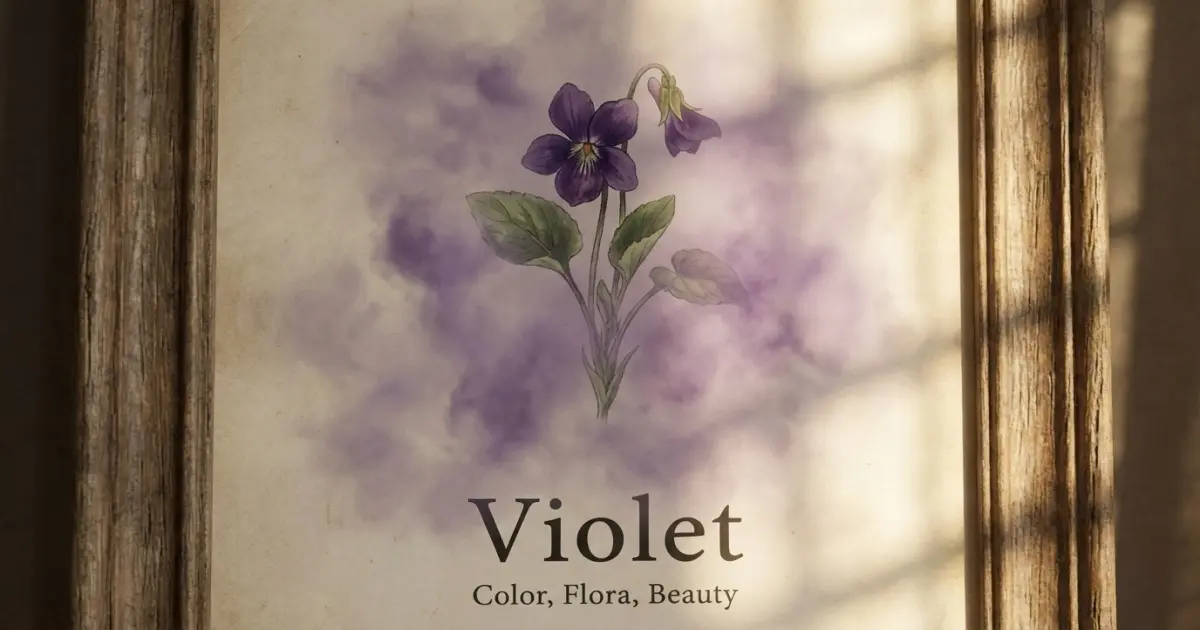
Violet came from Latin, but it stayed alive by becoming both flower and color
Historically, Violet belongs to the Latin naming stream, and that origin matters because it roots the name in the older European vocabulary of plants, color, and cultivated life. Latin-derived flower names often survive especially well because they sound both natural and civilizational at once. Violet has that advantage. It feels garden-grown, but it also feels linguistically established rather than improvised. For a broader list of names in this heritage, visit names from this linguistic background.

The name’s lasting strength comes from the fact that it did not remain attached only to the flower. It also became inseparable from the color violet. This doubled life matters a great deal. A flower name can sometimes risk feeling too pastoral or too soft. A color name can sometimes risk feeling too abstract. Violet avoids both problems because it belongs to both worlds at once.
That dual identity helps explain why the name has had such a strong modern revival. Parents who love nature names hear a flower. Parents who like atmospheric, artistic, or color-rich names hear something deeper. Parents who prefer vintage classics hear a name with history. Violet succeeds because it appeals across all of those preferences without seeming scattered or overconstructed.
How Violet stayed specific while other floral names drifted
Some flower names become so familiar that they detach from the actual bloom and survive mostly as sound. Violet has resisted that. Its imagery remains strong. The color reinforces the flower, and the flower softens the color. That mutual reinforcement keeps the name vivid.
This is also why Violet often feels more substantial than many of its floral neighbors. It carries more than petals. It carries atmosphere. That atmosphere is not vague or mystical. It is precise: purple, floral, shaded, composed, and quietly rich.
Why Violet does not feel antique even when it is old
Another advantage of the Latin background is that it gives the name age without requiring dust. Violet is undeniably old as a naming idea, but it never sounds trapped in one century. That is partly because flower and color words remain alive in everyday language. The name keeps breathing because the vocabulary behind it keeps breathing.
As a result, Violet can sound period-conscious in the right context and entirely contemporary in another. That kind of temporal flexibility is the mark of a very strong classic. It means the name can be revived without feeling manufactured.
Violet in literature and memory became more serious than sweet
One reason Violet has remained persuasive is that cultural memory tends to treat it as a serious flower name rather than a frivolous one. In English-language imagination, violets have long appeared in poetry, decorative art, and seasonal symbolism as emblems of delicate but enduring beauty. That history matters because it shaped the emotional climate around the name. Violet did not become common simply because it sounded pleasant. It came preloaded with literary and visual associations that made it feel cultivated.
At the same time, the name never became too symbolic to use. This is an important distinction. Some names with deep literary or artistic resonance can begin to feel overdetermined. Violet avoided that because its central image remains simple enough for ordinary life. It is still a flower you can picture, a color you can see, and a child’s name you can say without performance.
Why Violet feels thoughtful rather than sugary
It would be easy for a purple-flower name to drift into sentimentality. Violet usually does not. The reason is that the name has shadow in it. The opening consonant gives it edge. The color gives it depth. The older literary associations give it a slightly reflective quality. That is why Violet often feels more thoughtful than names whose beauty is brighter or more obvious.
In style terms, this makes Violet especially attractive to parents who want femininity without froth. It is beautiful, but its beauty is tempered. The name suggests feeling, but not sentimentality.
What current popularity says about Violet’s modern position
Official Social Security Administration (SSA) data shows Violet at No. 15 for girls in the United States in 2024. That is high enough to prove the name has crossed fully into mainstream success. But it still does not feel generic. This is one of the strongest signs that the name has moved from revival into modern standard. It is loved widely, yet the imagery remains so specific that it keeps its contour. To continue browsing names with a similar gender identity, see girls’ names with meanings.
In practical terms, Violet now belongs to that enviable group of names that are clearly current but not hollow. Parents choose it because it is beautiful, yes, but also because it offers history, atmosphere, and emotional intelligence in a compact form.
Why Violet sounds brighter and stronger than many people expect
Phonetically, Violet is better built than it first appears. The name opens with a crisp v sound and the strong first syllable Vy-, which immediately gives it lift and edge. That opening matters. Without it, the name might drift toward softness alone. With it, Violet has shape. It begins clearly, then unfolds into lighter syllables that keep it graceful.
The three-syllable pattern also helps. Violet is lyrical, but not languid. The middle syllable passes quickly, and the final syllable lands softly. This gives the name musicality without making it too ornate. In social use, that means Violet can sound nimble and contemporary even while carrying antique depth.
Violet is floral, but not fragile in the mouth
This may be one of the hidden reasons for the name’s current strength. Many floral names are phonetically soft from beginning to end. Violet is not. It starts with a voiced fricative and a strong diphthong, then only later softens. That sequence makes it feel more balanced and more adult-capable than some other flower names.
Parents often respond to that balance instinctively. Violet sounds pretty, but it also sounds alert. It has bloom in it, but it also has line and structure. This is why it can hold up so well in both playful and serious contexts.
Three directions Violet opens next
Middle names after Violet usually work best when they steady the color
Because Violet already carries image and atmosphere, the strongest middle names often add calm, breadth, or classic balance rather than more ornament. If you want the full pairing logic behind that contrast, see middle names for Violet.
Nicknames for Violet tend to soften intimacy rather than solve a structural problem
The full name is already socially complete, so nickname choices are usually about closeness, play, and tone rather than necessity. To see how those different moods shorten in real life, explore Violet nicknames.
Pronouncing Violet is simple, but the opening syllable gives it most of its life
The pronunciation is familiar to most English speakers, yet the vivid first syllable is what keeps the name from becoming too delicate in sound. If you want the full sound pattern behind that rhythm, read Violet pronunciation guide.
Why Violet still feels like Violet
The most compelling thing about Violet is that all of its layers still agree with one another. The Latin root gives it classical legitimacy. The flower gives it intimacy. The color gives it depth. The sound gives it brightness and structure. Current popularity shows that modern parents still hear all of this and continue to trust the name in real life. That coherence is rare. Many names are either beautiful in theory or practical in use. Violet manages to be both.
It also offers a version of femininity that many contemporary parents find especially convincing: graceful, artistic, and unmistakably soft, but not weak, not sugary, and not empty. Violet does not ask a girl to be ornamental. It gives her a name that already contains both bloom and gravity. That is a far richer inheritance than prettiness alone.
In the end, Violet lasts because it does something very difficult and makes it look effortless. It turns a flower into a color, a color into a mood, and a mood into a fully usable modern name. It stays small in scale and large in resonance. That is why Violet continues to feel not merely fashionable, but complete: a name with shade, clarity, and life still unfolding inside it.