
How to Pronounce Veda: How to Say It Clearly and Naturally
The moment pronunciation becomes real is usually public. It happens when a teacher reaches the new class list and hesitates for half a beat. It happens in a clinic waiting room, at a dance recital, during a graduation lineup, or in the silence just before someone tries a name for the first time. Veda is exactly the kind of name that can look simple on paper and still invite a second glance out loud. Some readers will know it immediately. Others will pause, wondering whether the first syllable should rhyme with bed, need, or day. That is why a name like Veda benefits from clear, confident pronunciation from the start.
The good news is that once heard correctly, Veda is easy to remember. It is not a long or crowded name. It is a two-syllable name with a clean stress pattern and a highly stable spoken form: VAY-duh. Its simplicity is one of its strengths. The challenge is not complexity. The challenge is making sure people do not guess from spelling alone and drift into a sound the family never intended. Veda sounds best when it is said with brightness at the front, lightness at the end, and no hesitation in the middle.
What Veda is actually asking you to say
Before getting into errors, accents, and practice, it helps to see the whole pronunciation picture at once. Veda is a short name, but its sound depends on getting a few small details right.
| Element | Phonetic Detail | Quick Tip |
|---|---|---|
| Everyday pronunciation | VAY-duh | Think of “VAY” as the strong first beat, then let the ending fall away gently. |
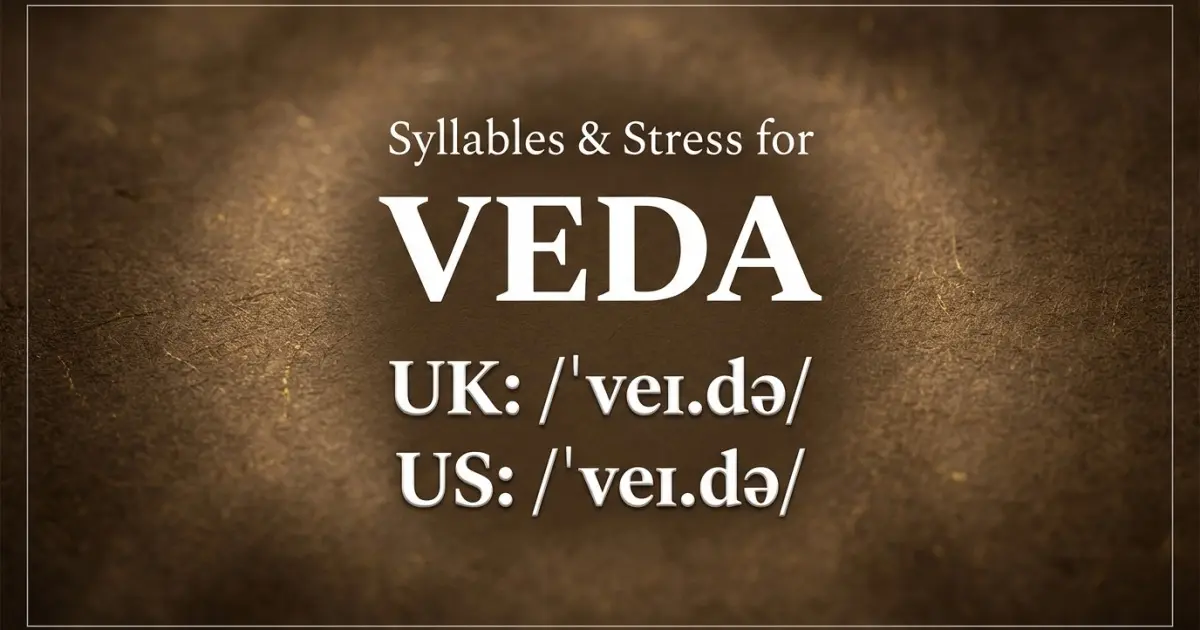
| IPA (US) | /ˈveɪdə/ | The stress mark at the front shows that the first syllable carries the weight. |
| IPA (UK) | /ˈveɪdə/ | The target pronunciation is effectively the same in standard U.S. and U.K. usage here. |
| Syllable count | 2 syllables | Keep it as two clean beats rather than rushing it into one blurred sound. |
| Main stress | First syllable: VAY | If the stress moves later, the name starts to sound uncertain or improvised. |
| Opening consonant | Voiced “v” fricative | Let the lips and teeth meet lightly so the sound hums instead of snaps. |
| Vowel quality | Long “ay” as in “day” | Do not flatten it into a short “e” sound. |
| Ending | Soft “duh” with a light final vowel | The second syllable should be easy and unstressed, not heavy or overpronounced. |
Why Veda sounds strongest when the front of the name carries the weight
Veda is a name that declares itself early. Unlike longer names that unfold gradually, Veda puts its main stress right at the front. That makes the name feel efficient, clear, and self-possessed. You hear the identity of the name almost immediately. Pronunciation lands more fully when the name’s roots and history are already in view, so begin with Veda meaning.
Veda is built on a bright first syllable
The first syllable, VAY, does most of the work. It begins with a v, which is a fricative. In accessible terms, that means the sound is made by narrowing the flow of air rather than stopping it completely. This gives Veda a smooth but definite opening. It is firmer than a breathy name, but softer than a name that begins with a hard k or t. Then comes the long ay vowel, which brightens the entire name. That combination is why Veda sounds clear rather than dull.
If speakers get that first syllable right, the rest usually follows naturally. The strongest mistake pattern happens when people misread the vowel and flatten it. Once that happens, the whole name changes color. The intended pronunciation is bright and forward, not closed or clipped.
The second syllable should release, not compete
The ending -duh is light. In everyday English terms, it should feel almost effortless after the stronger opening. The final vowel is not meant to be dramatic. It behaves more like a relaxed closing sound than a second focal point. That is one reason Veda sounds poised. It opens clearly and then settles.
When people overwork the second syllable, the name can start to sound heavier than it really is. The goal is balance: the first syllable leads, the second simply completes. Veda is not meant to sound chopped in half. It is meant to sound settled after its first bright lift.
Where Veda usually gets mispronounced
Because Veda is so short, most pronunciation mistakes come from assumption rather than difficulty. Readers see the spelling, connect it to a different sound pattern they already know, and move too quickly. A short name can invite that kind of overconfidence.
The most common mistake is flattening the vowel
The biggest error is turning VAY into something closer to VEH. This happens when people read the name as though the first vowel were short and plain. That pronunciation may feel visually plausible to some readers, but it does not match the intended sound pattern. Veda should open with the same long vowel heard in words like day or say.
This matters because the long vowel is part of what gives the name its brightness. Without it, Veda loses some of its clarity and starts to feel more muted. For families using the name, this is usually the one pronunciation point worth correcting early and consistently.
Some speakers overstate the ending
Another issue is putting too much emphasis on the final duh. When the second syllable becomes too strong, the name can sound heavier and more mechanical than intended. The stress belongs on the first syllable. The end should remain light.
That does not mean swallowing the final syllable. It should still be heard. But it is the quieter part of the name. A good mental model is this: Veda begins with certainty and ends with ease.
Spelling neighbors can push the ear in the wrong direction
Short names often get pulled toward better-known sound neighbors. With Veda, some people may unconsciously drift toward names or words they already know that begin similarly but carry different vowels or stresses. That is normal, especially on first reading. The solution is not overexplaining. It is simply offering the name once in its correct two-beat form: VAY-duh.
How Veda behaves across accents and everyday English
One reassuring feature of Veda is that the listed U.S. and U.K. IPA forms are the same: /ˈveɪdə/. In practical terms, that means the target pronunciation is highly stable across standard English-speaking contexts. Regional accents may color the exact texture of the vowels, but the structure of the name remains steady.
Accent differences change texture more than identity
An American speaker and a British speaker may not sound identical on every vowel, but both can still say Veda correctly. What matters most is preserving the long ay in the first syllable and the light unstressed final syllable. Those are the identity markers of the name. Accent variation may make the name warmer, brighter, flatter, or rounder in subtle ways, but it does not need to disturb the core pattern.
This portability is useful in real life. A name that can survive movement across regions without losing itself is easier to carry. Veda does that well. It is short enough to remember and structured enough to resist distortion once learned.
Sound neighbors can help, but only if they are used carefully
When helping someone learn the name, comparisons can sometimes be useful, but they should stay simple. The safest guide is the direct spoken form: VAY-duh. If you lean too heavily on analogies to other names, you risk pulling in extra sound baggage that does not belong there. The way the name resolves at the end often decides which short forms feel natural in speech, and that becomes clearer in nicknames for Veda.
The cleanest instruction is the simplest one. Two syllables. Stress on the first. Long ay. Light ending. That is really all the name needs.
Practice lines that make Veda feel natural fast
Pronunciation usually settles fastest when a name is spoken in ordinary sentences rather than repeated as an isolated sound. These lines help establish the rhythm naturally:
- “Veda is ready for class.”
- “Please welcome Veda to the stage.”
- “Veda left her book on the table.”
- “I love how clear Veda sounds when spoken aloud.”
When practicing, let the first syllable carry the energy and keep the second one light. If the name feels easy in a full sentence, it will usually remain easy everywhere else too.