
Tyrese Pronunciation: Speaking Tips for a Smoother Pronunciation

The real test of Tyrese often happens in a classroom doorway, on a sports roster, or at a front desk when someone sees the name before hearing it. The spelling looks modern and familiar enough to approach, but the rhythm matters: Tyrese is not meant to flatten into one quick blur. It has a clear rise, moving from the lighter opening ty into the stronger final syllable REESS.
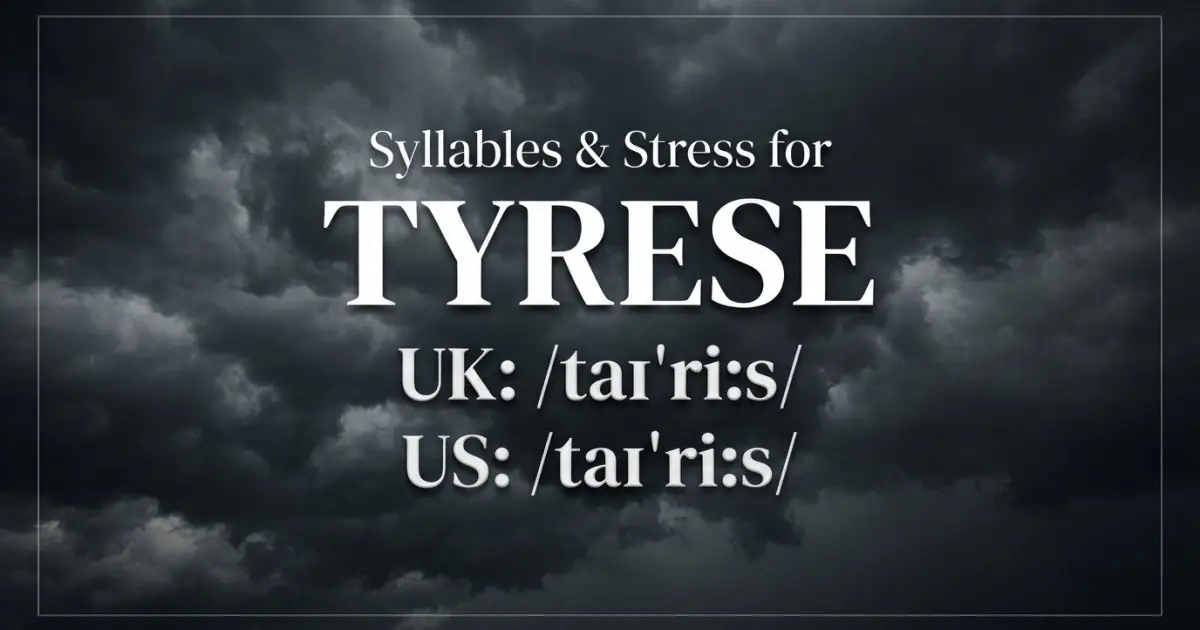
That second beat is the key. Tyrese is pronounced ty-REESS, with two syllables and the stress on the ending. Once the voice lands confidently on REESS, the name becomes easy to say, easy to remember, and smooth in everyday conversation.
Tyrese becomes simple when the final beat gets the emphasis
| Element | Phonetic Detail | Quick Tip |
|---|---|---|
| Standard pronunciation | ty-REESS | Say it like “tie” plus “reese,” with the stronger beat on “reese.” |
| Syllable count | 2 syllables | Keep it compact: ty + REESS. |
| Stress pattern | Second syllable stressed | The name should rise toward the ending, not hit hard at the start. |
| U.S. IPA | /taɪˈriːs/ | The mark before “riːs” shows that the stress belongs on the second syllable. |
| U.K. IPA | /taɪˈriːs/ | The listed U.S. and U.K. forms are the same, so the main difference is accent color, not structure. |
| Ending sound | Long “ee” plus final /s/ | Finish clearly: REESS, not “rez” or “rice.” |
The two syllables in Tyrese each have a different job
Tyrese works because the two syllables are not equal in weight. The first syllable, ty, is quick and light. It uses the same vowel sound heard in “tie” or “sky.” The second syllable, REESS, carries the stress, which means it receives more length, clarity, and vocal energy. The sound matters more once you know what the name is meant to carry, which is why the wider frame starts in Tyrese meaning.
The opening “Ty” should stay light
The first syllable should not be dragged out too much. Say ty cleanly, then move forward. If the first syllable becomes too heavy, the name can sound like TY-reese, which shifts the rhythm away from the intended pronunciation. Once the sound pattern is clear, some shortenings stop feeling optional and start feeling natural, and the clearest map is in Tyrese nicknames.
A helpful comparison is the difference between a launch and a landing. The opening ty launches the name. The ending REESS is where the voice lands. That landing is what gives Tyrese its smooth, modern sound.
The stressed “Reese” gives Tyrese its identity
The second syllable is pronounced like Reese. It uses a long “ee” sound, followed by a crisp final s. In linguistic terms, the final s is a fricative, which means air passes through a narrow space to create the sound. Parents do not need the technical term to pronounce the name, but it explains why the ending should feel clean rather than heavy.
The r in the second syllable also matters. In English, r is often described as a liquid consonant because it flows smoothly into nearby vowels. In Tyrese, that liquid sound helps the name move from the open ty into the bright ee vowel without feeling abrupt.
Tyrese sounds nearly the same across U.S. and U.K. pronunciation
The U.S. and U.K. IPA forms for Tyrese are both listed as /taɪˈriːs/. That means the core pronunciation remains stable: two syllables, first syllable like “tie,” second syllable stressed like “reese.” For most English speakers, the main differences will come from accent, not from a different pronunciation rule.
Where accents may color Tyrese
Some speakers may make the first vowel slightly broader or tighter depending on regional accent, but it should still remain the “eye” sound in ty. The second syllable should still keep the long “ee.” A British speaker and an American speaker may not sound identical when saying Tyrese, but both can preserve the same syllable structure.
The final s should remain voiceless, like the sound at the end of “peace.” It should not turn into a buzzing z sound. That distinction keeps Tyrese closer to ty-REESS and away from something like ty-REEZ.
Why stress matters more than accent
Most pronunciation issues with Tyrese are not caused by regional accents. They are caused by stress placement. If someone says the vowels a little differently because of accent, the name can still be recognizable. If someone puts the main emphasis on the wrong syllable, the name changes character more noticeably.
For that reason, the easiest correction is simple: “It’s ty-REESS, stress on the second part.” That gives the speaker everything they need without overexplaining.
The common mistakes with Tyrese are small but noticeable
Tyrese is not a difficult name, but its modern spelling can invite a few wrong guesses. Most mistakes come from reading too quickly, assuming a different stress pattern, or changing the final vowel.
Mistake one: saying TY-reese
The most common mistake is stressing the first syllable: TY-reese. This version is close enough to understand, but it changes the name’s rhythm. The correct form is ty-REESS, where the ending receives the stronger beat.
Mistake two: turning the ending into “rice”
Another possible mistake is reading the final part as if it rhymes with “rice.” That would make the name sound like ty-RICE. The correct ending is REESS, with the long “ee” vowel.
Mistake three: softening the ending into “rez”
Some speakers may reduce the final syllable into something closer to rez. That loses the clean vowel and the crisp final sound. Tyrese should end clearly: REESS.
Practice lines make Tyrese easier to say naturally
Practice helps because Tyrese is more about rhythm than difficulty. The goal is not to overpronounce every letter. The goal is to let the name rise naturally into the second syllable.
Slow practice
- Tyrese.
- ty-REESS.
- This is Tyrese.
- Tyrese is here.
- Please welcome Tyrese.
Everyday practice
- Tyrese, are you ready?
- I spoke with Tyrese today.
- Tyrese has a strong two-syllable rhythm.
- The name Tyrese ends like Reese.
For parents, teachers, and relatives, the simplest memory cue is this: Tyrese rhymes in part with “Reese,” and that part gets the emphasis. Once that is remembered, the name becomes straightforward in daily use.