
How to Pronounce Tristan: Clear Pronunciation Help for Everyday Use
You can hear the practical strength of Tristan in the kind of places where names are tested without warning: a teacher reading a roll sheet on the first day of school, a coach calling across a field, a pediatric nurse stepping into a waiting room, a graduation speaker trying to get one clean, confident version right in a crowded hall. Tristan usually survives those moments well. It looks more intricate than it sounds. Once spoken aloud, it tends to land quickly, with a crisp opening and a softer finish that makes it feel polished rather than heavy.
That balance is the real pronunciation story of Tristan. It is not a difficult name, but it does have a specific shape. The first syllable does the work. The second syllable relaxes. The stress sits clearly up front, and the ending should not be punched too hard. That is why Tristan sounds best when it is said as a natural two-beat name rather than a dramatic one. In everyday English, the winning version is usually the simplest one: TRIS-tun. It is clean, widely recognizable, and easy to carry from childhood into adult life without needing explanation every time it is spoken.
How Tristan Is Actually Said When People Get It Right
The pronunciation of Tristan becomes much easier once the name is broken into its small moving parts. What matters is not just the letters, but where the stress falls, how the vowel behaves, and how lightly the second syllable should be handled in natural speech.
| Element | Phonetic Detail | Quick Tip |
|---|---|---|
| Everyday pronunciation | TRIS-tun | Say the first syllable clearly, then let the second one soften and shorten. |
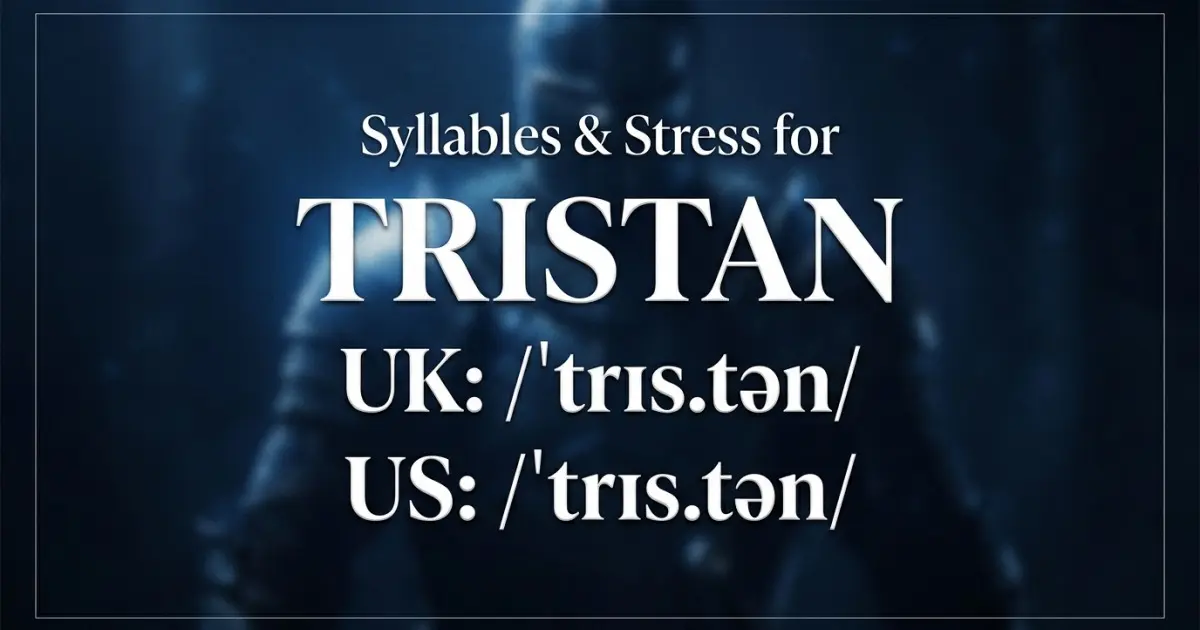
| IPA (U.S.) | /ˈtrɪstən/ | The stress mark at the front shows that the first syllable carries the name. |
| IPA (U.K.) | /ˈtrɪstən/ | In this case, U.S. and U.K. pronunciation align closely, which makes Tristan unusually portable. |
| Syllable count | 2 syllables | Think of it as a quick strong beat followed by a lighter echo. |
| Stress pattern | First syllable stressed | If you stress the second syllable, the name immediately starts to sound wrong in English. |
| First vowel | tris rhymes with “this” | Keep it short and relaxed, not drawn out like “trees” or “trice.” |
| Second syllable | -tun with a reduced vowel | The ending is usually softer than it looks on the page; do not overpronounce it as a full “tan.” |
| Consonant texture | tr opening, s fricative, light final n | The name sounds best when the opening stays crisp and the ending stays easy. |
Tristan Starts Strong and Finishes Light
The easiest way to master Tristan is to understand its architecture. This is a name with a strong front edge and a softened back edge. That is what makes it sound elegant rather than blunt. The sound matters more once you know what the name is meant to carry, which is why the wider frame starts in Tristan meaning.
The first syllable carries Tristan’s center of gravity
Tris is the stressed unit, and it does almost all the identity work of the name. The opening tr cluster gives Tristan a brisk launch. Linguistically, that cluster creates immediate forward motion. Then comes the s, a fricative consonant, which adds a clean hiss of definition before the name releases into the second syllable. This is why Tristan sounds alert and well-shaped even though it is not long.
The vowel in that first syllable is short: it is the same family of sound you hear in words like “this,” “list,” or “ship,” not in “tree” or “price.” If that vowel changes, Tristan changes with it. A long vowel makes the name sound artificial. A heavier vowel can make it drift toward another name entirely. The best version stays clipped and natural.
That first beat also explains why Tristan is easy to hear across a room. Names with vague openings often get blurred in real conversation. Tristan does not. The initial consonant blend makes the beginning distinct, which is especially useful in classrooms, sports, and public introductions.
Why the ending of Tristan should not be overworked
The second syllable, -tun, is where speakers most often overthink the name. In natural English pronunciation, that vowel is reduced. It is not usually a fully rounded, emphatic syllable. Instead, it settles into a softer sound, almost disappearing into the rhythm of the name. That lightness is what keeps Tristan from sounding stiff.
This is also where the IPA helps. The final part of /ˈtrɪstən/ shows a schwa-like reduced vowel in the unstressed position. In plain English, that means the second syllable should feel lighter than the spelling suggests. It should not come out as a sharp tan unless a speaker’s accent naturally pushes it in that direction. For most English-speaking parents, the safest spoken model is still TRIS-tun.
The final n matters too. It closes the name gently. There is no liquid consonant like l or r in the ending to stretch the line, so the finish stays neat and quiet. That tidy close is one reason Tristan sounds mature. It ends with control.
Where Tristan Gets Misheard, Flattened, or Overcorrected
Most pronunciation mistakes with Tristan come from one of three habits: treating the spelling too literally, shifting the stress, or overpronouncing the second syllable in an effort to sound careful.
The most common everyday slips
The first mistake is saying something closer to TRISS-tan. This version is understandable because the written form invites some speakers to give the second syllable a fuller a sound. But in everyday modern English, that heavier ending usually sounds less natural than TRIS-tun. It is not always shocking to the ear, but it does feel less settled.
A second slip is turning the first syllable too bright or too long, producing something like TREES-tun or TRICE-tun. Both versions distort the name’s balance. Tristan needs the short, grounded vowel up front to sound recognizably itself.
A third, less common error is stressing the second syllable. Once the emphasis moves away from Tris, the name stops sounding like standard English usage. Even speakers who cannot explain why will usually hear that something is off.
Accent differences without real confusion
One reason Tristan travels well is that accent differences do not usually disrupt its identity. American and British speakers may vary slightly in how relaxed the final vowel becomes, and some regional accents may give the ending a touch more weight. But the core pattern usually stays intact: first syllable stressed, short vowel in Tris, softened ending.
That makes Tristan more stable than many names with multiple accepted vowel patterns. Parents do not usually need to brace for major U.S.–U.K. divergence here. There may be tiny differences in texture, but not usually in the overall shape of the name.
Why overcorrection can make Tristan sound less elegant
Parents sometimes try to protect a name from mistakes by pronouncing every letter very deliberately. With Tristan, that instinct can backfire. If the second syllable is made too full, too careful, or too theatrical, the name loses the easy confidence that makes it appealing. Tristan is a name that sounds best when spoken clearly but not ceremonially.
In other words, accuracy matters, but ease matters too. The target is not a hyper-enunciated museum version of the name. It is the real-life version that sounds natural in ordinary speech.
Tristan Learns Best Beside Neighbor Sounds and Practice Lines
Many parents find that pronunciation clicks once a name is compared with familiar sound neighbors. Tristan is especially teachable this way because its opening syllable resembles simple everyday English sound patterns.
Sound neighbors that help Tristan settle into the ear
If you need a quick anchor, think of Tris as living near “this,” “kiss,” and “list” in vowel quality, not near “trees” or “tries.” Then let the ending fall away into a light -tun. That is usually enough to produce a stable, natural version of the full name. The way the name resolves at the end often decides which short forms feel natural in speech, and that becomes clearer in Tristan nicknames.
You can also think of Tristan as a name that begins with force and ends with air. The opening consonant cluster gives it structure. The reduced second syllable keeps it from sounding overly formal. That relationship is the heart of its pronunciation.
Practice lines that make Tristan easier to say aloud
Short practice lines are often more useful than abstract instruction because they train the mouth in connected speech. Try these out loud:
“Tristan is ready.”
“This is Tristan.”
“Tristan, your table is here.”
“We’re looking for Tristan.”
Each line reinforces the same rhythm: a clear stressed Tris, followed by a lighter second syllable. If the ending starts getting too heavy, shorten it again. If the first syllable becomes too long, bring it back toward the vowel in “this.” Most speakers will find the correct shape after just a few repetitions.