
Travis Name Meaning: Origin, Vibe, and Timeless Appeal
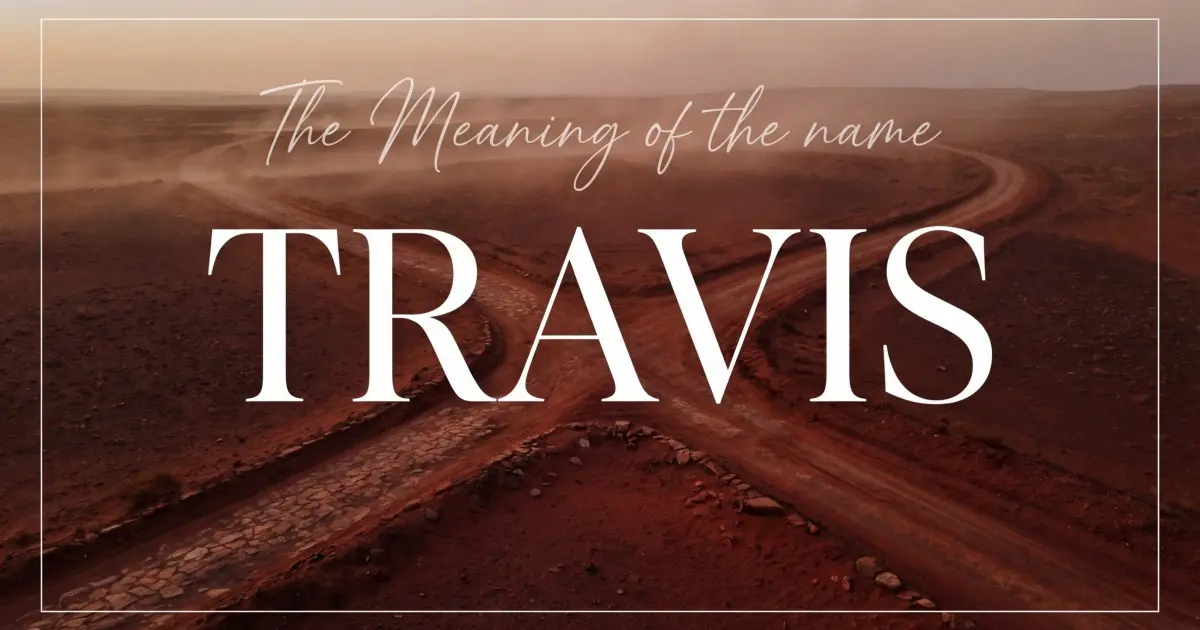
Travis is a name about thresholds. It does not begin with a castle, a crown, or a battlefield. It begins at the edge of a crossing: a bridge, a ford, a roadway, a place where movement must be watched, measured, or paid for. That is what makes the name more interesting than it first appears. “Toll-collector; to cross” sounds practical, almost bureaucratic, until you realize how much human life gathers at a crossing. Commerce gathers there. Risk gathers there. Travel, departure, arrival, reunion, migration, and exchange all gather there. Travis is not a name of fixed territory. It is a name of passage.
That central idea helps explain why Travis has remained so durable in English-speaking life. It carries work, motion, and supervision all at once. Official Social Security Administration (SSA) data shows it ranked No. 361 for U.S. boys in 2024, which places it in a useful middle zone: fully familiar, still current, but no longer so crowded that it feels like a generation’s default. Historically, naming references describe Travis as a surname rooted in French vocabulary linked to traversing, crossing a river or bridge, and collecting tolls. So while the modern ear often hears Travis as straightforwardly American, its deeper structure is older and more specific. It belongs to the person at the point where one side becomes another.
Travis's U.S. popularity rank over time, 1880–2024
Popularity statistics are based on official data from the Social Security Administration baby name records.
Travis: A Rugged and Reliable Crossing Pillar
Travis functions as a name with one unmistakable center of gravity in U.S. naming culture, with the boys’ side of the chart carrying nearly all of its public visibility. Reaching its massive peak in 1979, it remains a “safe but polished” favorite for parents who trust its independent, pioneering spirit and professional surname sound.
While historical traces exist in other tracks, its modern force belongs unmistakably to its primary lane. Meaning “crossing” or “tollgate-keeper,” its simple two-syllable structure provides a sense of durable character that has stood the test of time.
Why Travis still feels like a name in motion
| Key Facts | Information | Quick Insight |
|---|---|---|
| Name | Travis | The name sounds plainspoken and familiar, but its underlying image is surprisingly vivid and structural. |
| Primary usage | Male | Travis reads as strongly masculine in current use without sounding ornate or overengineered. |
| Primary origin | French | Its French background adds historical depth to a name that now feels thoroughly natural in English. |
| Core meaning | Toll-collector; to cross | This is a meaning of movement and mediation, not static power, which gives Travis a practical kind of strength. |
| Pronunciation | TRA-viss | The front-loaded stress makes the name sound brisk and grounded, which fits its working origins well. |
| Syllable count | 2 | Two syllables keep the name easy to say and widely usable without making it feel clipped. |
| U.S. boys’ rank (2024) | No. 361 | Travis remains clearly alive in use, but now carries more individuality than it did at peak ubiquity. |

Travis is a crossing name before it is anything else
Many names signal status. Travis signals function. That distinction matters. A toll collector is not a king, yet he stands at a point where movement must be acknowledged. A person who crosses, or makes crossing possible, belongs to the infrastructure of society. This gives Travis an unexpectedly social meaning. The name implies transaction, boundary, passage, and the practical management of human movement. It is less about domination than about interface.
That practical role gives the name more symbolic power than a quick reading might suggest. To cross is one of the oldest human actions. People cross rivers, borders, roads, thresholds, generations, and states of life. They cross from danger to safety, from home to elsewhere, from childhood to adulthood, from one community into another. A name built around crossing does not merely suggest travel. It suggests transition itself. Travis is therefore one of those rare names whose literal origin remains useful as metaphor. It is a name for movement with consequence. For related names from the same origin family, see names from French tradition.
The toll-collector aspect deepens that further. Historically, a toll collector is someone stationed at a point of exchange. That role implies responsibility, regulation, and a public-facing relationship with strangers. It is not glamorous work, but it is socially central. The person at the crossing must understand flow. He must recognize who comes through, what is carried, and what the crossing costs. That is why Travis often feels sturdier than more abstract names. Its origin is occupational, yes, but it is not trivial. It belongs to the machinery of human connection.

How Travis moved from a working surname into a lasting first name
Historically, naming references describe Travis as an English surname from French traverse, linked to crossing a bridge or river and to the occupational role of a toll collector. That pathway is important because it explains why the name feels both modern and settled. Like many strong English-language first names, Travis began as a surname tied to a real-world task and later moved into given-name use. It did not begin as an invented style statement. It began as social description.

The toll-keeper at the threshold
The occupational background gives Travis an earthbound credibility. Surname names often carry extra adulthood because they were shaped by work, geography, or lineage before they were ever chosen for babies. Travis inherits exactly that kind of seriousness. It is not merely a pleasing sound. It is the record of someone’s place in a working world. That can make the name feel more durable than names that rest entirely on trend or atmosphere.
There is also a curious dignity in this kind of origin. Some occupational names point to fabric, trade, or manual craft. Travis points to passage and regulation. It imagines a person standing where transit becomes accountable. That gives the name a surprisingly civic quality. It does not just imply movement. It implies managed movement.
From traverser to modern first name
Over time, as many surnames did, Travis shed the need to explain its occupational origin in everyday use. It became legible as a first name on sound alone. But the history did not vanish. It still lends the name texture. This is one reason Travis feels more substantial than some other two-syllable male names of similar familiarity. It has a built-in backstory. If you want to branch out from Travis without leaving this category, explore a wider list of boy names.
Modern naming references also connect Travis with ideas such as passage, crossroads, and traversal. Those related shades of meaning do not contradict the core definition. They widen it. The name becomes not only about the collector at the crossing, but about the crossing itself. That makes Travis an unusually rich surname-to-first-name evolution: occupational, geographic, and metaphorical at once.
Why Travis sounds grounded even though its meaning points toward motion
Phonetically, Travis does almost the opposite of what its meaning does. The meaning suggests movement and crossing. The sound suggests firmness and control. That contrast is one reason the name works so well. In American and British English alike, the pronunciation TRA-viss is front-stressed and clean. The opening consonant cluster Tr- gives immediate traction, the broad front vowel in the first syllable gives it body, and the light second syllable lets the name close without drag.
The sound of a name that plants its feet first
The strongest syllable comes first, which makes Travis feel practical and self-possessed. This front-loaded stress is common in English masculine names that read as straightforward and dependable. The name starts decisively and then resolves without flourish. There is no dramatic final stress, no lyrical tail, no ornamental elongation. Travis says what it needs to say and stops. That economy fits the working origin beautifully.
The internal sounds matter too. The r gives the opening cluster motion, but the name is anchored by the broad short vowel in Trav-. Then the second syllable, -iss, softens the close just enough to keep the name from becoming too blunt. In other words, Travis sounds firm, but not severe.
Why the phonetics help the meaning rather than contradict it
The sound of Travis may be grounded, but that groundedness actually helps the crossing meaning. A name about movement could easily become slippery or diffuse. Travis avoids that by sounding controlled. It feels like the person at the crossing rather than the chaos of the crossing itself. The phonetics give the name posture. They make it sound equal to the responsibility embedded in the meaning.
That is why Travis often feels more mature than some names built around travel, journey, or adventure. It does not romanticize movement. It administers it. The sound supports that social role perfectly.
Travis belongs to a family of movement names, but it is the most practical among them
Modern naming culture includes many names tied to roads, travel, and motion: Walker, Wade, Journey, Quest, Wilder, Brooks, and others. Travis belongs near them in symbolic territory, but it occupies a distinct position. Walker suggests the act of walking itself. Wade points toward a river crossing with more elemental simplicity. Wilder emphasizes untamed terrain. Brooks is scenic and flowing. Chance implies risk and opportunity. Travis, by contrast, feels institutional. It belongs to the crossing point, not the scenery around it.
This is one reason the name can feel especially grounded. It is not only about travel as romance or adventure. It is about passage as something that must be negotiated. That gives Travis an air of realism absent from many movement-adjacent names. It does not imagine the open road in abstraction. It imagines the exact place where the road narrows into a bridge or a gate.
Among its stylistic neighbors, Travis also reads as more rooted in the late-20th-century and early-21st-century American male naming field than some of the newer one-syllable alternatives. It is familiar without being currently overexposed. That helps it feel both settled and available. A boy named Travis is unlikely to be confused for a trend experiment, but the name still has enough room around it to feel individually chosen.
Travis in contemporary life feels familiar, but no longer automatic
Official SSA data showing Travis at No. 361 for U.S. boys in 2024 tells an important story about the name’s current social position. It is still in circulation, still recognizable, still fully viable. But it is no longer pressed into the most crowded naming tiers. That gives the name a useful kind of breathing room. Travis now sounds more intentional than it may have at moments of heavier popularity.
This shift matters because names often change their emotional value once they leave their peak. A name that once felt common can later feel stable, grounded, and refreshingly unforced. Travis benefits from exactly that transition. It has enough history in modern use to avoid seeming obscure, yet enough distance from peak saturation to recover some individuality. For many families, this is the ideal zone. The name is known, but not tired.
It also helps that Travis ages well. On a child, it sounds energetic and straightforward. On an adult, it sounds fully plausible in professional, social, and family settings. The name already contains adulthood because of its surname and occupational roots. It does not need reinvention to grow up.

Where Travis opens next
Middle names can either deepen Travis or sharpen its clean profile
Because Travis is compact and sturdy, middle names often do important balancing work. A longer, more historical middle can give the full name more breadth, while a shorter one can preserve its no-nonsense clarity. If you want the full pairing logic behind that contrast, see middle names for Travis.
Nicknames usually soften Travis rather than replace it
Travis is already easy to use in full, so nicknames tend to be relational and familiar rather than necessary. That gives the full name unusual stability across childhood and adulthood. To see how those different moods shorten in real life, explore Travis nicknames.
Pronunciation is one of Travis’s hidden advantages
The name is easy to say, easy to spell, and highly stable across accents. That practical clarity strengthens its social durability more than many parents first realize. If you want the full sound pattern behind that rhythm, read Travis pronunciation guide.
Why Travis still carries such quiet force
The deepest strength of Travis is that it turns an ordinary social function into lasting symbolism. A crossing is never merely a road detail. It is the place where decisions are made, where movement becomes visible, where one side yields to another. A toll collector stands at that point not as a conqueror, but as a mediator of passage. That makes Travis a name of transition with authority, not a name of authority detached from the world.
In literary terms, Travis feels like a name for someone positioned where things change. It is practical enough to avoid myth, yet symbolic enough to carry more than its literal origin. It begins in work, grows into movement, and ends in a surprisingly rich image of human life as crossing after crossing. That is why the name lasts. Travis does not need grandeur to matter. It already stands where people pass from one place into another. And that is what gives Travis its enduring power: it sounds like a threshold made personal.