
How to Pronounce Timothy: What People Often Get Wrong
The first real test of Timothy’s pronunciation does not happen in a dictionary. It happens in ordinary rooms: a teacher reading a class list on the first morning of school, a nurse calling the next patient, a grandparent seeing the name written down before hearing it aloud, a coach saying it quickly enough that the child has to recognize himself inside the sound. Timothy generally does well in those moments because it is familiar, established, and built from speech patterns English speakers already know. That matters. A traditional name can carry history beautifully, but if people hesitate over it every time they meet it, daily life becomes heavier than the meaning deserves.
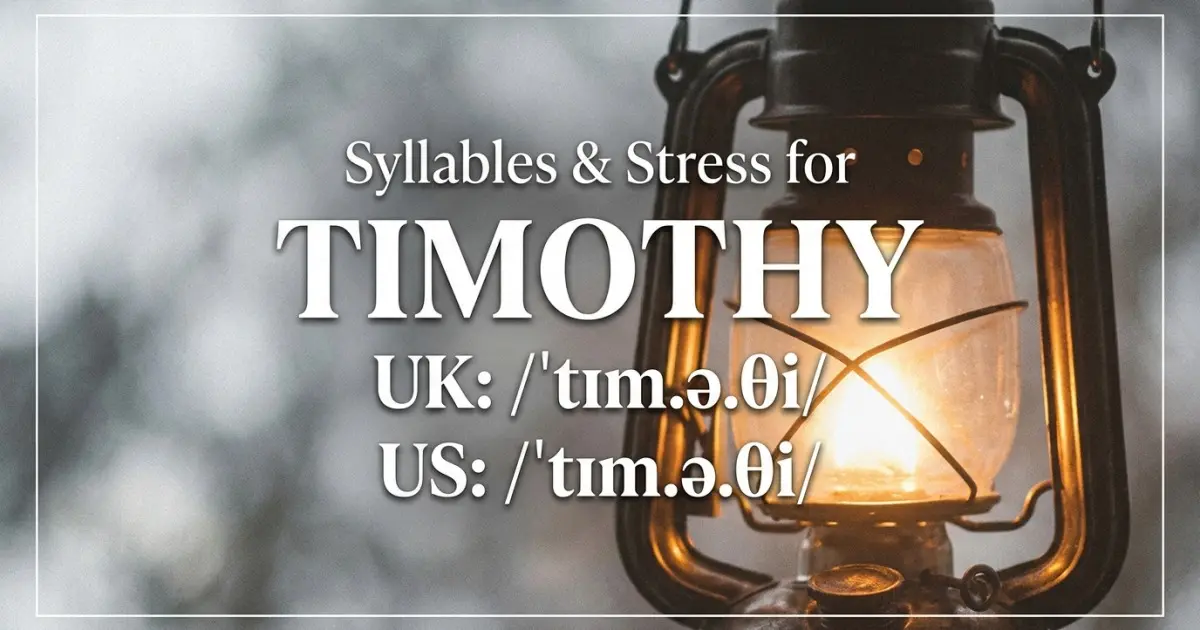
Timothy avoids that problem. In everyday English, it is pronounced TIM-uh-thee. In both American and British IPA, that appears as /ˈtɪməθi/. The first syllable carries the stress, and the following two syllables soften and narrow behind it. That pattern is one reason the name remains so usable. Timothy sounds respectful and full without becoming stiff. It has three syllables, but they do not march. They flow. Once that rhythm is heard correctly, the name feels exactly as it should: warm, clear, and stable.
How Timothy is actually said when people say it naturally
Before looking at mistakes or accent notes, it helps to see the structure of the name plainly. Timothy is not difficult, but it does sound best when the stress and softness are placed in the right spots.
| Element | Phonetic Detail | Quick Tip |
|---|---|---|
| Everyday pronunciation | TIM-uh-thee | Keep the first syllable clear and strongest, then let the name relax as it continues. |
| IPA (U.S.) | /ˈtɪməθi/ | The stress mark shows the opening syllable is the anchor of the whole name. |
| IPA (U.K.) | /ˈtɪməθi/ | British and American pronunciation align almost perfectly here. |
| Syllable count | 3 syllables | Think one strong beat followed by two lighter beats. |
| Stress pattern | First-syllable stress | Do not flatten the name into three equal parts. |
| Opening sound | /tɪm/ | The first syllable rhymes with him and trim. |
| Middle syllable | /ə/ | The middle is a reduced vowel, more like a soft uh than a strong separate syllable. |
| Final syllable | /θi/ | The last syllable begins with the unvoiced th sound heard in thin, then ends like thee. |
| Closest sound cue | “tim” + “uh” + “thee” | If the first part is firm and the middle light, the name will sound natural. |
Timothy works because the first syllable leads and the rest opens
The strongest part of Timothy is the opening TIM. That syllable carries the identity of the name. It begins with a crisp /t/, moves through the short vowel /ɪ/, and closes on /m/, which gives the name immediate steadiness. Then comes the middle syllable, which reduces to a soft schwa. That reduction matters. It is one of the most natural things English does with unstressed vowels, and Timothy depends on it. If speakers try to give the middle syllable too much shape, the name starts sounding more mechanical than lived-in. Pronunciation lands more fully when the name’s roots and history are already in view, so begin with Timothy meaning.
The final syllable brings the most distinctive sound in the whole name: /θ/, the unvoiced th fricative. A fricative is a consonant made by letting air pass through a narrow gap rather than stopping it entirely. In simple terms, it is a flowing sound rather than a hard one. That is one reason Timothy ends more gently than many classic boys’ names. The name does not slam shut. It opens out into air and then finishes on a clear vowel.
Why the middle syllable should stay light
When the middle syllable becomes too strong, Timothy can sound as though it is being read from a spelling sheet instead of spoken naturally. English rhythm prefers the first beat to dominate here. The middle is real, but it should not compete. A natural Timothy has one clear front edge and a softer center.
Why the “th” gives Timothy its character
If Timothy ended with a harder consonant, the whole emotional temperature of the name would change. The th fricative softens the exit. It keeps the name articulate without making it sharp. That is one of the reasons Timothy sounds respectful and warm rather than severe.
Where Timothy can go wrong when speakers trust the spelling too literally
Timothy is familiar, but familiarity can sometimes encourage overconfidence. The common mistakes are not dramatic. They are usually small distortions of rhythm or of the final consonant sound.
Mistake pattern one: making every syllable equally strong
The most common problem is flattening the rhythm into three equally weighted parts: TIM-OH-THEE or something similarly over-articulated. That kind of carefulness feels understandable when someone is trying to be correct, but it does not sound natural. Timothy needs one strong opening beat and two lighter follow-up beats.
Mistake pattern two: losing the real “th”
Another mistake is replacing the th with a hard t or d sound. That can happen when the speaker is moving quickly or comes from an accent background where the th fricative is less stable. In standard English pronunciation here, the ending should still use the /θ/ sound, as in thin.
Mistake pattern three: over-rounding the last syllable
Some speakers may make the final syllable too formal or too elongated, as though the name ends in a highly emphatic -thee. The last syllable should be clear, but it is not supposed to overpower the name. Timothy sounds best when the ending is audible and light, not theatrical.
Timothy across accents stays remarkably steady
One practical strength of Timothy is that the American and British IPA forms are identical in the provided facts. That tells you something important: the backbone of the name is highly stable across major English-speaking contexts. Parents do not need to worry that Timothy will become a different-sounding name once it crosses a border or enters a new school system.
Accent differences are mostly about texture, not structure
In everyday life, some accents may shorten the middle vowel a touch more, or make the final vowel slightly tighter or looser. Some may articulate the th more crisply than others. But these are surface differences. The essential shape of the name remains intact: TIM-uh-thee, with the first syllable leading and the ending opening gently.
Why Timothy travels well in public life
Timothy succeeds because it uses very familiar English rhythms even while carrying classical depth. Teachers, relatives, employers, and strangers usually know what to do with it. That makes the name highly portable. It feels established without ever becoming phonetically difficult.
Timothy becomes even easier when you hear it beside its sound neighbors
Comparison often clarifies pronunciation faster than rules. Timothy begins with the same opening sound as Tim, of course, and that is no accident. The formal name grows naturally out of the short form. It also shares some of its gentleness with names like Jeremy or Zachary, which also open strongly and then relax into softer final syllables. But Timothy remains distinct because of its th ending, which gives the name a more classical and slightly more devotional sound profile. Because the strongest energy lands early, the shorter forms often grow from the opening of the name, and that pattern is easier to see in Timothy nicknames.
That comparison matters because it shows why Timothy feels both familiar and specific. It belongs to a known family of English names, but it still keeps a sound marker that listeners notice. The result is a name that is easy to place without becoming generic.
How to practice Timothy until it feels fully natural
Practice help that follows the real stress pattern
Start by saying the first syllable alone: Tim. Then add the reduced middle: uh. Then finish with thee, making sure the th sound is the same one you would use at the start of thin. Once those three pieces feel comfortable, say the whole name at natural speed: Timothy.
A useful reminder is that the middle should almost disappear into the movement of the name. If the whole form starts sounding too segmented, it usually means the second syllable is being pronounced too heavily.
Practice lines that sound like real life
“Timothy, it’s your turn.”
“Have you met Timothy yet?”
“Timothy left his notebook here.”
“This one belongs to Timothy.”
Practice lines matter because some names feel easy in isolation and then shift shape in real sentences. Timothy generally holds together beautifully in connected speech. Once the first syllable is secure and the middle stays light, the rest of the name tends to fall into place on its own.
Why Timothy sounds respectful without sounding rigid
The larger pronunciation story of Timothy is one of balance. The opening syllable gives the name structure and familiarity. The reduced middle keeps it natural. The final fricative opens the ending instead of closing it hard. That combination is why Timothy sounds warm, dignified, and easy to live with all at once.
It also explains the name’s endurance. Timothy does not depend on novelty, dramatic stress, or rare sounds. It depends on the opposite: familiar rhythm, clear pronunciation, and a finish that feels gentle rather than blunt. Say the first syllable firmly, keep the middle soft, let the th breathe, and Timothy becomes exactly what it has long been in everyday life: stable, gracious, and easy to carry.
Common Questions About Pronouncing Timothy
Is Timothy pronounced the same in American and British English?
Yes, in the provided facts both are given as /ˈtɪməθi/. Small accent differences may affect texture slightly, but the overall pronunciation pattern stays the same.
Which syllable is stressed in Timothy?
The first syllable is stressed, so the name should sound like TIM-uh-thee, with the last two syllables lighter.
What is the most common pronunciation mistake with Timothy?
The most common issue is over-pronouncing all three syllables equally or losing the soft th sound at the end. In natural speech, the middle reduces and the final consonant remains a true th fricative.
Is Timothy generally easy for teachers and relatives to say?
Usually yes. Timothy follows a very familiar English rhythm and uses common sounds, so most speakers can pronounce it correctly after hearing it once, and many will get it right from the page.