
How to Pronounce Tiana: A Beginner-Friendly Pronunciation Walkthrough
Tiana is the kind of name that gets tested in public long before anyone thinks of it as a phonetic object. A teacher meets it on a classroom roll and has one second to decide where the stress falls. A nurse calls it from a waiting room. A graduation announcer reads it after a dozen familiar names and either lands it cleanly or flattens its elegance. That is where pronunciation becomes more than technical detail. A name either survives those ordinary moments with ease or starts gathering corrections. Tiana can survive them beautifully, but only if the speaker understands one crucial thing: the name does not bloom at the front. It opens lightly and then lands in the middle.
That middle landing is what gives Tiana its grace. Spoken correctly, tee-AHN-uh has motion in it. The first syllable is bright but brief. The second carries the warmth and weight. The last syllable softens the exit. This is why Tiana sounds more fluid than blunt, and more poised than many other three-syllable names. It is not difficult, but it is shaped. Once you hear that shape clearly, the whole name starts making sense—not only as sound, but as social presence.
What Tiana’s sound pattern is actually clarifying
| Element | Phonetic Detail | Quick Tip |
|---|---|---|
| Everyday pronunciation | tee-AHN-uh | Keep the first syllable light and let the middle syllable carry the emphasis. |
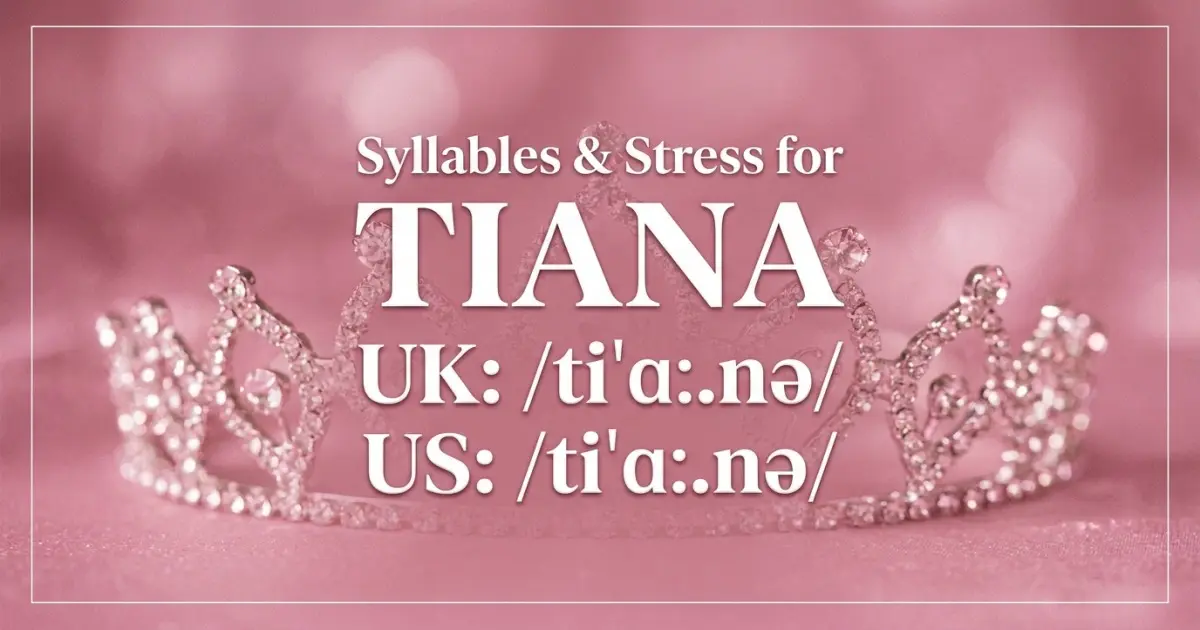
| IPA (US) | /tiˈɑːnə/ | The stress mark before the second syllable shows exactly where the name should land. |
| IPA (UK) | /tiˈɑːnə/ | The standard British form matches the American one, which makes Tiana unusually stable across accents. |
| Syllable count | 3 syllables | Think of it as tee + AHN + uh, not as TEE-anna and not as tee-ANN-uh. |
| Stress pattern | Weak-strong-weak | The middle syllable is the anchor; the other two should support it, not compete with it. |
| Opening vowel | /i/ sound | The first syllable sounds like “tea,” which gives the name brightness at the start. |
| Core vowel | /ɑː/ sound | The middle syllable should sound open and warm, like “ahn,” not clipped or nasal. |
| Final ending | Schwa /ə/ | The last syllable should relax gently, like the final sound in “sofa.” |
How Tiana moves through everyday speech
In ordinary English speech, Tiana is pronounced tee-AHN-uh. The first syllable introduces the name. The second gives it body. The third releases it. That three-part motion is why the name sounds elegant without being fussy. It does not arrive in one hard block. It unfolds. Pronunciation lands more fully when the name’s roots and history are already in view, so begin with Tiana meaning.
Tiana begins with brightness, not force
The opening tee is clean and high. It uses the close front vowel /i/, the same sound heard in “see” or “tea.” This gives Tiana a bright, alert opening. There is no heavy consonant cluster at the start, no fricative drag, no roughness. The initial t is crisp, and the vowel that follows makes the first syllable feel light rather than heavy.
This matters because it sets up the name’s elegance. Tiana does not begin like a blunt command. It begins like an invitation. Speakers who overemphasize that first syllable can make the name sound flatter than it really is. The beginning should be clear, but not dominant.
The middle of Tiana is where the name truly lives
The stressed syllable AHN is the heart of the name. In phonetic terms, this open vowel /ɑː/ gives Tiana warmth and depth. Socially, it is also what makes the name sound graceful rather than clipped. Without that middle syllable carrying the stress, Tiana would lose much of its poise.
This is why the name should never be rushed into something like “TEE-anna.” That front-loaded reading changes the whole rhythm. tee-AHN-uh lets the name gather in the middle, which is what gives it its balance.
Why Tiana rises in the middle
The standard pronunciation in both the U.S. and the U.K. is /tiˈɑːnə/. The most important symbol in that transcription is the stress mark before the second syllable. Tiana is a weak-strong-weak name. In practical terms, that means the voice lifts and settles in the center.
The middle stress keeps Tiana elegant
Names with center stress often feel more fluid than names that slam their weight at the front. Tiana benefits enormously from that pattern. The first syllable is bright but passing. The middle syllable expands. The final syllable softens. Together, that produces a name that sounds polished without sounding formal in a stiff way.
It also helps Tiana avoid one of the main risks of names associated with royalty or fantasy: sounding too theatrical. The controlled rhythm keeps the name human. It sounds beautiful in real speech, not just on paper.
The final syllable should relax, not perform
The ending uh is a schwa, the most relaxed vowel in English. Its job is not to demand attention. Its job is to let the name land gently. This is important because some speakers, especially when reading a name carefully for the first time, may over-articulate the last syllable and turn it into something heavier or sharper than intended. Tiana works best when the ending is soft and unforced.
A good way to hear it is this: the first syllable opens the door, the second is the room, and the third is the curtain closing behind you. The name should feel finished, not chopped.
Where Tiana stays stable across accents
One of Tiana’s quiet strengths is that the standard American and British pronunciations match: /tiˈɑːnə/. That kind of stability is not guaranteed, especially for names with international or lyrical styling. Here, though, the stress pattern and the core vowel target remain the same.
Tiana sounds largely the same in major English-speaking settings
In both the U.S. and the U.K., the first syllable still sounds like “tea,” the middle still carries the open ahn sound, and the final syllable still relaxes into schwa. That makes Tiana highly portable. It does not need one home pronunciation and another public one. Most English speakers are aiming at the same basic sound.
Accent differences are more texture than identity
Real speech will always introduce small differences. One speaker may make the first vowel slightly tenser, another may let the final schwa sound a touch fuller, and regional speech can color how open the middle vowel feels. But these are accent textures inside the same pronunciation, not competing versions of the name.
Because Tiana has no liquid consonant like r or l shaping the center, and no fricative cluster complicating the flow, it holds its identity well across accents. That is one reason it tends to sound smooth in so many English-speaking environments.
What people get wrong with Tiana, and how to fix it fast
Tiana is not hard, but it is vulnerable to a few predictable mistakes. Most come from people assuming the stress belongs somewhere else or trying to simplify the name into a more familiar pattern.
The most common mistake is front-loading the stress
The most likely misstep is turning Tiana into “TEE-anna,” with too much weight on the first syllable and too little on the second. That pronunciation sounds flatter and less graceful because it ignores the name’s true architecture. The fix is simple: keep the first syllable light and let the voice open on AHN.
Another mistake is clipping the middle vowel
If the middle syllable becomes too short, too nasal, or too tight, Tiana loses warmth. The center of the name should sound open and rounded. Not dragged out theatrically, but not pinched either. A good target is “ahn,” as in a calm, open exhale.
Practice lines that make Tiana feel natural
The best way to settle the pronunciation is to use it in living sentences: “Tiana is here.” “Have you met Tiana?” “Tiana, your table is ready.” “Thank you, Tiana.” These phrases naturally reinforce the weak-strong-weak rhythm. Once the name is heard in context, its balance becomes much clearer. The way the name resolves at the end often decides which short forms feel natural in speech, and that becomes clearer in nicknames for Tiana.
A useful mouth-feel guide is this: start with bright tee, open fully into AHN, then let the last syllable fall away softly. The whole name should feel like one smooth curve, not three equally weighted pieces.