
How to Pronounce Thomas: An Easy Sound-by-Sound Breakdown
The easiest way to understand how Thomas is pronounced is to picture a place where nobody has time for rehearsal. A teacher reaches the middle of a class roster and says it in one clean motion. A doctor calls it from a waiting room. A referee or coach sends it across a field. Thomas survives those moments well because it is both familiar and structurally strong. It does not ask the speaker to do anything unusual once the basic English pattern is known. The spelling may look older than the sound, but the spoken form itself is direct and stable.
That stability is part of the reason Thomas has lasted so well. Official data shows it remained one of the most established boys’ names in the United States in 2024, and names that stay active that long often do so because they are easy to carry in public speech. Thomas is a good example. It has two syllables, a clear first stress, and a softened ending that keeps the name from sounding too hard. The interesting wrinkle is that the spelling suggests more complexity than the pronunciation actually delivers. The name looks slightly formal, but in the mouth it is plain, grounded, and easy to repeat.
What Thomas Is Actually Doing When People Say It Correctly
The guide below clarifies the spoken structure behind the standard English pronunciation of Thomas.
| Element | Phonetic Detail | Quick Tip |
|---|---|---|
| Common spoken form | TOM-uhs | Put the strongest beat on TOM, then let the second syllable relax. |
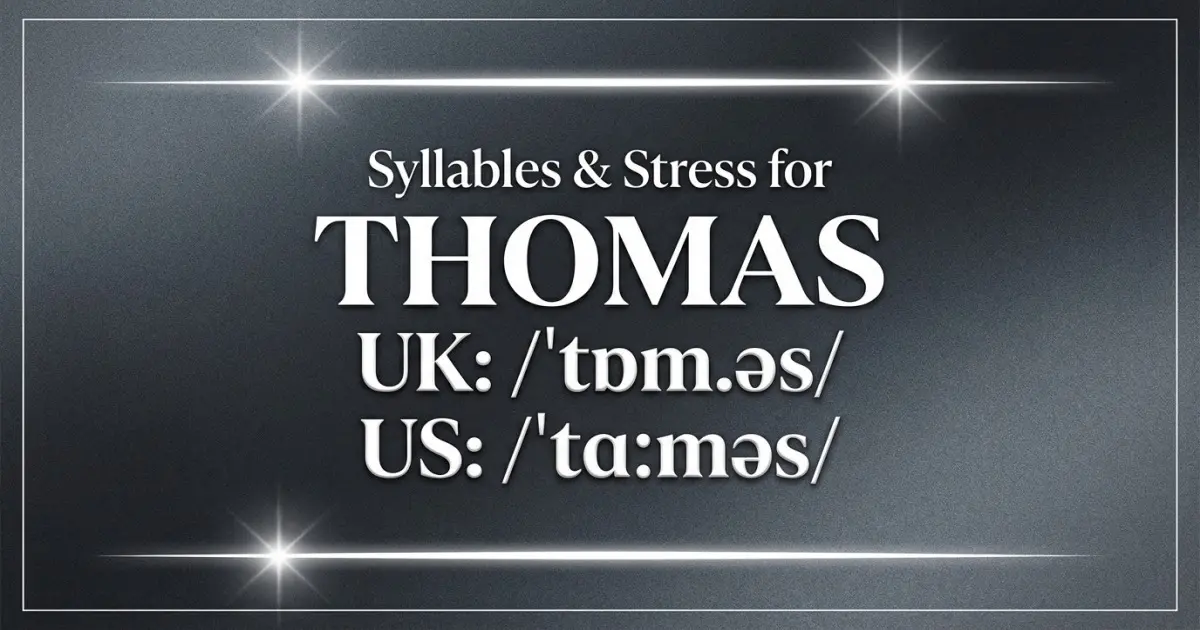
| U.S. IPA | /ˈtɑːməs/ | The main stress falls on the first syllable, and the second syllable reduces to a softer vowel sound. |
| U.K. IPA | /ˈtɒməs/ | The first vowel is slightly different in quality, but the rhythm stays the same. |
| Syllable count | 2 syllables | Hear it as TOM – uhs, not as one compressed block. |
| Stress pattern | First-syllable stress | The opening carries the name. The second syllable should support it, not compete with it. |
| Spelling note | The h is silent in standard English Thomas | Do not pronounce the name like Thaw-mas or with a separate th sound. |
Why Thomas Sounds Simpler Than It Looks on the Page
Thomas is one of those names whose spelling carries history while the pronunciation carries ease. The visual form may tempt some readers to expect the th of think or this, but standard English Thomas does not work that way. The name begins with a plain t sound. In practical terms, the h is silent. That single fact explains most of the confusion people have the first time they look closely at the name. Before focusing only on syllables and stress, it helps to step back into the fuller frame of Thomas meaning.
Thomas starts with a firm stop, not a fricative
The initial sound in Thomas is a stop consonant: t. A stop is made by briefly blocking the airflow and releasing it cleanly. That gives Thomas a strong, stable opening. It does not begin with a fricative like the th sound in thin or this, where air passes through a narrow gap and creates friction. This distinction matters because many spelling-based misreadings come from treating Thomas as though the letters th must behave the same way they do in ordinary English words such as thing or then.
Once you know that the first sound is simply T, the name becomes much more straightforward. The opening syllable is Tom, and that syllable carries the main stress. That is why Thomas feels so solid in speech. The most important information arrives immediately.
The second syllable is softer by design
After the strong opening comes a reduced second syllable, usually something close to uhs. In both American and British English, the back half of Thomas is lighter than the front. This is one reason the name sounds mature and balanced. It does not hammer both syllables equally. It starts with authority and then releases.
The second vowel is often a schwa-like sound, the relaxed vowel English uses in many unstressed syllables. That makes Thomas easy to say at normal speed. You do not need to over-articulate the ending. In fact, over-pronouncing the second syllable usually makes the name sound less natural, not more.
The nasal middle keeps Thomas grounded
The m in the first syllable is a nasal consonant, which adds softness inside the name without weakening it. That detail helps explain Thomas’s personality in sound. The name starts firmly, but the nasal center stops it from feeling harsh. The result is a spoken form that feels strong, calm, and dependable rather than sharp or aggressive.
Thomas Across Accents Keeps the Same Basic Shape
Thomas changes slightly between American and British English, but not in a way that alters its identity. The main difference lies in the vowel of the first syllable. In American English, the opening often sounds like /ˈtɑːməs/. In British English, it more often sounds like /ˈtɒməs/. To most listeners, though, the name still behaves the same way: strong first syllable, softer second syllable, silent h.
The U.S. and U.K. versions are rhythmically identical
This is the important point. The vowel color may shift, but the rhythm does not. In both accents, Thomas remains a two-syllable name with primary stress on the first beat. That shared architecture is why the name travels so easily. It may sound slightly different in tone, but it does not feel like a different name.
What listeners actually notice in conversation
In ordinary conversation, most people notice stress and syllable count more than fine IPA distinctions. Thomas succeeds across accents because those larger features remain stable. A speaker from London and a speaker from Chicago may shape the opening vowel differently, but both are still clearly saying Thomas. The name’s internal design is doing the real work.
Why Thomas feels familiar in public life
Names that are easy across accents tend to feel institutionally strong. They work in schools, workplaces, introductions, and formal announcements without much correction. Thomas belongs to that category. It is old enough to carry history, but phonetically simple enough to survive modern public speech without friction.
Where Thomas Gets Misread and How to Fix It Gently
Most pronunciation mistakes with Thomas come from spelling, not from the sound itself. Once the name is heard aloud, confusion usually disappears quickly.
When the th is pronounced like an English word
The most common mistake is assuming the first letters must sound like the th in thin or this. That leads to versions that feel overly literal to the spelling and wrong in standard English use. The correction is simple: drop the idea of a separate h sound and start with plain TOM.
When the second syllable is made too heavy
Another mistake is over-emphasizing the ending, turning Thomas into something closer to TOM-ASS or another over-separated form. Standard English Thomas keeps the second syllable reduced. It should be audible, but not dominant. If the first syllable sounds like the name’s center of gravity, you are close to the natural pronunciation.
When Thomas is confused with related forms
Thomas can sometimes blur with related names such as Tomas or Tomás, especially in writing. These names are connected historically, but they do not always share exactly the same pronunciation in every language or cultural context. In English, Thomas usually stays with TOM-uhs. That is why it helps to think of English Thomas as its own settled form rather than as a direct copy of every international relative.
Thomas in Real Speech: practice lines that reveal the rhythm
The best way to test a name is to place it in ordinary sentences. A good pronunciation should survive casual conversation, formal introductions, and quick spoken instructions.
Practice lines for hearing the natural stress
- Thomas will join us after lunch.
- Please ask Thomas to call back.
- Thomas Reed is waiting in the lobby.
- I saved this seat for Thomas.
- Thomas said the meeting starts at noon.
What these sentences make clear
In each example, the first syllable carries the name forward and the second syllable resolves it. That is the pattern to listen for. If the opening sounds strong and the ending stays light, Thomas will sound natural in almost any setting. The name does not need dramatic performance. It needs proportion.
That is the real lesson of Thomas. It is a historically deep name whose modern pronunciation is unexpectedly plain. The spelling hints at age and tradition, but the spoken form is economical, calm, and durable. That combination is one of the reasons Thomas has lasted so well: it looks serious, sounds easy, and stays recognizable wherever ordinary English is spoken.