
Theodore Pronunciation: How to Say It with More Confidence

The real pronunciation test for Theodore happens before anyone opens a dictionary. It happens when a teacher pauses over the first class roster, sees a long formal name, and decides whether to say the full version or retreat into Theo. It happens when grandparents try the name after hearing it once, or when a parent calls across a playground and needs all three syllables to travel clearly. Theodore passes that test because it sounds larger than most current boys’ names, but not harder. Even at full length, it remains orderly in the mouth.
That order matters. Official data shows Theodore remained one of the most visible boys’ names in the United States in 2024, and high visibility tends to stabilize pronunciation in public life. Most English speakers already have a working spoken version in mind. Still, Theodore is more interesting than it first appears. It opens with a soft fricative, stretches through a bright first syllable, relaxes in the middle, and lands differently depending on accent. That is why Theodore can sound warm and stately at the same time. The name has breadth, but it also has internal rhythm.
What Theodore’s Full Sound Is Actually Telling You
| Element | Phonetic Detail | Quick Tip |
|---|---|---|
| Everyday pronunciation | THEE-uh-dor | Say it in three clear beats, with the first syllable leading the whole name. |
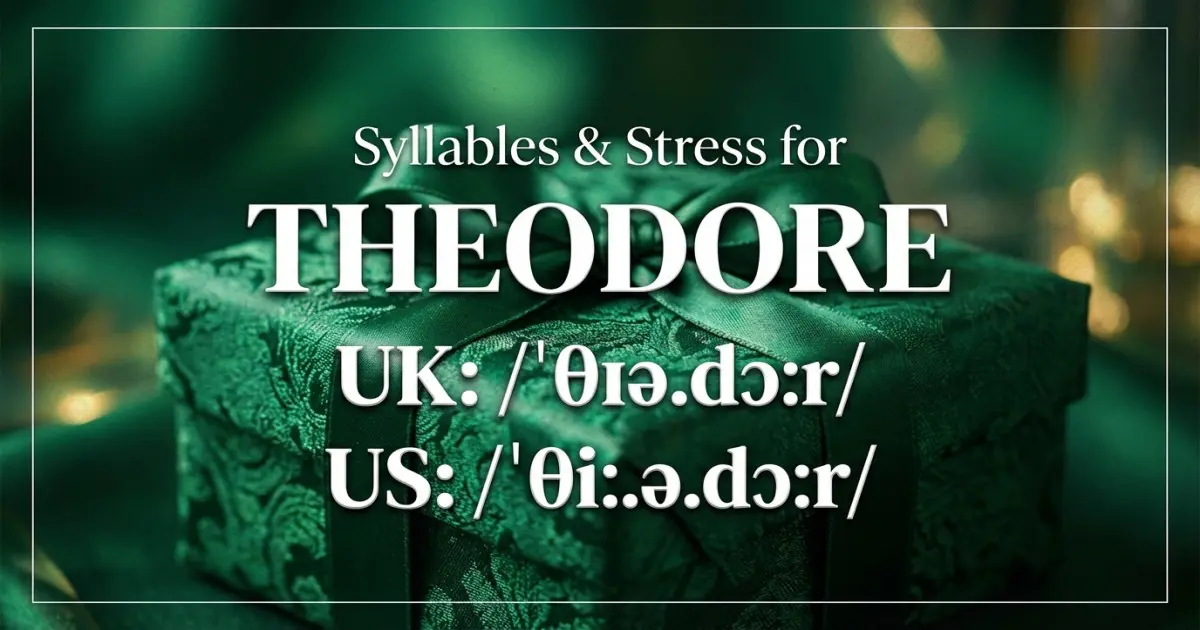
| US IPA | /ˈθiːəˌdɔːr/ | In American English, the final syllable often feels a little firmer because the r is pronounced. |
| UK IPA | /ˈθiːədɔː/ | In many British pronunciations, the ending is softer because the final r is not heard. |
| Syllable count | 3 syllables | Keep all three syllables audible. Theodore should feel generous, not rushed. |
| Main stress | Primary stress on the first syllable | The name begins with its strongest pulse. The rest of the name should flow from that opening. |
| Key consonants | Opening /θ/ fricative, ending liquid /r/ in rhotic accents | The soft th keeps the start refined, while the final r can make the ending feel more grounded in American speech. |
| Common drift | Dropping the middle syllable or overcompressing the ending | Do not flatten Theodore into two beats. The middle syllable matters for the name’s warmth. |
How Theodore Moves Through Everyday Speech
Theodore works because it is long without being loose. Many three-syllable names either spill outward or become stiffly formal when fully pronounced. Theodore avoids both outcomes. Its structure is controlled: a bright opening, a lighter middle, and a deeper ending. That sequence is what gives the name its dignified but usable sound. Pronunciation lands more fully when the name’s roots and history are already in view, so begin with Theodore meaning.
Why the opening of Theodore feels clear, not harsh
The first sound in Theodore is /θ/, the voiceless fricative heard in words like think and thin. A fricative is made by forcing air through a narrow passage, so the sound has a soft friction rather than a hard stop. That matters because Theodore begins with breath and definition, not with a blunt impact. The opening feels polished rather than aggressive.
Then comes the long /iː/ vowel, the sound in see or tree. This gives the first syllable its brightness. Theodore does not begin in darkness or weight. It begins in light. That is why the first syllable should never be clipped too tightly. If the opening becomes too short, the name loses much of its elegance.
Why the middle syllable keeps Theodore human
The middle uh syllable is easy to underestimate because it is not the most dramatic part of the name. But it is crucial. Without it, Theodore would feel more abrupt and more mechanical. That middle syllable creates space between the bright beginning and the heavier end. It keeps the name from sounding like a title. It makes the full pronunciation feel warm and inhabited.
This is also why Theodore should not be rushed into something like THEE-dor in careful speech. People may reduce names casually in fast conversation, but the full form is at its best when the middle syllable stays audible. That small vowel is part of the name’s generosity.
Why the ending gives Theodore its dignity
The final syllable carries the darker vowel and, in American English, the audible r. That ending is what grounds the whole name. After the open first syllable and the lighter middle, the final dor provides weight. In British pronunciation, the final syllable softens because the r is not usually pronounced, but the underlying effect remains the same: Theodore lands with more gravity than it began with.
That landing is one reason Theodore sounds so balanced. It starts bright and ends substantial. The arc feels intentional.
Where Theodore Changes Color Across Accents
The supplied American and British pronunciations are very close in structure, but they do not feel exactly the same in the ear. The main difference is rhoticity: whether the final r is pronounced. That one feature changes the texture of the ending quite noticeably.
US Theodore: firmer and more anchored
In American English, /ˈθiːəˌdɔːr/ keeps the final r. This makes the last syllable feel slightly more sculpted and grounded. The name comes to rest with a little more grip. That can make Theodore sound a touch more solid and a touch less airy, especially in careful speech.
UK Theodore: softer and more flowing at the end
In many British pronunciations, /ˈθiːədɔː/ drops the final r. The result is softer and more flowing. Theodore still sounds substantial, but the end of the name relaxes more fully. This can make the whole pronunciation feel slightly more classical or more old-world, especially to American ears.
Neither version changes the identity of the name. Both preserve Theodore’s three-part rhythm and its strong first syllable. What changes is the finish: one more grounded, one more gliding.
Where Theodore Most Often Gets Slightly Misread
Theodore is not especially difficult, but because it is longer than many currently fashionable boys’ names, it does attract a few predictable simplifications. These are usually not major mistakes. They are more often small reductions that alter the name’s tone.
Mistake pattern one: swallowing the middle syllable
The most common drift is collapsing THEE-uh-dor into something closer to two beats. This usually happens in fast speech, especially when speakers are more accustomed to Theo than Theodore. But in the full name, the middle syllable matters. It is what keeps Theodore from sounding overly clipped or overly stern.
Mistake pattern two: hardening the opening too much
Another issue is replacing the soft /θ/ with a harder consonant quality. Theodore should begin with the th of think, not with a plain t or d-like start. That first sound is part of the name’s refinement. If it hardens too much, Theodore can lose some of its natural polish.
Sound neighbors that help keep Theodore stable
If someone is learning the name by ear, it helps to think of it as Theo plus a fuller ending rather than as one long unbroken word. The first half resembles the name Theo, and the second half adds the darker final syllable. It may also help to remember what Theodore is not. It is not a two-syllable name. It is not THAY-dor. And it is not meant to feel rushed. Theodore should sound spacious, but orderly. Once the sound pattern is clear, some shortenings stop feeling optional and start feeling natural, and the clearest map is in nicknames for Theodore.
How to Practice Theodore Until It Sounds Natural
The best way to learn Theodore is to say it in ordinary sentences rather than staring at the letters too long. Once the rhythm settles into the mouth, the name becomes much easier than it looks. The first syllable leads. The middle opens space. The last syllable lands.
Simple practice lines for Theodore
- Theodore is waiting by the door.
- I saved a seat for Theodore.
- Did Theodore call this morning?
- Theodore will be here after lunch.
Say those aloud and listen for the same pattern every time. The name should not tumble. It should unfold. When spoken well, Theodore feels less like a burden of syllables and more like a measured line of music.
How to know you are saying Theodore well
You are probably pronouncing Theodore correctly if three things happen at once: the opening th stays soft and clear, all three syllables remain audible, and the final syllable gives the name a firm landing without overwhelming it. In American speech, that often means a more audible r. In British speech, it means a softer ending. In both cases, the name should feel full, warm, and composed.
That is Theodore’s spoken strength. It is a larger name, but not a cumbersome one. It proves that formality can still sound affectionate, and that length can still sound easy when the rhythm is right.