
Teo Name Meaning: Short Forms, Character, and Friendly Vibes
A three-letter name can hold a sentence-sized meaning. On a birth certificate, Teo occupies little space; spoken aloud, it takes only two beats. Yet behind that compact form stands one of the oldest ideas parents have placed inside a child’s name: that a life may be received as a gift rather than possessed as an achievement. In a hospital room, at a naming ceremony, or around a family table, “gift of God” can express relief after uncertainty, gratitude after waiting, or wonder at the arrival of someone whose future remains entirely unwritten.
That is the central strength of Teo. The name does not describe what a child must become. It describes how his arrival may be understood. A gift is valued before it proves useful, successful, talented, or exceptional. Read with care, Teo therefore resists the pressure hidden inside many aspirational names. Its meaning does not demand greatness from the bearer; it asks the family to begin with gratitude. The child may grow into any temperament or vocation, while the name continues to remember the moment when his life was welcomed.
Teo's U.S. popularity rank over time, 1968–2024
Popularity statistics are based on official data from the Social Security Administration baby name records.
Teo: A Short and Luminous Mediterranean Gem
Teo behaves as a name with a fluid identity, showing meaningful growth for boys in recent years. This “short and sweet” choice travels well due to its vowel-rich sound and its fit with a style family parents trust for being both spirited and international in appeal.
The chart indicates that while both sides show trace movement, its modern force belongs unmistakably to its primary track. As a diminutive of Mateo or Teodoro, its simple structure carries a sense of approachable charm.
Teo in Focus: Three Letters with a Larger Inheritance
| Key Facts | Information | Quick Insight |
|---|---|---|
| Name | Teo | Its three-letter form gives the name unusual visual economy while preserving a complete two-syllable identity. |
| Primary gender use | Male | Teo has a clearly masculine profile but remains warm and light rather than heavily formal. |
| Origin | Spanish | The name belongs naturally within Spanish-speaking naming culture while traveling easily across languages. |
| Meaning | Gift of God | The meaning centers gratitude and belonging rather than predicting a particular talent, status, or personality. |
| Pronunciation | TAY-oh | The strong first syllable gives Teo clarity, while the open ending keeps it friendly and expressive. |
| U.S. pronunciation | /ˈteɪoʊ/ | The two vowels remain distinct, producing two clean beats rather than one compressed sound. |
| U.K. pronunciation | /ˈteɪəʊ/ | The final vowel changes slightly with accent, but the name retains the same front-stressed rhythm. |
| Syllable count | Two | Teo sounds fuller than its short spelling suggests and can support either concise or elaborate middle names. |
| U.S. boys’ rank (2024) | No. 759 | Teo is established enough to be visible in national use while remaining far from overexposure. |

Teo Turns “Gift of God” into a Family Statement
Names with gift meanings often begin in gratitude. They may be chosen after a long-awaited pregnancy, a difficult season, an unexpected change in family life, or simply the ordinary astonishment of meeting a child for the first time. The meaning of Teo gives parents a way to record that emotional truth without placing the entire story into the spoken name.
The phrase “gift of God” has an explicitly religious dimension, but its emotional range is wider than a single circumstance. For a family of faith, Teo may acknowledge divine generosity and the belief that life is entrusted rather than owned. For parents drawn to the name through language, heritage, or sound, the meaning may still express gratitude, humility, and the sense that another person’s existence cannot be reduced to parental plans.
A gift is valued before it performs
One of the most humane interpretations of Teo begins with the difference between a gift and a project. A project is assessed by progress, results, and completion. A gift is first received. Its value is not postponed until it satisfies a list of expectations.
This distinction matters in childhood. Parents naturally hope that a son will become capable, kind, resilient, and fulfilled, but a meaning such as “gift of God” can act as a quiet correction when ambition becomes too controlling. Teo does not say that the child must justify the name through achievement. It remembers that his worth came first.
The meaning can therefore age well. During infancy, it may describe the wonder of arrival. During childhood, it can remind a family to notice the person rather than only his performance. In adulthood, it may become an invitation to understand one’s own abilities, relationships, and opportunities as things to steward rather than proofs of superiority.
Gratitude does not require idealizing the child
Calling a child a gift should not mean pretending that family life will always feel easy. Gifts bring responsibility. A newborn changes sleep, finances, routines, and relationships; an older child develops preferences and convictions that may differ from those of his parents. Teo’s meaning becomes more credible when gratitude includes the real person rather than an imagined perfect son.
This protects the name from sentimentality. A gift is not valuable because it causes no difficulty. It is valuable because the relationship matters. Teo can therefore hold both tenderness and realism: the child is welcomed deeply, but he is not required to remain uncomplicated, agreeable, or permanently small.
Teo Carries Spanish Warmth in a Remarkably Compact Form
Spanish naming traditions include long formal names, affectionate household forms, saint names, biblical choices, and compact names that move easily between family and public life. Teo fits comfortably within that landscape. It has enough history to feel rooted, yet its brief spelling gives it a distinctly contemporary presence.
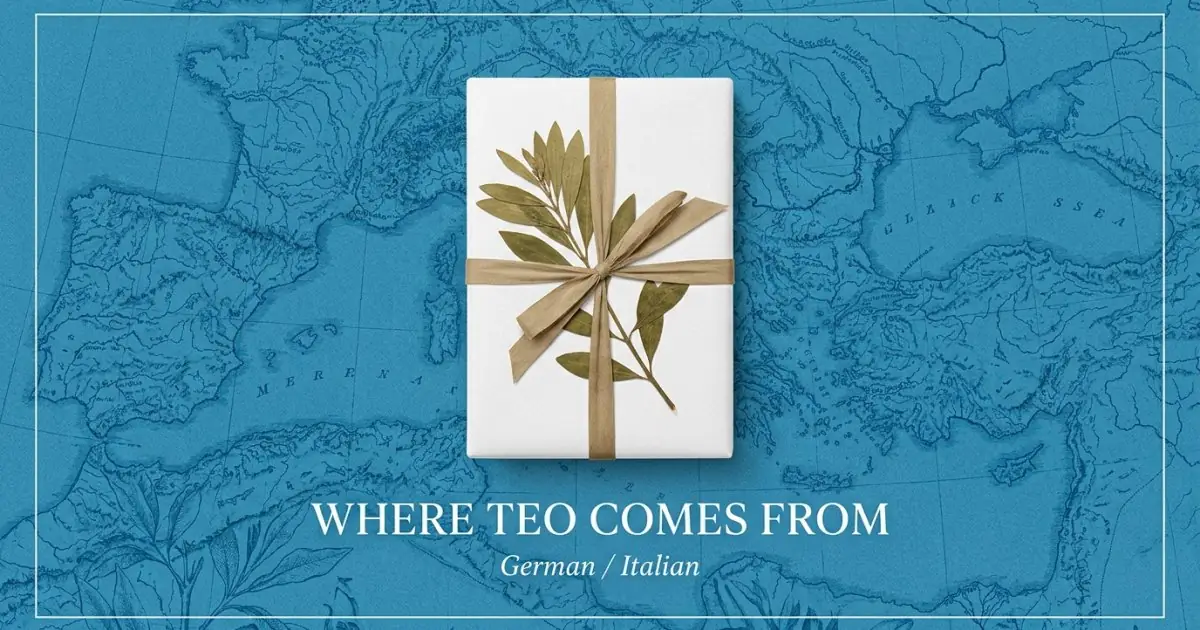
The name also sits near longer Spanish forms associated with the same broad idea of divine gift, including Mateo and Teodoro. Those names reach the meaning through different historical pathways, but in everyday style they form a recognizable constellation: names in which faith, gratitude, and family continuity are expressed through familiar sounds.
Teo can stand alone rather than waiting to be expanded
Short forms often begin as intimate versions of longer names. Over time, some become independent choices because they already possess everything a given name needs: a stable pronunciation, recognizable spelling, social history, and enough substance to function across a lifetime.
Teo meets that test. It does not feel incomplete when printed on a certificate or spoken in a professional introduction. There is no missing syllable that must be restored before the name becomes formal. A child named Teo may be asked whether it is short for something, but the answer can simply be no.
This independence is part of the name’s modern appeal. Parents can choose Teo because they prefer its exact balance—short but not abrupt, affectionate but not juvenile, culturally grounded but internationally manageable. The form does not require the greater ceremony of Teodoro or the additional syllable of Mateo to justify itself.
A compact name can preserve heritage without sounding ceremonial
Heritage names are sometimes imagined as long, difficult, or reserved for formal occasions. Teo offers a different model. Its Spanish identity is present, but it does not depend on complexity. The name can preserve a linguistic or family connection while remaining easy to use in an English-speaking classroom, a multilingual household, or an international workplace.
This may be especially valuable in families where more than one language is spoken. Teo does not ask one side of the family to manage a long unfamiliar consonant sequence. Its sounds are simple, its rhythm is clear, and its spelling is memorable. The name can travel without losing the cultural reason it was chosen.
That ease should not be confused with cultural neutrality. Teo still carries a specific origin and meaning. Its versatility comes from a form strong enough to cross borders while retaining a recognizable home. For parents interested in this heritage, a good next step is more names from this origin.
Teo’s Sound Makes Gratitude Feel Bright Rather Than Solemn
Meaning and sound do not always create the same mood. “Gift of God” could support a highly formal or ceremonial name, yet Teo sounds light, immediate, and energetic. This contrast keeps the meaning from becoming heavy.
The name is pronounced TAY-oh. In American English, the transcription /ˈteɪoʊ/ shows two distinct vowel movements. The first syllable carries the stress, while the second opens into a long o. The result is clear at the beginning and expansive at the end.
The first beat gives Teo confidence
Teo begins with /t/, an unvoiced stop consonant. The tongue briefly blocks the airflow behind the upper teeth before releasing it. This creates a clean and decisive entrance. The consonant is firm without being harsh because it moves immediately into the bright /eɪ/ vowel heard in day.
That first syllable carries the primary stress: TAY-oh. The emphasis makes the name easy to identify in conversation. It does not trail into focus or depend on a final stressed syllable. The listener hears the defining beat immediately.
The sound can suggest confidence, but not weight. Teo lacks the dense consonant clusters found in more severe-sounding names. Its strength comes from clarity rather than force.
The open ending gives Teo warmth
The second syllable ends in an open vowel. Names with open endings often feel fluid because the mouth does not close on a final consonant. In Teo, the transition from TAY to oh creates a small release: the name begins crisply and finishes generously.
This sound pattern helps Teo function across age groups. On a toddler, it feels lively and affectionate. On a teenager, it sounds streamlined. On an adult, the decisive first syllable prevents the open ending from feeling overly delicate.
The two-vowel sequence also gives the name more presence than its three letters imply. Teo is short on paper but not spoken as a single compressed beat. Each syllable receives space, allowing the name to sound complete.
Teo Sits Near Theo, Leo, and Mateo—but Keeps Its Own Identity
Teo belongs to a style neighborhood filled with compact, vowel-rich masculine names. Leo, Theo, Nico, Milo, Enzo, and Mateo all share some combination of open endings, international familiarity, and easy two- or three-syllable rhythms. These similarities make Teo feel current without making it interchangeable.
Teo and Theo differ by more than one letter
Theo is usually pronounced THEE-oh in English, while Teo is pronounced TAY-oh. The presence or absence of the letter h therefore signals a meaningful sound difference, not merely a visual variation.
Theo is strongly associated with Theodore and carries a familiar English-language nickname history. Teo has a more direct Spanish profile and a different vowel at the beginning. Parents choosing Teo should expect occasional spelling substitution because Theo is widely recognized, but a simple correction—“Teo without the h, pronounced TAY-oh”—usually resolves the issue.
That small correction may be worthwhile for families who prefer Teo’s brighter first vowel and more streamlined appearance. The name feels less like an abbreviation in English and more like a complete international form.
Teo is lighter than Mateo and sharper than Leo
Mateo offers a longer, more lyrical route to a related divine-gift meaning. Its three syllables give it greater movement and formality. Teo concentrates a similar warmth into a shorter structure. Families may prefer Mateo when they want a fuller ceremonial name, or Teo when they value economy and immediacy.
Leo shares Teo’s two syllables and open ending, but it begins with a liquid consonant rather than a stop. Leo flows into speech; Teo enters more crisply. Nico and Milo have the same broad international ease, while Enzo offers a stronger central consonant. Among these neighbors, Teo occupies a clear position: bright, brief, warm, and more distinctive than its simple construction initially suggests.
The 2024 Ranking Places Teo Between Rarity and Recognition
Official Social Security Administration (SSA) data placed Teo at No. 759 for boys in 2024. A position within the top thousand indicates meaningful national use. The name is not merely theoretical or confined to one family archive; parents are actively choosing it in contemporary America. If you want to branch out from Teo without leaving this category, explore boy names and meanings.
At the same time, a rank of 759 leaves considerable distance from the most frequently used boys’ names. Teo may be recognized by teachers, pediatricians, and other parents, but repeated encounters in the same classroom are unlikely in many communities. It offers distinction without depending on an unfamiliar sound system.
Teo’s rarity is softened by familiar sounds
Some uncommon names create friction because both their spelling and pronunciation are new to listeners. Teo is uncommon in a gentler way. Its letters are familiar, its two syllables are easy to reproduce, and its style resembles several names already established in American life.
The main uncertainty is likely to involve Teo versus Theo, not the basic ability to say the name. This distinction matters because correcting one familiar letter is usually easier than teaching an entirely new sequence of sounds.
The ranking should not be stretched into a trend claim. One year cannot prove that Teo is rapidly rising, declining, or about to become fashionable. It does establish the name’s present position: visible, usable, and still uncommon enough to preserve individuality.
A name outside the crowded center can age more freely
Names strongly associated with one popularity wave sometimes reveal the decade in which their bearers were born. Teo has not reached that level of concentration in the United States. Its Spanish history gives it roots older than any current chart position, while its compact form suits contemporary tastes.
This combination may help it age well. Teo can sound playful on a young child without becoming trapped in childhood. It can also appear on an adult without seeming like a formal name was shortened against his wishes. The full name and the everyday form are already the same.
Living with Teo Means Paying Attention to the Small Details
Teo is simple, but simplicity makes every element visible. With only three letters, surname rhythm, initials, and pronunciation habits can shape the full identity strongly.
Begin with the surname. Teo pairs easily with both short and long family names, but repeated open vowels may create a highly flowing sequence. Teo Ortega, for example, moves from one open vowel pattern into another, while Teo Grant closes more sharply. Neither effect is inherently better; the family should decide whether it prefers continuity or contrast.
The name’s two syllables allow considerable freedom in the middle position. A one-syllable middle can produce a compact, decisive full name, while a three- or four-syllable choice can add ceremony. The surname should determine how much additional length the combination can carry.
Initials deserve attention because T can combine with middle and surname letters to form familiar abbreviations. Write the full sequence in uppercase, lowercase, monogram order, and a likely email format. A name that looks balanced in a baby-name list should also function on school records and professional documents.
Spelling correction is the most predictable practical issue. Some English speakers will write Theo automatically. Parents should decide whether the distinction feels easy to maintain. Teo’s brevity makes the correction simple, but it may recur. Consistent pronunciation—TAY-oh—helps establish the intended form.
Sibling fit should come from shared tone rather than matching endings alone. Teo can work beside Spanish names, international classics, biblical choices, or concise modern names. A sibling set of Teo and Leo may sound too close when called quickly, while Teo and Nico share style without becoming identical. Distinct opening sounds usually matter more in daily family life than perfect thematic coordination.
Three Routes Deeper into Teo
Middle names can give Teo either weight or lift
A traditional middle can add formality to Teo’s compact brightness, while a longer international choice can create a more lyrical full name. Surname length, initials, and family significance should guide the final pairing. If you want the full pairing logic behind that contrast, see Teo middle names.
Nicknames show whether Teo should remain untouched
Teo is already as short as many nicknames, so most affectionate forms will come from repetition, initials, or private family language rather than practical shortening. Exploring realistic options can help parents distinguish natural pet names from forced inventions. To see how those different moods shorten in real life, explore Teo nicknames.
Pronunciation protects Teo from becoming Theo
The intended pronunciation is TAY-oh, with two clear syllables and stress on the first. A fuller guide can explain the vowel sequence, American and British accent differences, and the easiest way to correct common misreadings. If you want the full sound pattern behind that rhythm, read Teo pronunciation guide.
Teo Names the Gift Without Writing the Child’s Future
The deepest appeal of Teo lies in what its meaning does not attempt to control. “Gift of God” does not prescribe a career, temperament, social role, or measure of success. It records the posture in which the child was received. Before anyone knew what he would accomplish, prefer, resist, or become, his life was welcomed as something valuable.
That meaning gains power from the name’s brevity. Teo does not sound like a proclamation carved into stone. It arrives lightly: two bright syllables, a decisive beginning, and an open finish. The sound makes gratitude feel lived rather than ceremonial.
Its Spanish identity adds another layer. Teo can carry heritage without requiring length, preserve a faith-inflected meaning without sounding solemn, and cross linguistic settings without surrendering its character. It belongs beside longer traditional names, yet it is complete enough to stand independently.
Every child eventually moves beyond the story parents first imagined. He develops private ambitions, contradictions, relationships, and convictions of his own. Teo leaves space for that freedom. The name does not tell him what kind of gift he must become. It simply remembers that his worth was recognized before the world asked him to prove it.