
How to Pronounce Tate: What People Often Get Wrong
Imagine a teacher reading a classroom roster on the first morning of school. Some names require a pause, a second look, or a gentle correction from the child. Tate does not ask for much decoding. It is pronounced TAYT, a single clean syllable that rhymes with date, late, and great. The sound begins crisply, opens into a bright long ay vowel, and closes with a firm final t.
That clarity is one of Tate’s strongest practical advantages. The name is unisex in structure, though current U.S. data shows it is used much more often for boys. Its Norse origin and meaning, “cheerful,” give it warmth, while the pronunciation keeps it sharp and compact. Tate is not stretched into two syllables, not softened into Tay-tee, and not pronounced with a short vowel. It is simple, exact, and complete: TAYT.
How Tate Is Actually Said in Everyday English
The everyday pronunciation of Tate is TAYT. It has one syllable, and the whole name carries the stress because there is no second syllable to reduce. The first sound is the long ay vowel, and the final t should remain clear. This gives Tate its bright, clipped, memorable sound.
| Element | Phonetic Detail | Quick Tip |
|---|---|---|
| Everyday pronunciation | TAYT | Say it like “date” without the opening “d.” |
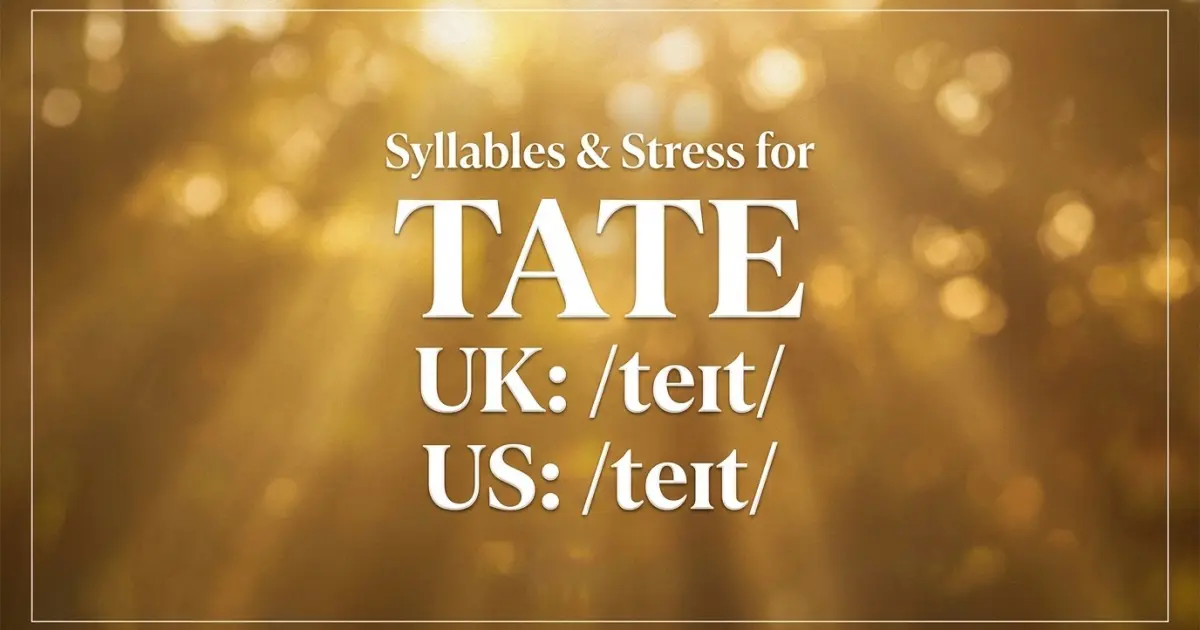
| U.S. IPA | /teɪt/ | The vowel is the long “ay” sound, followed by a final “t.” |
| U.K. IPA | /teɪt/ | The standard U.K. pronunciation uses the same one-syllable form. |
| Syllable count | 1 syllable | Keep Tate compact; do not add an extra ending. |
| Primary stress | Single stressed syllable | The whole name receives the stress because it is one beat. |
| Opening sound | /t/ | Begin with a clean “t” sound, not a soft “d” or “th.” |
| Vowel sound | /eɪ/ | The vowel matches “day,” “say,” and “name.” |
| Ending sound | /t/ | Let the final “t” close the name clearly. |
Tate’s One-Beat Shape Is the Source of Its Clarity
Tate works because the sound is so efficient. Many names have a lead-in syllable, a stressed center, and a softer ending. Tate compresses everything into one beat. That makes it easy to call across a room, easy to read from a list, and easy to repeat after hearing it once. Pronunciation lands more fully when the name’s roots and history are already in view, so begin with Tate meaning.
The first “T” gives Tate a clean start
The opening t is a stop consonant, which means the airflow briefly closes and releases. In everyday language, that simply means Tate begins with a crisp edge. The name does not slide into speech; it starts clearly. This helps the name remain audible in noisy settings such as classrooms, playgrounds, sports fields, and family gatherings.
Because Tate is so short, that first consonant matters. A weak opening can make the name sound less distinct. A clean T gives the name its structure from the first instant.
The long “ay” sound gives Tate its brightness
The vowel in Tate is the long ay sound, represented in IPA as /eɪ/. This is the same vowel heard in day, way, late, and great. It is bright and open, which fits the name’s meaning, “cheerful,” without making the sound feel overly sweet.
This vowel is also the main feature to protect. Tate should not sound like tat. It needs the long vowel: TAYT. Once the vowel is correct, the rest of the name is straightforward.
The final “T” gives Tate its firm landing
The ending is another t, so Tate begins and ends with the same crisp consonant. That symmetry gives the name its compact force. The final sound should be audible, especially in careful speech. If the ending disappears, the name can blur into Tay, which may work as a nickname but is not the full pronunciation.
The correct full-name form is TAYT: bright in the middle, clean at both edges.
Why Tate Sounds Stable Across Accents
Tate has the same IPA form in U.S. and U.K. English: /teɪt/. That makes the name highly stable across major English-speaking accents. Speakers may color the long ay vowel slightly differently depending on region, but the basic structure remains the same: one syllable, long vowel, final t.
American English pronunciation
In American English, Tate is usually said with a clear long ay sound and a firm final t. It rhymes cleanly with date, gate, and late. Because American English often keeps final consonants fairly clear in careful speech, Tate tends to sound crisp and direct.
British and international English pronunciation
In British English and other international English accents, Tate remains very close to the same pronunciation. The exact vowel glide may vary, and some speakers may release the final t more lightly in casual speech, but the name should still be recognized as TAYT. The key is to keep it one syllable.
Common Tate Pronunciation Mistakes to Avoid
Tate is easy, but short names can still be altered by habit, accent, or over-softening. Most mistakes come from changing the vowel, adding an extra syllable, or turning the full name into a nickname form.
Mistake one: saying TAT instead of TAYT
The most important mistake to avoid is shortening the vowel. Tate should not sound like tat. It uses the long ay sound, so it rhymes with date, not cat. A helpful correction is: “Tate rhymes with late.”
Mistake two: adding a second syllable
Tate should not become Tay-tee unless someone is using an affectionate nickname such as Tatey. The formal name has one syllable. Keep it compact: TAYT.
Mistake three: dropping the final consonant
If the final t is dropped too strongly, Tate can sound like Tay. Tay can be a nickname, but it is not the full pronunciation. In introductions and careful speech, the final t should stay clear.
Sound Neighbors That Make Tate Easy to Teach
Tate is simple to teach through rhyme. It belongs beside words like date, late, gate, state, and great. These sound neighbors show both the long vowel and the final consonant, making them more useful than spelling explanations. Because the strongest energy lands early, the shorter forms often grow from the opening of the name, and that pattern is easier to see in nicknames for Tate.
The name also sits near other short, high-impact names such as Ace, Cade, Jace, Beau, Knox, and Reid. Tate’s pronunciation is especially direct because the spelling and sound line up closely. Once someone knows the vowel is long, there is little else to learn.
Practice Lines for Saying Tate Clearly
Practice for Tate should focus on precision, not length. The name is already short; the goal is to preserve the long vowel and final consonant.
Slow practice
- Tate.
- TAYT.
- Tate has one syllable.
- Tate rhymes with date.
Everyday sentence practice
- This is Tate.
- Tate will be here soon.
- Please give this to Tate.
- Tate, your name is short and clear.
Simple correction line
The easiest correction is: “It’s pronounced TAYT, like ‘date’ with a T.” That gives the listener the vowel, the rhyme, and the final consonant in one quick explanation.
How to Pronounce Tate: FAQ
How do you pronounce Tate?
Tate is pronounced TAYT. It rhymes with “date,” “late,” and “great.”
How many syllables are in Tate?
Tate has one syllable. The full name is spoken in a single beat: TAYT.
What is the IPA pronunciation of Tate?
The U.S. and U.K. IPA pronunciation of Tate is /teɪt/.
Is Tate hard to pronounce?
No. Tate is usually very easy for English speakers to pronounce. The main rule is to keep the long “ay” vowel and say it as one syllable.