
How to Pronounce Tariq: Syllables, Stress, and Common Tips
Imagine Tariq being read aloud from a graduation program, a classroom roster, or a name tag at a community event. The spelling is short, but the final q may make a reader slow down for half a second. The name is not pronounced with a hard, unfamiliar ending or an extra hidden syllable. The everyday English pronunciation is tah-REEK, with the name rising into a clear, bright final syllable.
That rising sound is central to Tariq’s character. The name means “night visitor; morning star,” and its pronunciation almost follows that image: a quieter opening, then a stronger point of light at the end. Tariq has two syllables, stress on the second, and a clean final k sound. Once the stress is placed correctly, the name feels poised, elegant, and easy to remember.
Tariq is said with a quiet opening and a bright final syllable
| Element | Phonetic Detail | Quick Tip |
|---|---|---|
| Standard pronunciation | tah-REEK | Let the name rise into the second syllable. |
| Syllable count | 2 syllables | Keep both parts clear: tah + REEK. |
| Stress pattern | Second-syllable stress | The final syllable should sound stronger than the first. |
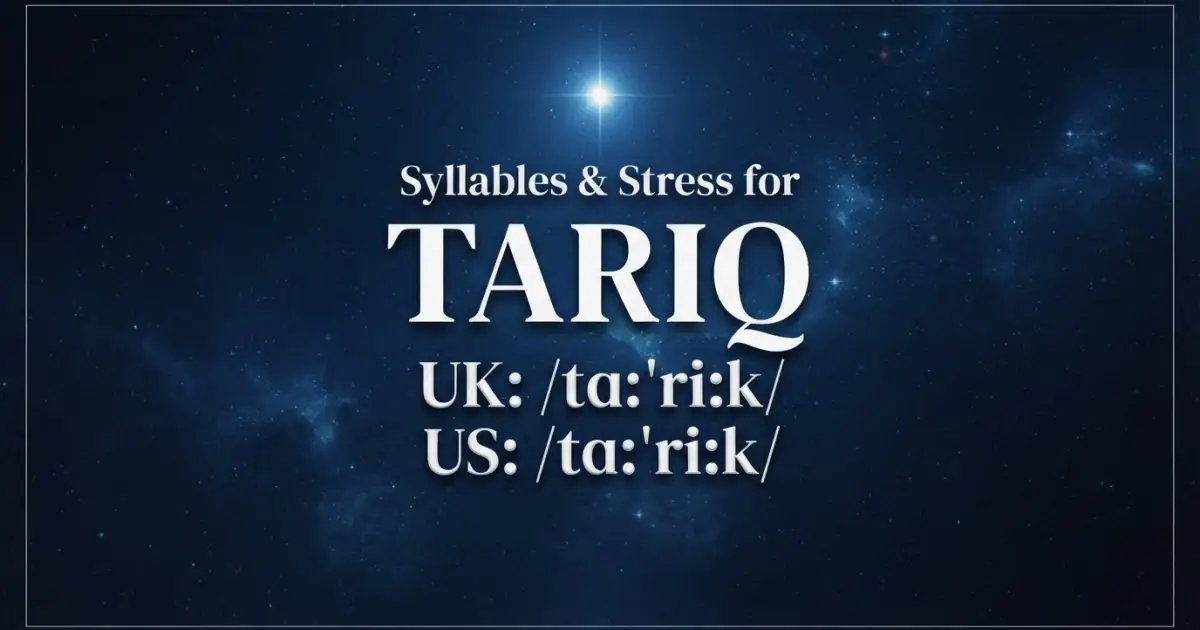
| US IPA | /tɑːˈriːk/ | American English usually gives the first vowel a broad “ah” quality. |
| UK IPA | /tæˈriːk/ | UK English may make the first vowel shorter or flatter. |
| Opening sound | t + unstressed vowel | Begin cleanly, but do not put the main weight on the first syllable. |
| Final sound | Long ee + k | End crisply; the q is pronounced like a k in everyday English. |
The stress pattern gives Tariq its rising rhythm
Tariq has a different rhythm from many familiar English boys’ names. Names such as Riker, Liam, Ezra, and Noah place their main force near the beginning. Tariq does the opposite. It begins lightly, then lands on the second syllable: tah-REEK. That final stress gives the name its lift. Pronunciation lands more fully when the name’s roots and history are already in view, so begin with Tariq meaning.
The first syllable should open, not dominate
The opening syllable, tah, should be clear but not heavy. It begins with t, a stop consonant. In simple terms, the tongue briefly blocks the airflow and then releases it. That gives Tariq a clean start without making the first syllable sound forceful.
The first vowel changes slightly by accent. In American English, it is represented as /tɑː/, which gives it a broader “ah” quality. In UK English, it is represented as /tæ/, which may sound shorter or flatter. Either way, the first syllable remains the softer part of the name.
The final syllable carries the name’s identity
The second syllable, REEK, is where Tariq becomes fully recognizable. It uses a long ee sound and ends with a crisp k. The final consonant matters because it gives the name a clean finish. Tariq should not fade away at the end; it should close with clarity.
The q in Tariq is pronounced like k in everyday English. There is no extra “kw” sound. It is not tah-REE-kw or tah-RICK-uh. The pronunciation is direct: tah-REEK.
Tariq changes slightly between U.S. and UK accents
The IPA forms show the main accent difference clearly: U.S. /tɑːˈriːk/ and UK /tæˈriːk/. The final syllable stays stable in both. The long ee sound and final k remain the anchor. The difference is mostly in the first vowel.
American English gives Tariq a broader first vowel
In American English, Tariq often begins with a broad “ah” sound. The first syllable may feel open and calm, leading into the stronger final syllable. The name should still avoid first-syllable stress. Even if the opening vowel is broad, the name should rise toward REEK.
For American speakers, the easiest guide is to keep the first syllable relaxed and let the second syllable carry the name. When the stress is right, the pronunciation sounds smooth and natural.
UK English may make Tariq’s opening shorter
In UK English, the first vowel may be shorter or flatter, closer to the vowel represented by /æ/. This can make the opening syllable sound slightly different from the American version, but the name remains easy to recognize.
The important point is that UK pronunciation still places the main stress on the second syllable. The name does not become TA-riq. It remains tah-REEK, with the final syllable strongest.
Common Tariq mistakes usually come from the q and the stress
Tariq is short, but it can be misread because the q ending is less common in everyday English names. Most mistakes are easy to correct once the speaker understands that the q closes the name with a k sound and that the stress belongs on the second syllable.
Mistake one: saying TA-rik
One common mistake is placing the stress on the first syllable, as in TA-rik. That changes the character of the name. Tariq should rise into the final syllable: tah-REEK. The second syllable is the brightest and strongest part.
Mistake two: saying tah-RICK
Another mistake is shortening the final vowel, making the ending sound like “rick.” The standard pronunciation uses a long ee sound: REEK. Keeping that vowel long helps the name sound elegant rather than clipped.
Mistake three: adding a w sound after the q
Because English often pairs q with u, some readers may expect a kw sound. Tariq does not use that pattern in everyday pronunciation. The q is simply a final k sound. The name ends cleanly, without an added w.
Tariq’s sound neighbors can help people learn it quickly
Tariq is easiest to explain through names and words that share parts of its sound. The final syllable sounds like “reek,” but the full name should not be reduced to that word association. The helpful comparison is structural: a light first syllable followed by a strong final syllable. When the stress sits in the center, the nickname logic often follows that same center of gravity, which is why Tariq nicknames is the natural next step.
Tariq and Malik share a rising strength
Names such as Malik can help illustrate second-syllable stress, though the vowel and ending are different. Both names feel balanced because the first syllable prepares the listener and the second syllable carries the name’s main force.
Tariq should stay distinct from Derek and Tarek
Some speakers may drift toward more familiar English patterns such as Derek, where the first syllable is stronger. Tariq should not follow that rhythm. It also has spelling neighbors and variants that may be pronounced similarly in some contexts, but for this form the intended guide is tah-REEK.
Practice lines make Tariq natural in everyday speech
Names become easier when they are practiced in normal sentences rather than isolated syllables. Tariq should sound clear in introductions, classroom calls, family conversation, and formal announcements.
- Tariq is here.
- This is Tariq.
- Tariq, please come in.
- We saved a seat for Tariq.
- Tariq wrote his name clearly.
- The invitation is for Tariq James.
- Can you call Tariq after lunch?
- Tariq will join the group today.
In each line, the same rhythm should hold: tah-REEK. The first syllable opens gently, the second syllable rises, and the final k closes the name with precision. That is what gives Tariq its everyday elegance: it is short, meaningful, and memorable when the stress falls in the right place.