
How to Pronounce Stuart: Syllables, Stress, and Common Mistakes

Stuart is one of those names that looks familiar, yet shifts subtly depending on accent. In an American classroom, a teacher reading it from a roster will usually say STOO-ert, with the first syllable sounding like “stew.” In many British settings, the same name may begin with a slight y-like glide, closer to STYOO-uht. The name remains recognizable either way, but the accent difference gives Stuart more texture than its simple spelling first suggests.
The pronunciation matters because Stuart is a name of steadiness. Its meaning, “steward,” already suggests responsibility, care, and trust, and the sound reinforces that composed feeling. It has two syllables, stress on the first, and a firm opening that relaxes into a lighter ending. Said clearly, Stuart feels traditional without being fussy: STOO-ert in American English, and often STYOO-uht in British English.
Stuart Is Pronounced With a Strong STOO and a Lighter Ending
| Element | Phonetic Detail | Quick Tip |
|---|---|---|
| Everyday pronunciation | STOO-ert | Say it in two beats, with the weight on STOO. |
| Syllable count | 2 syllables | Keep the name compact: STOO, then ert. |
| Stress pattern | First syllable stressed | The name should begin strongly, not rise at the end. |
| U.S. IPA | /ˈstuːərt/ | American English usually uses a clear STOO opening and pronounces the final r. |
| U.K. IPA | /ˈstjuːət/ | British English often includes a y-like glide after st and softens the ending. |
| Main pronunciation risk | Flattening or overcomplicating the second syllable | Let the first syllable lead; the ending should be lighter and quick. |
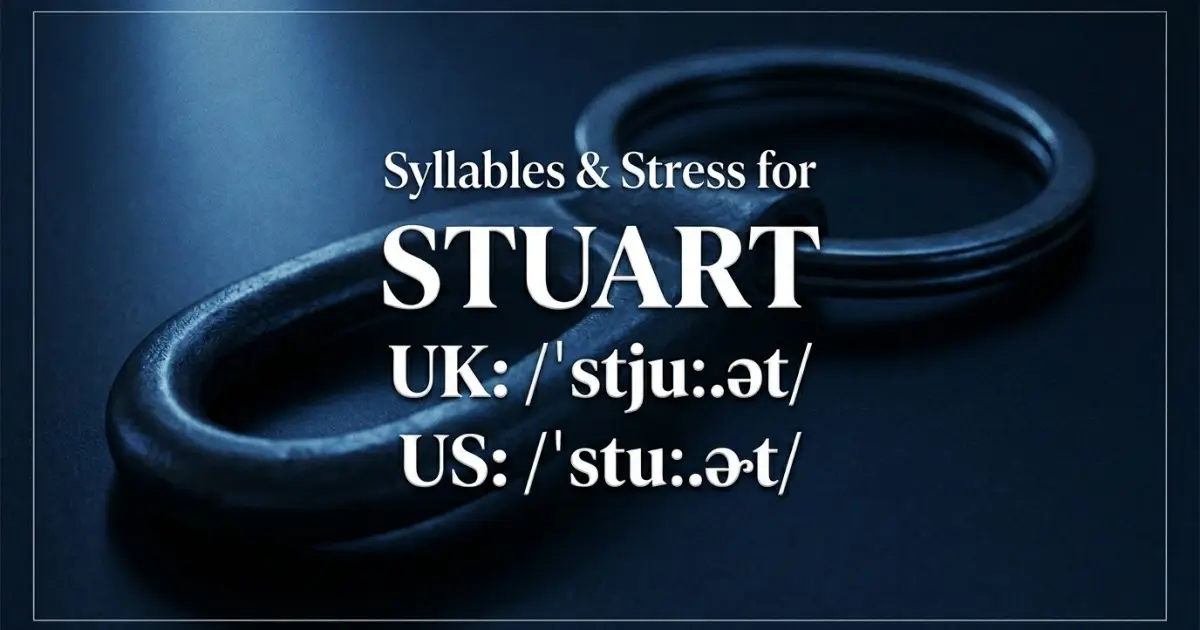
The Everyday Pronunciation of Stuart Starts With the First Syllable
Stuart is pronounced STOO-ert in common American English. The first syllable carries the stress, so it should be clear, strong, and slightly longer than the second. The name does not need a dramatic ending. Its spoken shape is front-loaded: STOO first, then a lighter ert. Before focusing only on syllables and stress, it helps to step back into the fuller frame of Stuart meaning.
The STOO opening gives Stuart its steadiness
The first sound cluster in Stuart begins with st, a crisp pairing that gives the name structure. Then comes the long oo vowel, the same broad vowel heard in words such as “stew” or “blue.” Together, STOO gives Stuart a firm, composed opening.
This opening should not be reduced too much in careful speech. If the first syllable becomes weak, the name loses its traditional strength. A clear STOO helps Stuart sound confident, grounded, and easy to recognize.
The ending should stay light, not stretched
The second syllable is shorter and less forceful. In American English, it often sounds like ert, with the r pronounced. In British English, it may be closer to uht, with the r less present. Either way, the ending should not become a heavy separate event.
Stuart should not sound like STOO-ART with a strong second half. The ending is there, but it is secondary. The name works best when the first syllable carries the sound and the second syllable closes it neatly.
Stuart’s U.S. and U.K. IPA Reveal the Accent Difference
The U.S. IPA pronunciation of Stuart is /ˈstuːərt/. The U.K. IPA pronunciation is /ˈstjuːət/. Both forms show stress at the beginning of the name. The main differences are the y-like glide in many British pronunciations and the treatment of the final r.
How Stuart sounds in American English
In American English, Stuart is usually STOO-ert. The first syllable sounds close to “stew,” and the final r is typically pronounced. This gives the name a compact but clearly two-syllable shape.
American speakers should avoid turning Stuart into a single blurred sound. It is not simply “sturt.” The careful pronunciation has two beats: STOO-ert. The second beat is lighter, but it should still be heard.
How Stuart sounds in British English
In many British accents, Stuart may sound closer to STYOO-uht. The U.K. IPA /ˈstjuːət/ shows a y-like sound after the st, similar to the difference some speakers make between “toon” and “tune.” The ending is usually softer, and the final r is not strongly pronounced.
This does not make it a different name. It is the same two-syllable structure shaped by accent. The important rule remains the same: stress the first syllable and let the ending fall lightly.
Common Stuart Pronunciation Mistakes Usually Come From the Ending
Stuart is familiar enough that most people can say it once they have heard it. Still, a few pronunciation mistakes can make the name sound awkward. Most involve compressing the syllables too much, overemphasizing the ending, or confusing the American and British vowel movement.
Mistake one: swallowing the second syllable completely
In fast speech, Stuart can become very compact. But in careful pronunciation, the name has two syllables. STOO-ert should keep a light second beat. If the ending disappears entirely, the name can sound clipped or unclear.
Mistake two: saying stu-ART
The stress should not move to the ending. Stuart is not pronounced stu-ART. The first syllable carries the emphasis: STOO-ert. The ending should close the name, not take it over.
Mistake three: forcing one accent pattern everywhere
American and British pronunciations differ naturally. STOO-ert and STYOO-uht can both be recognizable depending on accent. The goal is not to erase accent, but to preserve the name’s essential rhythm: first syllable strong, second syllable light.
Stuart Shares Sound Neighbors With Steward, Stewart, and Sturdy Traditional Names
Stuart naturally sits near Stewart in spelling and sound, and the two are closely related in everyday recognition. It also shares a traditional atmosphere with names such as Graham, Malcolm, Douglas, Warren, Walter, and Russell. These names tend to feel grounded, adult-ready, and less trend-driven. The way the name resolves at the end often decides which short forms feel natural in speech, and that becomes clearer in nicknames for Stuart.
Compared with softer names, Stuart has more consonant structure at the beginning. Compared with longer Scottish or surname-style names, it is compact and direct. The pronunciation supports that identity: STOO-ert is firm, practical, and controlled. It sounds like a name that does not need ornament to feel complete.
Practice Lines Help Stuart Stay Clear Across Accents
The best way to practice Stuart is to give the first syllable enough weight and then let the ending relax. The name should sound steady, not overworked.
Slow practice
- Stuart: STOO-ert.
- The first syllable is strong: STOO-ert.
- The ending is lighter: STOO-ert.
- Stuart has two syllables.
Everyday sentence practice
- This is Stuart.
- Stuart is here today.
- We named him Stuart.
- Stuart, come here for a minute.
Full-name practice
- Stuart James.
- Stuart Reid.
- Stuart Elias.
- Stuart Alexander.
When pairing Stuart with a middle name or surname, listen for repeated st, t, and r sounds. Stuart Reid can sound crisp but r-rich in American English. Stuart Elias softens the full name. Stuart James creates a clean traditional break. The first name itself should remain steady: STOO-ert first, then the rest of the name.
Pronouncing Stuart: Common Questions
How do you pronounce Stuart?
Stuart is pronounced STOO-ert in American English. It has two syllables, with the stress on the first syllable.
What is the IPA pronunciation of Stuart?
The U.S. IPA pronunciation is /ˈstuːərt/. The U.K. IPA pronunciation is /ˈstjuːət/. The main differences are the y-like glide in the U.K. form and the treatment of the final r.
How many syllables are in Stuart?
Stuart has two syllables: STOO-ert. The first syllable is stronger, and the second syllable is lighter.
Is Stuart pronounced differently in the U.S. and U.K.?
Yes, slightly. American English usually says STOO-ert with a clearer final r, while many British speakers say something closer to STYOO-uht. Both keep the stress on the first syllable.