
How to Pronounce Sol: What People Often Get Wrong
The real pronunciation test for a name like Sol rarely happens in a quiet naming conversation. It happens when a teacher reads it from a class list and has less than a second to decide whether the name is as simple as it looks. It happens at a clinic front desk, at graduation rehearsal, or in the tiny pause before a relative says it aloud for the first time from a baby announcement. Sol is exactly the kind of name that can create that pause. It is only three letters long, yet it carries enough cultural and linguistic range that people may wonder whether it should sound clipped, warm, Spanish-leaning, English-leaning, or something in between.
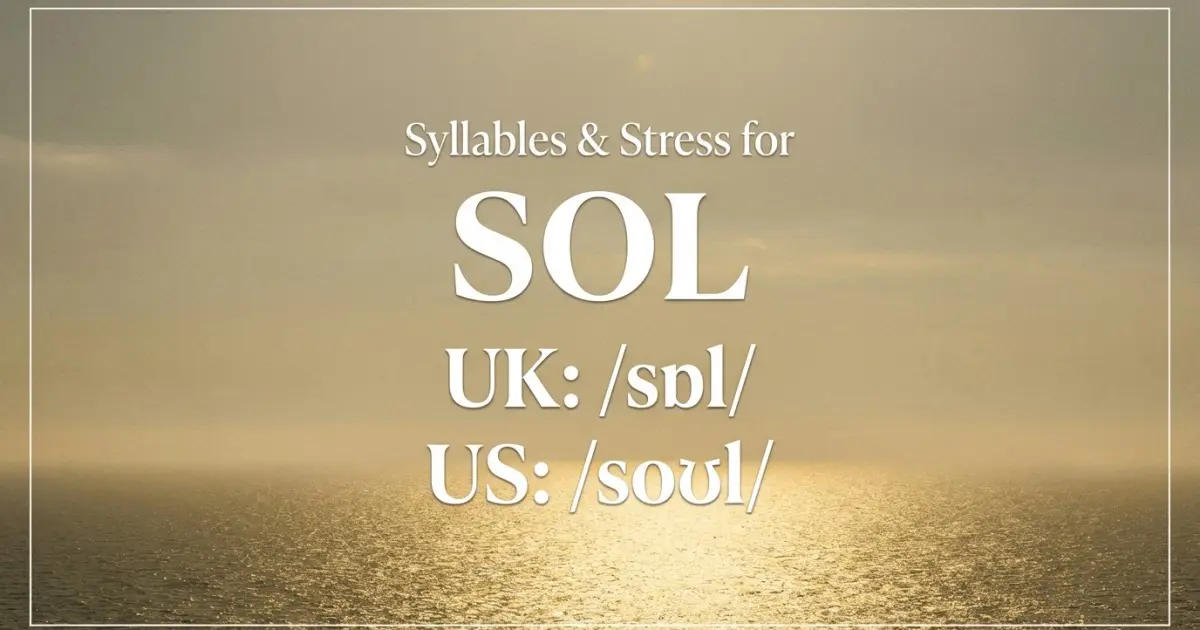
What makes Sol reassuring is that, in everyday English, it settles quickly once heard. The common spoken guide here is SOHL. In American English, the IPA is /soʊl/, which gives the vowel a long rounded glide. In British English, the IPA is /sɒl/, which keeps the name shorter and rounder in the center. The shape remains the same in both: one syllable, clear stress, soft ending. That is why Sol works so well in practice. It is short, but not abrupt. It is simple, but not empty. A name like this lives or dies by sound, and Sol has enough warmth in its single syllable to sound like a person rather than a fragment.
What Sol Is Really Saying When You Hear It Aloud
| Element | Phonetic Detail | Quick Tip |
|---|---|---|
| Everyday pronunciation | SOHL | Keep it to one clean beat and let the vowel stay open rather than clipped. |
| IPA (US) | /soʊl/ | In American English, the sound moves through a long rounded vowel, almost like the word “soul” in everyday speech. |
| IPA (UK) | /sɒl/ | In British English, the vowel is shorter and rounder, but the name remains compact and clear. |
| Syllable count | 1 syllable | Do not over-separate it. The name’s elegance comes from its compression. |
| Primary stress | Single stressed syllable | Because Sol is one syllable, the whole name carries the stress at once, which is part of its force. |
| Opening consonant | /s/ | Let the opening feel soft and smooth, not hissed or overemphasized. |
| Ending consonant | /l/ | The final l gives Sol warmth. Let it close gently rather than snap shut. |
Sol in Everyday English: One Syllable, but Not One Flat Sound
It is easy to assume that a one-syllable name has no pronunciation complexity at all. In reality, short names often depend more heavily on vowel shape and ending texture than longer names do. With Sol, the entire personality of the name lives inside a single syllable. That means the vowel matters. The closing consonant matters. The degree of openness matters. A one-syllable name has nowhere to hide. Every sound is visible. The sound matters more once you know what the name is meant to carry, which is why the wider frame starts in Sol meaning.
In American English, /soʊl/ gives Sol a long, rounded vowel that glides slightly before settling into the final l. That makes the name feel warm and a little expansive for such a short form. In British English, /sɒl/ sounds shorter and slightly more grounded, but it still keeps the same calm shape. In both cases, the final l is important. It is a liquid consonant, and liquid consonants often soften the edge of a short name. Without that l, Sol might feel sharper or more abrupt. With it, the name closes gently.
Why Sol sounds warmer than many other one-syllable names
Many short names end in a stop consonant such as t, d, or k. Those endings can give a name snap, but they can also make it feel hard. Sol does something different. It begins with a soft fricative-like airflow in the s and ends with a liquid l. That combination gives the whole syllable a more human texture. It slides in and settles rather than striking and stopping.
This is one reason Sol can feel both minimal and gentle. The name is concise, but it is not severe. The sound supports the meaning beautifully. A sun name could have been harsh or blazing. Sol is luminous without being sharp.
Why the one-syllable structure helps Sol stay memorable
The brevity of Sol is part of its social advantage. Once heard, it is very easy to retain. But memorability in names is not just about length. It is about contour. Sol has contour because the vowel is full and the ending is soft. That gives the name a distinct acoustic outline even though it lasts for only one beat. It sounds complete rather than clipped.
Sol Across American and British English
The fact packet provides two closely related but not identical pronunciations: /soʊl/ in American English and /sɒl/ in British English. This difference is worth noting because it slightly changes the color of the name without changing its identity. American English tends to stretch the vowel a little more, creating a sound close to “sohl.” British English tends to keep the vowel rounder and shorter. Neither version is wrong. They are simply accent-based realizations of the same core name.
In practical terms, that means Sol travels well. A child with this name is unlikely to face serious cross-accent confusion. People may color the vowel differently, but they will still recognize the name immediately. That matters because some short names become unstable across English dialects. Sol does not. Its basic structure is too clear for that. One syllable, one bright center, one soft landing.
What the IPA tells you in plain language
The IPA here is unusually easy to translate. The American /soʊl/ tells you the vowel opens and glides, then closes into the final l. The British /sɒl/ removes some of that glide and gives you a rounder, shorter sound. What remains constant is the opening s and the final l. So the practical takeaway is simple: whichever accent you speak, Sol should sound compact, rounded, and gentle.
What accents may change, and what they should not
Accent may change the exact vowel quality, but it should not turn Sol into a two-syllable name or flatten it into something harsh and clipped. The name needs one full beat and a soft finish. As long as that remains intact, Sol stays recognizably itself.
Where Sol Usually Gets Misread
Because Sol is so short, most pronunciation confusion does not come from difficulty. It comes from assumption. Some readers may wonder whether they should say it with a more Spanish-feeling sound. Others may over-Anglicize it into a clipped short-vowel form. Still others may hesitate because the written form is so brief that they assume there must be some hidden complexity. In reality, Sol is less tricky than it looks. The challenge is mostly social, not phonetic.
The most common mistake patterns
The first pattern is clipping the vowel too much, which can make the name sound abrupt rather than luminous. The second is over-stretching or theatricalizing it, as though a short, meaningful name needs ceremony to feel significant. The third is trying to over-foreignize it without evidence from the family’s actual preferred pronunciation. All of these miss the same point: Sol works best when it is spoken simply, clearly, and warmly.
Because the name is only one syllable, even a small change in vowel quality can feel noticeable. That is why the clean spoken guide SOHL is so helpful. It keeps speakers from flattening the sound or overcomplicating it.
Sound neighbors that help, and sound neighbors that mislead
Helpful sound neighbors are short English words with a similar open rounded vowel and soft final l, because they preserve the name’s warmth. Less helpful are short clipped words that encourage a harder, drier ending. Sol should feel sunlit, not snapped off. If someone is unsure, the easiest correction is also the best one: “It’s SOHL, one syllable.” Once the sound pattern is clear, some shortenings stop feeling optional and start feeling natural, and the clearest map is in Sol nicknames.
Practicing Sol Until It Feels Natural
The best way to learn Sol is not through elaborate phonetic breakdown, but through ordinary use. Say it in sentences: Sol is here. Please ask Sol to come in. Sol did a wonderful job. When spoken in normal rhythm, the name’s shape becomes immediately clear. It sounds like a complete name, not an abbreviation.
Another useful method is to hold the vowel for just a fraction longer than you might with a clipped English short vowel, then let the l land softly. Think of it less as punching out a short syllable and more as letting one small syllable glow. That may sound poetic, but it is also practical. A name like Sol succeeds when it is given enough sound to feel alive.
Once heard a few times, Sol usually becomes effortless. That is one of its great strengths. It is brief, memorable, and easy to repeat, but it still carries enough tonal warmth to feel like a full identity rather than a minimal gesture. In pronunciation, as in meaning, Sol proves that small does not have to mean slight.