
How to Pronounce Sloane: An Easy Sound-by-Sound Breakdown
The moment when pronunciation matters most is often painfully ordinary. A teacher pauses over a class list. A host at a restaurant glances down and hesitates for half a second. A receptionist says a name into a waiting room microphone and, in that instant, decides whether the person attached to the name must correct the room or simply stand up and walk forward. Sloane performs unusually well in these moments. It looks sleek on the page, and once spoken aloud, it proves much simpler than its spelling may initially suggest to some readers. The name does not require special vocal skill. It requires confidence in one clean syllable.
That is part of Sloane’s appeal. It has the visual sophistication of a surname-style name, but it does not come with a complicated sound map. There are no hidden stress shifts, no unstable vowel patterns, and no difficult consonant pileups beyond the opening blend. What makes Sloane feel elegant is not difficulty. It is precision. The name works when the opening consonants glide smoothly into the long vowel and the final n lands lightly. In other words, Sloane sounds polished because it is controlled, not because it is elaborate.
What People Need to Hear Clearly When They Say Sloane
Sloane is a one-syllable name, but one-syllable names still have internal structure. The table below breaks down the parts that make the pronunciation sound correct, natural, and socially effortless.
| Element | Phonetic Detail | Quick Tip |
|---|---|---|
| Common spoken guide | SLOHN | Say it in one smooth beat, not as two separate parts. The name should feel compact and finished. |
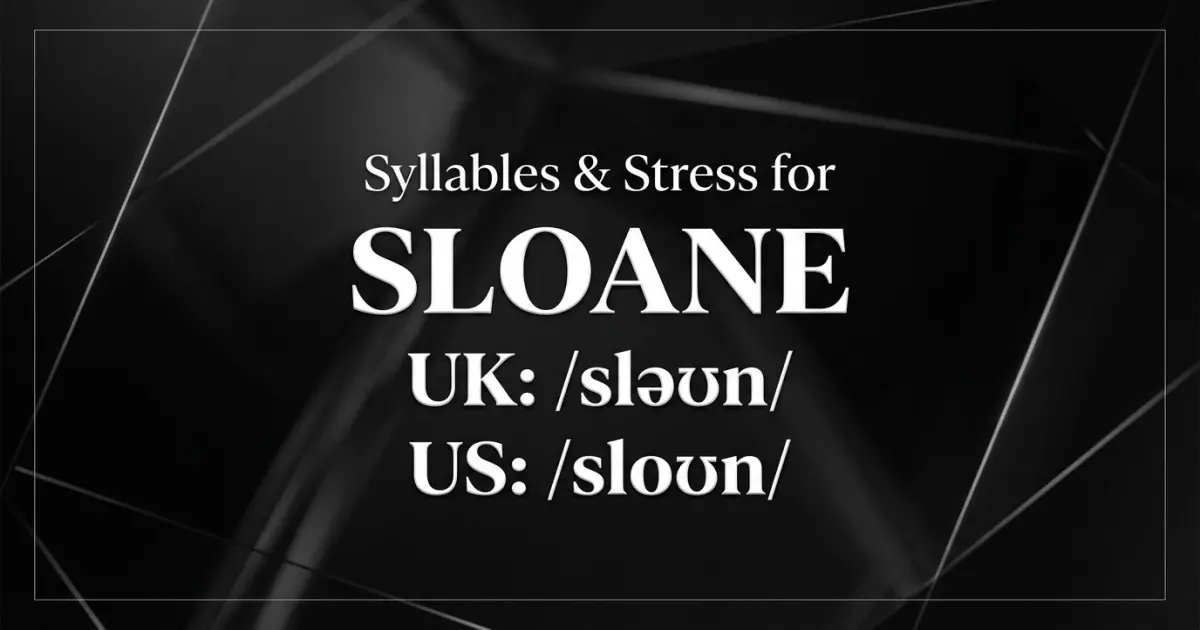
| IPA (US) | /sloʊn/ | The core sound is a long English o, like the vowel in “stone” or “tone.” |
| IPA (UK) | /sloʊn/ | The pronunciation remains effectively stable across major English-speaking accents, which makes the name easy to carry internationally. |
| Syllable count | 1 syllable | There is no second beat to rescue you. The whole impression depends on getting that single syllable right. |
| Opening sound | /sl/ consonant cluster | Let the initial s flow directly into the l. Do not separate them too sharply. |
| Main vowel | Long /oʊ/ sound | Keep it close to “oh,” not “aw,” and not a flat short vowel. |
| Ending sound | Final /n/ | Close the name lightly with n. Do not overhit the ending or let it disappear entirely. |
Sloane Works Because the Sound Is Cleaner Than the Spelling Looks
Many people first encountering Sloane on paper assume the final e or the cluster of letters must complicate the pronunciation. In practice, it does not. The spelling looks tailored and slightly formal, but the spoken name is very straightforward: one syllable, beginning with sl, opening into a long o, and ending in n. The final e is visual polish, not a spoken extra. Before focusing only on syllables and stress, it helps to step back into the fuller frame of Sloane meaning.
The opening of Sloane is smooth, not sharp
The name begins with /s/, a fricative, followed immediately by /l/, a liquid consonant. That combination is one reason Sloane sounds sleek. Fricatives create a narrow stream of air; liquid consonants allow the sound to flow forward more softly. Put together, they give the name forward motion without harshness. That is why Sloane does not sound blunt even though it is so short.
Speakers should resist over-separating the two sounds. You are not saying suh-lohn. You are saying one joined opening cluster: sl. That cluster is common in English words like “slow,” “slide,” and “slip,” so most English speakers already know how to produce it instinctively.
The vowel is where Sloane gets its polish
The long /oʊ/ in Sloane matters. It is the difference between a refined one-syllable name and a flatter, heavier sound. Think of the vowel in “stone,” “phone,” or “grown.” That rounded center keeps the name from sounding clipped. If the vowel is too short, Sloane loses much of its elegance. If it drifts toward “slawn,” the name starts sounding less precise than intended.
The ending should close quietly
The final /n/ is simple but important. It gives Sloane its neat finish. There is no need to punch it hard. A light nasal close is enough. In fast speech, the danger is not major mispronunciation so much as swallowing the end. Spoken well, Sloane should feel complete in one controlled breath.
Where Sloane Usually Goes Wrong in Everyday Speech
Sloane is not a difficult name, but simple names can still be mishandled if speakers overthink the spelling or rush through the sound. Most errors follow predictable patterns.
The most common mistake is over-reading the spelling
Because Sloane looks a little more formal than it sounds, some readers may hesitate and wonder whether there is an extra syllable hidden inside it. There is not. The name is not Slo-ahn, not Slo-anne, and not Slo-ay-nee. It is one syllable throughout. Once that is understood, the rest falls into place quickly.
Another mistake is flattening the vowel
The name can lose definition if the vowel gets dragged too far toward aw or clipped into something closer to a short o. Sloane sounds best with the clean English long o. That is the center that gives the name its modern, composed effect.
Some speakers make Sloane harsher than it is
Because Sloane is associated with tailored, surname-style naming, people sometimes say it too aggressively, almost as if the name should strike the ear. In reality, the sound is smoother than its social reputation. The liquid l softens the opening, and the long vowel gives it space. Sloane should sound controlled, not clipped with attitude.
Sloane Holds Steady Across Accents Better Than Many Stylish Names
One reason Sloane works so well in contemporary life is that accent differences do not destabilize it much. In both the supplied US and UK pronunciation, the IPA remains /sloʊn/. That kind of stability matters more than people sometimes realize. Names that change shape dramatically across accents often require more correction or explanation. Sloane does not.
American and British speech both keep the core intact
Regional accents may shade the vowel slightly or change how sharply the final n is released, but the fundamental identity of the name stays the same. Speakers in different English-speaking regions will still hear the same name. That is a practical advantage in school, travel, work, and digital communication, where names need to cross accents cleanly.
Why surname-style names benefit from this kind of stability
Names like Sloane often rely on sounding crisp and socially legible. If pronunciation drifted too much from place to place, the name would lose some of that confidence. Instead, Sloane remains reliable. It sounds like itself almost everywhere English is spoken, which helps explain why it feels so usable despite its relatively high-style image.
Sloane Gets Easier Once You Practice It in Real Sentences
The best way to learn a name is to place it where names actually live: in ordinary conversation. Practicing Sloane in full sentences helps the mouth understand its rhythm much faster than saying it in isolation over and over again.
Simple practice lines for Sloane
- “Sloane, your table is ready.”
- “Has Sloane already checked in?”
- “I’m glad you could make it, Sloane.”
- “Sloane will join us after lunch.”
- “Can Sloane come to the front office?”
In each case, the target remains the same: one syllable, smooth sl opening, long o center, light final n. If the name sounds easy in these sentences, it is being pronounced correctly.
Sound neighbors can help
If someone needs a sound anchor, use familiar English neighbors such as “stone,” “tone,” or “phone” for the vowel. Then add the opening sl cluster. This is often enough to settle uncertainty immediately. Sloane is far easier to pronounce than it may look at first glance. Once the sound pattern is clear, some shortenings stop feeling optional and start feeling natural, and the clearest map is in Sloane nicknames.
Why Sloane Sounds Sophisticated Without Being Hard to Say
The elegance of Sloane comes from compression. It is not long, not ornamented, and not phonetically exotic. It sounds sophisticated because each sound is placed efficiently: the opening fricative gives it edge, the liquid consonant gives it glide, the long vowel gives it breadth, and the final nasal gives it closure. That is a remarkably balanced structure for a one-syllable name.
And that, finally, is why Sloane performs so well in real life. It can appear on a class roster, a boarding pass, a business card, or a birthday cake, and it remains the same name each time: clear, controlled, and immediately recognizable. In pronunciation terms, that is a real kind of luxury. Sloane does not need to be explained. It just needs to be said cleanly once.
Common Questions About Pronouncing Sloane
How do you pronounce Sloane correctly?
Sloane is pronounced SLOHN, as one syllable with a smooth sl opening, a long o sound, and a light final n.
What is the IPA pronunciation of Sloane?
The IPA is /sloʊn/ in both American and British English, which reflects how stable the name is across accents.
Is Sloane one syllable or two?
Sloane is one syllable. The spelling may look formal, but there is no extra spoken syllable hidden in the final letters.
What pronunciation mistake happens most often with Sloane?
The most common issue is over-reading the spelling and wondering whether the name should have more than one syllable. The correct pronunciation stays compact: SLOHN.