
Skylar Pronunciation: A Sound Guide with Common Missteps
The real pronunciation test for Skylar usually happens in a public moment that leaves no room for theory. A teacher reaches the middle of a class list on the first day of school. A receptionist scans a clipboard in a waiting room. A coach reads a roster fast enough that every unfamiliar name is exposed immediately. Skylar tends to do well in those moments because it looks modern but not cryptic, and because the name’s rhythm becomes obvious as soon as it is spoken once. Even so, it lives near a cluster of similar names and spellings—Skyler, Skyla, Skye, Schuyler—that can make the eye hesitate for a split second before the mouth commits.
That split second matters. It is where a name either feels effortless or gets overthought. Skylar is strongest when it is treated as a simple two-beat name with a clear opening and a softer finish: SKY-ler. The first syllable does the heavy lifting. The second syllable closes the line without demanding equal attention. That is part of what makes the name feel so current. It sounds bright and open, but it is structurally disciplined. Once the stress is in the right place, the whole name settles almost instantly.
What Skylar’s spoken shape is really clarifying
Before looking at accent shifts or common mistakes, it helps to lay out the core pronunciation pattern plainly. Skylar is easier than it first appears because the stress, syllables, and vowel movement all point in the same direction. The way the name resolves at the end often decides which short forms feel natural in speech, and that becomes clearer in nicknames for Skylar.
| Element | Phonetic Detail | Quick Tip |
|---|---|---|
| Everyday pronunciation | SKY-ler | Say it in two beats, with the first syllable clearly stronger than the second. |
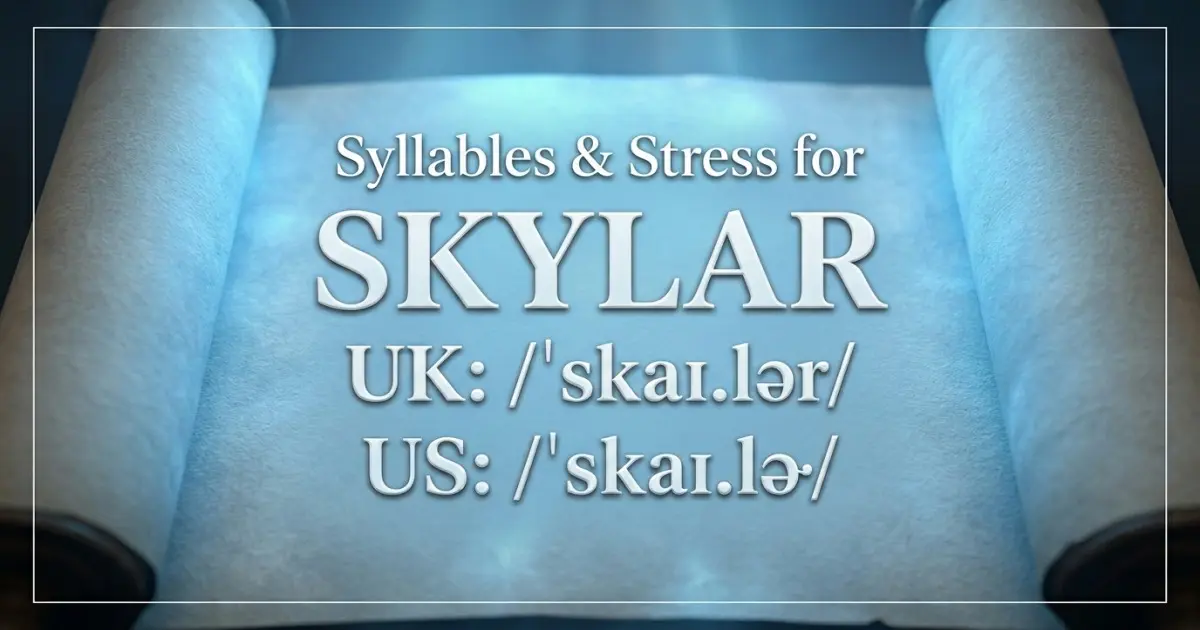
| IPA (US) | /ˈskaɪlər/ | In rhotic American speech, the final r is usually heard clearly. |
| IPA (UK) | /ˈskaɪlə/ | In many non-rhotic British accents, the final r softens or disappears unless another vowel follows. |
| Syllable count | 2 syllables | Hear it as SKY / ler, not as one rushed unit and not as a stretched three-syllable form. |
| Stress pattern | Primary stress on the first syllable | The opening should carry the name. If the second syllable gets too much emphasis, the whole rhythm weakens. |
| Ending sound | Light -ler ending | Let the ending land gently. It should finish the name, not compete with the opening. |
Why Skylar sounds right when the first syllable does the work
Skylar begins with a full, open vowel for a reason
The opening syllable in Skylar is where the name gets its brightness. Sky is not a reduced or passing sound. It is broad, clear, and unmistakably stressed. That strong opening is one reason the name feels so easy in modern speech. English speakers are very comfortable with names that declare their rhythm early, and Skylar follows that pattern perfectly. Pronunciation lands more fully when the name’s roots and history are already in view, so begin with Skylar meaning.
This first syllable also shapes the name’s personality. It feels open, quick, and slightly lifted. If that opening is weakened, the whole name becomes flatter. If it is spoken confidently, the name sounds exactly as it should: clear, modern, and easy to remember.
Why the second half of Skylar should stay lighter
The second syllable, -ler, should not carry equal weight. It exists to resolve the name rather than to balance it symmetrically. This lighter ending is part of what keeps Skylar from sounding hard or abrupt. The full name starts brightly and then lands softly.
That softness matters because the consonant cluster in the second half could otherwise make the name feel heavier than it is. Instead, the ending stays reduced and practical. In linguistic terms, the liquid consonant l helps the voice flow forward rather than stop sharply. That is one reason Skylar sounds smoother than some other brisk two-syllable names.
How the final sound differs slightly in US and UK speech
The supplied IPA forms show the main regional difference clearly. In American pronunciation, the name often ends in a lightly pronounced r: /ˈskaɪlər/. In many British pronunciations, that final r disappears unless another vowel follows: /ˈskaɪlə/. This is a normal rhotic versus non-rhotic difference, not a disagreement about the name itself.
That distinction is useful because it explains why Skylar can sound almost identical across accents while still having a subtly different finish. The opening remains the same. The stress remains the same. Only the tail changes slightly.
Where Skylar gets misheard, and why it usually happens fast
Skylar often gets pulled toward its nearest sound-neighbors
The most common challenge with Skylar is not that the name is difficult. It is that it lives in a crowded neighborhood of similar modern names. Skyler is the closest visual and phonetic cousin. Skyla sits right beside it. Skye can make the first syllable feel familiar before the reader has fully processed the rest. Schuyler, historically related in some naming traditions, can also make people pause if they know the older form.
Because of that, most errors happen at the level of expectation rather than actual pronunciation difficulty. A person sees the first four letters and assumes one of the neighboring names before finishing the word. Once corrected or heard once, Skylar usually stays fixed in memory.
What the most common pronunciation mistake usually sounds like
The most likely slip is not a dramatic mangling of the name. It is usually a drift toward Skyler as a spelling assumption or toward a heavier second syllable than the standard pattern really wants. That can make the name sound a little more deliberate and less effortless than intended.
The simplest fix is to return to the two clear beats: SKY-ler. Strong first syllable. Lighter second syllable. Once that balance is restored, the name sounds natural again.
Why Skylar is still easier than many trend-era names
Despite those neighboring-name issues, Skylar remains easier than many modern names because its sound structure is straightforward. There are no silent letters that radically alter expectation. There are no competing mainstream stress patterns. There is no unclear vowel sequence once the first syllable is recognized. In practice, Skylar is low-friction. It is a name people learn very quickly.
How Skylar shifts slightly across accents without losing itself
Skylar stays structurally stable in both US and UK English
One of the practical strengths of Skylar is that the core form stays stable across major English accents. The first syllable remains sky. The name remains two syllables. The stress stays on the opening. That kind of consistency makes a name easier to live with over time, especially in schools, travel, and increasingly international workplaces.
What changes is not the identity of the name but the edge of it. In American English, the ending usually closes with a clear r. In much of British English, it softens into a lighter final vowel unless another word links into it. That is a tiny adjustment, not a real pronunciation split.
Why this small accent difference rarely causes confusion
The reason the variation is so manageable is that the entire character of the name lives in the first syllable. Once a listener hears SKY-, the rest is familiar enough to resolve itself. Accent may color the landing, but it does not destabilize recognition. This is exactly the kind of variation most parents can comfortably live with: present, but not identity-changing.
How to make Skylar sound effortless in daily speech
Break Skylar into two beats, then say it naturally
The easiest practice method is rhythmic. Say it first in two beats: SKY / ler. Then say it again at ordinary conversational speed. If the ending starts sounding too heavy, lighten it. If the first syllable weakens, restore the stress. The goal is not to say the name theatrically. The goal is to let the natural balance show.
A helpful contrast set is:
- Skylar, not a rushed one-syllable blur
- SKY-ler, not sky-LER
- bright opening, softer finish
Practice lines that sound like real life
Names are easiest to learn inside normal speech rather than in isolation. Try saying Skylar in phrases such as:
- Skylar, your table is ready.
- This certificate is for Skylar Brooks.
- Can Skylar come to the office, please?
- I’m looking for Skylar Parker.
These kinds of phrases matter because they place the name where it actually lives: classrooms, ceremonies, appointments, sports teams, and daily family life. Skylar works well there because its rhythm is immediate and its syllables are familiar.
Why Skylar sounds polished because it never overcomplicates itself
Skylar is a good example of a name whose elegance comes from balance rather than elaboration. It does not need extra syllables, difficult clusters, or unstable stress to sound current. Its effect comes from a strong first beat, a quick second beat, and a clean overall silhouette. That is why it feels so effortless in speech.
In the end, the best way to pronounce Skylar is also the most natural one: open clearly on SKY, let the second syllable fall into place without overemphasis, and trust the name’s built-in rhythm. SKY-ler is not only the standard pronunciation. It is the version that best preserves what makes the name work so well aloud: brightness, clarity, and easy modern poise.