
Sierra Name Meaning: Origin, Vibe, and Timeless Appeal
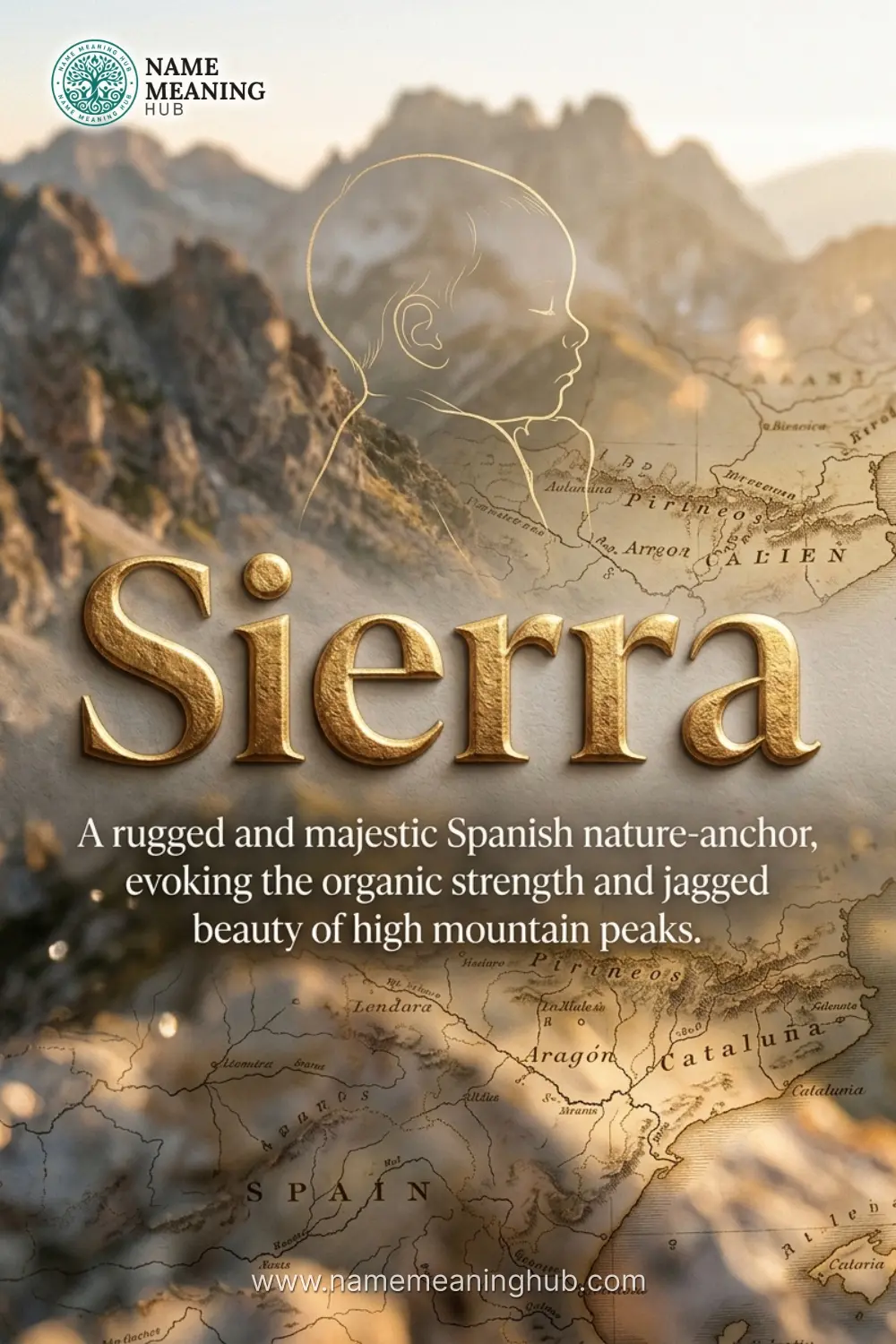
Sierra is one of those names that sounds expansive before anyone explains it. It carries distance, elevation, weather, and contour in a way few modern names do. The meaning “mountain range” is important here because it makes Sierra more than a pretty landscape label. A mountain range is not one peak and not one dramatic gesture. It is a long line of rising forms, a geography of endurance. That is the central thread running through the name: Sierra does not suggest a single brilliant moment. It suggests sustained presence.
That is why Sierra has lasted. Many nature names lean soft, floral, or delicate. Sierra belongs to another branch of the category altogether. It is beautiful, but with backbone. It evokes distance and height without sounding remote. It hints at the natural world, but not at the garden edge. This is a name of ridgelines, horizons, and something larger than ornament. Even when chosen simply because it sounds graceful, Sierra carries an older visual truth inside it: a range is many forms holding together. The name, in that sense, is not only scenic. It is structural.
Sierra's U.S. popularity rank over time, 1940–2024
Popularity statistics are based on official data from the Social Security Administration baby name records.
Sierra: A Rugged and Majestic Natural Strength
Sierra functions as a name with one unmistakable center of gravity, where the girls’ side of the chart carries nearly all of its public visibility. Its strongest momentum belongs to the late 1990s, yet it remains a reliable choice parents trust for its evocative connection to nature.
The lack of a secondary track reinforces its firm and focused public identity. Meaning “mountain range,” its melodic three-syllable sound provides a sense of durable character that remains widely recognized.
What Sierra tells you once you stop hearing only scenery
| Key Facts | Information | Quick Insight |
|---|---|---|
| Name | Sierra | The name feels open and natural, but it also has sharper edges than many other landscape names. |
| Primary gender usage | Female | It is clearly feminine in current use, though its sound has enough strength to avoid fragility. |
| Primary origin | Spanish | The Spanish origin gives the name geographic authenticity rather than a purely invented outdoorsy mood. |
| Core meaning | Mountain range | This is a landscape meaning with scale, endurance, and shape built into it. |
| Pronunciation | see-AIR-uh | The soft opening and broader center make the name sound airy, but the overall line remains grounded. |
| IPA (US) | /siˈɛrə/ | The stress in the middle gives Sierra a subtle swell, which helps the name feel spacious rather than flat. |
| IPA (UK) | /siˈerə/ | The pronunciation remains stable across accents, which adds to the name’s everyday usability. |
| Syllables | 3 | Three syllables give the name grace and movement without turning it overly formal. |
| U.S. girls’ rank (2024) | No. 596 | Official data shows a name that is familiar enough to feel established, but not overused. |
Sierra means landscape with backbone, not just beauty
What separates Sierra from many other attractive modern names is that its image is already doing moral work. “Mountain range” is not a decorative meaning. It implies continuity, line, elevation, roughness, and resilience. That makes Sierra fundamentally different from names that name a single flower, a single season, or a color. A range is plural even when spoken as one thing. It is made of separate forms that hold together as a whole. That collective quality gives the name unexpected depth.
Research across naming guides often shows that place and nature names become durable when they suggest more than scenery. Sierra does. It carries the visual grandeur of mountains, but also their discipline. There is height here, but also contour. There is beauty, but it is not fragile beauty. The name therefore appeals to parents who want something natural without making it gentle to the point of weightlessness.
Why “mountain range” is stronger than “mountain”
It is worth dwelling on the exact meaning. A mountain is singular. A mountain range is relational. One summit may be striking, but a range suggests sequence and endurance over distance. In symbolic terms, that makes Sierra feel more dimensional than many other place names. It points not only to height but to span. The name can therefore imply strength without sounding hard, because the image it offers is sweeping rather than blunt.
This also explains why Sierra often feels mature in a way some modern landscape names do not. It is not cute. It is not whimsical. It is not a little postcard of nature. It is topography. Parents may choose it because it sounds lovely, but what gives it staying power is that it means something larger than loveliness.
Why the landscape behind Sierra never feels cold
And yet Sierra does not sound severe. This is where the name is especially successful. A word tied to serrated ridges and dramatic landforms might have become abrupt or overly rugged in English, but Sierra softens the geography into graceful speech. The meaning contributes strength; the sound contributes warmth. That balance is crucial. Without it, the name might have remained only a place-word. With it, Sierra becomes a person-name that carries grandeur lightly.
In practical life, this gives the name unusual flexibility. It can suggest independence, natural beauty, calm confidence, even a kind of untamed dignity, without locking a child into a harsh image. The range remains there, but the voice is human-sized.
How Sierra moved from Spanish landscape into modern naming
Sierra is rooted in Spanish, and modern naming references regularly explain the word through two linked ideas: the literal sense of a “saw” and the visual extension to mountain ranges with jagged or serrated outlines. That is useful because it shows how the name’s geography came into being. The mountains are not only high. They are named through shape. The ridgeline matters.
This linguistic detail deepens the name rather than complicating it. A name like Sierra is not merely “nature” in the abstract. It comes from a real descriptive logic. Historically, the word moved from object to landscape, and then from landscape into naming. That kind of pathway often produces some of the most durable modern names because they feel anchored in something observable, not just imagined.
Why the Spanish origin matters to the feel of the name
Spanish contributes more than etymology here. It contributes atmosphere. Many Spanish-origin names in English feel fluid, bright, and open-voweled, and Sierra benefits from that same musical ease. The name sounds elegant enough to be feminine and airy, but still grounded because the source image is so physical. That is a powerful combination. Parents do not have to choose between lyricism and terrain. Sierra gives them both. If you want to go deeper into this heritage, visit baby names in this origin group.
It is also notable that Sierra entered wider English-speaking naming culture at a moment when place names and nature names were becoming increasingly attractive. Books of names from the late twentieth and early twenty-first centuries repeatedly group Sierra alongside other place-based and landscape-based choices, but it tends to stand out because it sounds less trendy than many of its neighbors. It has more semantic weight than names chosen only for atmosphere.
Why John Muir’s mountain vision still fits Sierra
One of the strongest literary anchors around Sierra comes from mountain writing itself. John Muir famously described the Sierra as a “Range of Light,” and that phrase remains one of the best ways to understand why the name carries such emotional force. The phrase does not appear on the birth certificate, but it shadows the name beautifully. Sierra is not just rock and altitude. It is a line of land made radiant by light. That image helps explain why the name can sound both strong and luminous at once.
In other words, Sierra does not merely mean wilderness. It means wilderness seen with reverence. That is a richer inheritance than many modern place names can offer.
Why Sierra sounds graceful even though its meaning is rugged
Phonetically, Sierra succeeds because the sound profile softens the visual harshness of the mountains behind it. The opening see- is light and immediate. The stressed middle, AIR, opens the name wide, giving it a feeling of space. The final -uh lets it settle gently. The result is a name that sounds expansive rather than jagged, even if the image behind it is rugged.
That tension between sound and meaning is part of what makes Sierra so compelling. A harsher sound would have made the name too blunt. A softer meaning would have reduced its strength. As it is, Sierra sounds approachable while still carrying topographic heft. This is rare. Many names either sound stronger than they mean or mean more than they sound. Sierra is balanced.
How the stress pattern helps the name breathe
The stress falls in the middle: see-AIR-uh. That creates a swell rather than a strike. The name seems to widen in the center before trailing off softly. This is one reason Sierra feels so wearable in daily speech. It is not abrupt, and it is not overlong. It breathes in the middle. For a name tied to open terrain, that is a fitting sound pattern.
This also makes Sierra more memorable. Names with a clear internal expansion often leave a stronger trace in the ear than names that remain equally flat across all syllables. Sierra opens, and that opening becomes part of its elegance.
Why Sierra avoids the over-sweetness of some nature names
Many feminine nature names drift toward sweetness, especially if they end in floral softness or open vowels without any underlying structure. Sierra avoids that because the middle stress and the mountain imagery keep it grounded. Even when it sounds lovely, it never sounds flimsy. There is always a ridge beneath the softness.
That is one reason the name matures well. A child named Sierra can sound bright and outdoorsy, but an adult named Sierra still sounds credible, composed, and fully formed.
Sierra among its style neighbors is less delicate than it first appears
Style neighbors help clarify what kind of femininity a name suggests. Compared with Savannah, Sierra feels less sprawling and less Southern in atmosphere. Compared with Sienna, it feels less color-based and more land-based. Compared with Skye, it has more structure and more groundedness. Compared with Aspen, it sounds warmer and less clipped. Compared with names like Meadow or Prairie, Sierra feels more geographic and less pastoral.
This is a useful distinction. Sierra belongs to the nature-name world, but not to the meadow-and-bloom side of it. It belongs to the elevation side: cliffs, ridgelines, mountain light, distance. That gives the name a type of femininity that is strong without needing hardness. It sounds self-possessed more than decorative. That may be exactly why it remains attractive even after the peak popularity era of many other landscape names has passed.
It also means Sierra can fit a surprisingly wide range of surnames and family styles. It is feminine without being ornate, outdoorsy without being rustic, and modern without feeling invented. Those are valuable qualities for a name that sits outside the classic saint-and-family-name tradition.
Sierra in the current landscape feels known, not crowded
Official Social Security Administration (SSA) data places Sierra at No. 596 for girls in 2024. That position tells a useful story. The name remains recognizably part of the naming vocabulary, but it is no longer so common that it dissolves into repetition. For many parents, that is ideal. They can choose a name people already know how to say and spell, while still giving their child something that feels distinctive. To explore more names that sit in this same category, see more baby girl names.
This middle zone may suit Sierra especially well. The name was always a little expansive, a little scenic, a little more cinematic than ordinary utility names. If it becomes too common, some of that specialness can flatten. If it becomes too rare, it can seem like a statement. At its current level, Sierra keeps its individuality without feeling unfamiliar. It is known, but not crowded.
That also helps the name age better. A highly trendy place name can feel pinned to one decade. Sierra now sits at enough distance from peak saturation that its deeper qualities are easier to hear again: strength, terrain, brightness, and line.
Where Sierra naturally opens next
Middle names that either sharpen or soften Sierra
Because Sierra already has grace and topographic strength, middle names usually work best when they either provide crisp classic contrast or deepen the natural warmth. The strongest pairings help the full name sound complete without overdoing the landscape effect. If you want the full pairing logic behind that contrast, see Sierra middle names.
Nicknames that make Sierra more intimate without shrinking it too much
Sierra does not need a nickname to function, but a few plausible shortenings can make it friendlier, younger, or softer in daily life. The challenge is finding a diminutive that keeps enough of the name’s shape intact. To see how those different moods shorten in real life, explore Sierra nicknames.
Pronunciation that preserves both air and ground
see-AIR-uh works because the name opens lightly, broadens in the middle, and settles softly. If that rhythm stays intact, Sierra sounds as spacious as the image behind it. For the detailed stress pattern, accent notes, and IPA, see Sierra pronunciation guide.
Why Sierra still sounds like more than a place name
Sierra lasts because it does more than point to scenery. It gives a child a name with line, elevation, and light inside it. It is a geography name, yes, but one with emotional architecture. The range behind it suggests endurance. The sound softens that endurance into grace. The Spanish origin keeps the word rooted in a real descriptive world. The modern usage keeps it human and wearable.
Some names borrowed from the natural world remain charming but slight. Sierra does not. It holds together beauty and terrain, softness and ruggedness, openness and form. That is why it keeps attracting parents even after its first wave of popularity has passed. Sierra does not just sound pretty. Sierra sounds like it can hold weather. And that, in the end, may be the most faithful way to understand the name: not as a postcard, but as a line of land strong enough to stay visible from far away. That is why Sierra still sounds like Sierra.