
How to Pronounce Siena: Clear Pronunciation Help for Everyday Use
Siena is the kind of name that often gets tested in one ordinary, revealing moment: a teacher pausing at roll call, a receptionist reading from a clipboard, or a barista trying to say it correctly from handwriting alone. It looks elegant enough to make some people hesitate, especially because it resembles the more familiar visual pattern of names that can be read more than one way. But once spoken aloud, Siena usually feels simpler than it first appears. It is not a name that asks for performance. It asks for rhythm.
That rhythm is what makes Siena so wearable. The name is said see-EN-uh, with the stress landing clearly in the middle. The first syllable opens lightly, the second does the real work, and the final syllable falls away softly. That pattern matters because it gives the name both grace and clarity. Siena sounds cultured without sounding fussy, and much of that comes down to how cleanly its pronunciation moves. When it is said well, the name feels warm, fluid, and easy in the mouth.
What Siena is actually asking your mouth and ear to do
| Element | Phonetic Detail | Quick Tip |
|---|---|---|
| Everyday pronunciation | see-EN-uh | Think of a light opening, a strong middle, and a soft final release. |
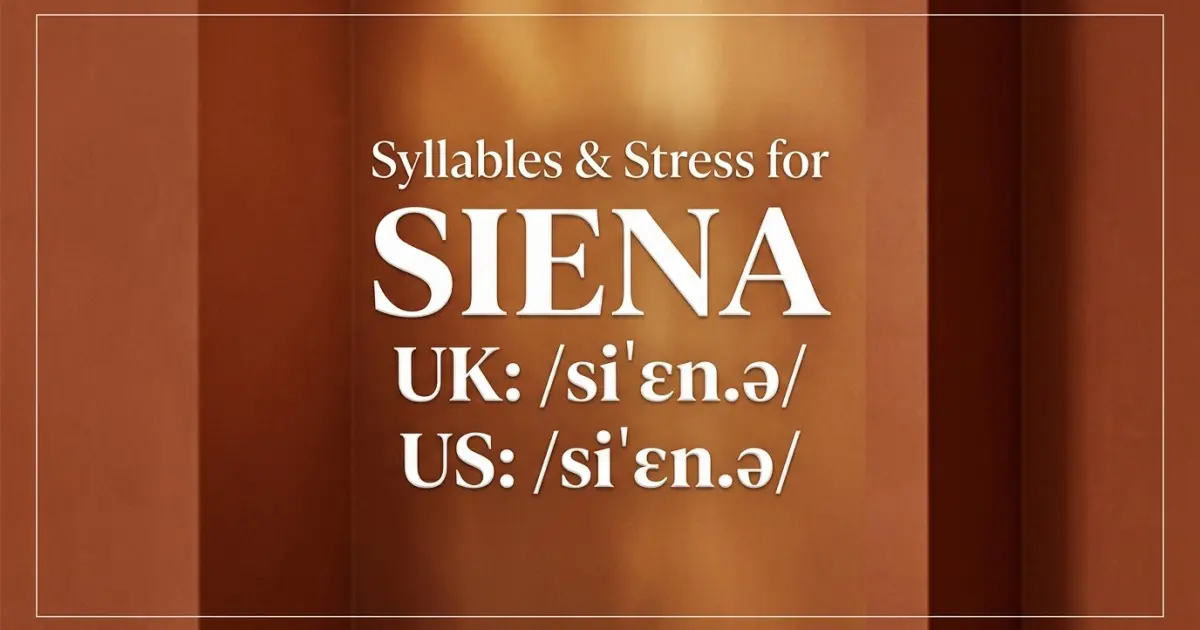
| IPA (US) | /siˈɛnə/ | The stress mark before ɛn shows that the middle syllable carries the name. |
| IPA (UK) | /siˈenə/ | The UK version stays extremely close, so the overall rhythm remains stable across accents. |
| Syllable count | 3 syllables | Break it into see + EN + uh, not a rushed two-part blur. |
| Stress pattern | Second syllable stressed | If the first syllable gets too much emphasis, the name immediately sounds less natural. |
| Opening sound | /si/ | Start with the clean “see” sound, not “say” or “she.” |
| Middle sound | /ɛn/ or /en/ | This is the name’s anchor. Let it be clear, short, and slightly firmer than the other syllables. |
| Ending | /ə/ | Finish with a light schwa sound, not a full “ah” or a clipped stop. |
Siena in everyday speech is easier than the spelling first suggests
Siena works because its sound pattern is cleaner than its visual elegance might imply. The name opens with /s/, a fricative. That simply means the sound is formed by letting air move through a narrow passage, as in sun or see. Fricatives often help names begin smoothly, and Siena benefits from that immediately. It does not enter the ear with a hard strike. It glides in. The sound matters more once you know what the name is meant to carry, which is why the wider frame starts in Siena meaning.
After that smooth opening comes the real center of the name: the stressed EN. This is the syllable that gives Siena its shape. Without that clear middle beat, the name can sound vague or over-softened. With it, the name sounds poised and complete. Then comes the final, light uh, which lets the name land softly rather than closing it too sharply.
Why the middle syllable matters so much in Siena
The most important pronunciation fact about Siena is that the stress belongs in the middle. A lot of name confusion happens when readers assume that a beautiful or Italian-looking name must be spread evenly across all syllables. Siena does not want that. It wants a center of gravity. The middle syllable gives the name lift, and it is the reason the name sounds elegant rather than flat.
A useful way to hear it is this: the first syllable invites the name in, the second names it, and the third lets it go. That is why see-EN-uh works so naturally. It gives Siena motion and contour at the same time.
Why Siena should never sound over-enunciated
Some names become awkward because people try too hard to say them “correctly.” Siena is not improved by excessive precision. If every syllable is given equal force, the name can sound stiff or theatrical. The best spoken version is fluid. The opening is light. The middle is clear. The end is gentle.
In everyday life, this makes Siena especially strong. It sounds graceful without demanding special care every time it is spoken. That is one reason it travels so well in English-speaking settings.
Where people usually go wrong with Siena
Most pronunciation mistakes with Siena come from two habits: trusting the spelling too much or flattening the rhythm too quickly. The good news is that the errors are predictable, which means they are easy to correct once the pattern is understood.
Turning Siena into “see-AH-nuh” or “say-EN-uh”
The first common mistake is shifting the first vowel or misplacing the emphasis. Some readers may try something closer to see-AH-nuh, especially if they are treating the name as more fully Italian in rhythm than it is in current English use. Others may drift toward say-EN-uh, which usually happens when the letters are read too literally or compared to neighboring names with different vowel patterns.
The fix is simple: keep the opening at see, not say, and let the middle do the stress work. Once that happens, the rest of the name usually falls into place on its own.
Collapsing Siena into two syllables
Because Siena looks compact on the page, some speakers rush it and end up with something closer to SYEN-uh or a blurred two-beat version. In fast speech, some natural compression is normal, but the name still needs three audible parts. Siena loses some of its elegance when the first two syllables are crushed too tightly together.
The easiest correction is to rehearse the beats separately: see / EN / uh. The first and second syllables should stay distinct even in casual speech.
Overweighting the final syllable
A less common mistake is making the ending too dramatic, as if the name finished with a bold AH. Siena does not need that. The final syllable is a schwa, the soft neutral vowel sound heard in many English unstressed endings. It should feel light, almost like the sound at the end of sofa. That softness is part of the name’s grace.
Siena keeps its identity across American and British accents
One of Siena’s practical strengths is that its U.S. and U.K. pronunciations remain very close. The IPA forms differ only slightly in the middle vowel coloring: /siˈɛnə/ in the U.S. and /siˈenə/ in the U.K. For most listeners, this difference is subtle. The name still begins with see, stresses the middle, and ends softly.
What changes slightly from accent to accent
The middle vowel may sound a touch more open in American speech and slightly narrower in some British speech. But this is accent texture, not a real identity shift in the name. The overall musical line stays the same. That makes Siena unusually stable for a name with Italian origin and stylish modern use.
That stability matters more than people think. A name that sounds essentially like itself in multiple English accents is easier to live with. It reduces friction in school, travel, introductions, and professional life.
Siena’s closest sound neighbors are the best teaching tools
The easiest way to teach Siena is to build it from sounds people already know. Start with see. Then add EN. Then let it fall into uh. This is much more useful than comparing it to another full name, because the rhythm is the real point. Once someone hears that middle stress, the name becomes easy to remember. The way the name resolves at the end often decides which short forms feel natural in speech, and that becomes clearer in nicknames for Siena.
That is also why Siena tends to be learned quickly. It is elegant, but not phonetically exotic. It sounds name-like to English ears almost immediately.
How to practice Siena until it feels completely natural
The best test of a pronunciation is not whether it sounds right in isolation, but whether it stays right in normal sentences. Siena performs especially well here because the name keeps its shape in connected speech. It does not collapse when another word follows it.
Practice lines that help Siena settle into the voice
- Siena is here.
- I’m calling Siena now.
- Siena left her notebook.
- We’re so glad Siena came.
- Siena, your table is ready.
These practice lines do something useful. They reinforce the middle stress and keep the final syllable light. They also reveal how easily Siena moves in daily speech. The name sounds polished, but never precious. That is a real pronunciation advantage. A beautiful name that stays easy in ordinary life tends to feel more durable.
In the end, Siena’s pronunciation reflects the best part of the name itself: warmth carried with discipline. Say it lightly, center it clearly, and let it land softly. Once you do, Siena sounds exactly as it should—graceful, vivid, and far easier than its beauty first suggests.