
How to Say Semaj Correctly: A Simple Pronunciation Guide
Imagine a substitute teacher pausing over a classroom roster. The spelling looks simple enough at first — five letters, familiar pieces — but then the order reveals the twist: Semaj is James reversed. That visual discovery can make readers hesitate, because the name does not sound like James backward in a mechanical way. It has its own spoken identity: suh-MAHZH. Once heard, the pronunciation is smooth and memorable, but it often needs one clear model the first time.
Semaj is an American-origin boy’s name meaning “supplanter,” through its relationship to James. Its pronunciation is part of what makes it feel modern rather than merely reversed. The name has two syllables, stress on the second, and a soft final sound like the ending of mirage. That final zh gives Semaj a polished finish, very different from the hard j sound in James. The key is to say it as a flowing name, not as a spelling puzzle: suh-MAHZH.
Semaj Is Said With a Soft Opening and a Stylish Final “Zh”
| Element | Phonetic Detail | Quick Tip |
|---|---|---|
| Standard pronunciation | suh-MAHZH | Begin lightly with suh, then place the emphasis on MAHZH. |
| Syllable count | 2 syllables | Say it in two beats: suh + MAHZH. |
| Stress pattern | Second syllable stressed | The name should rise into the second syllable, not lean heavily on the first. |
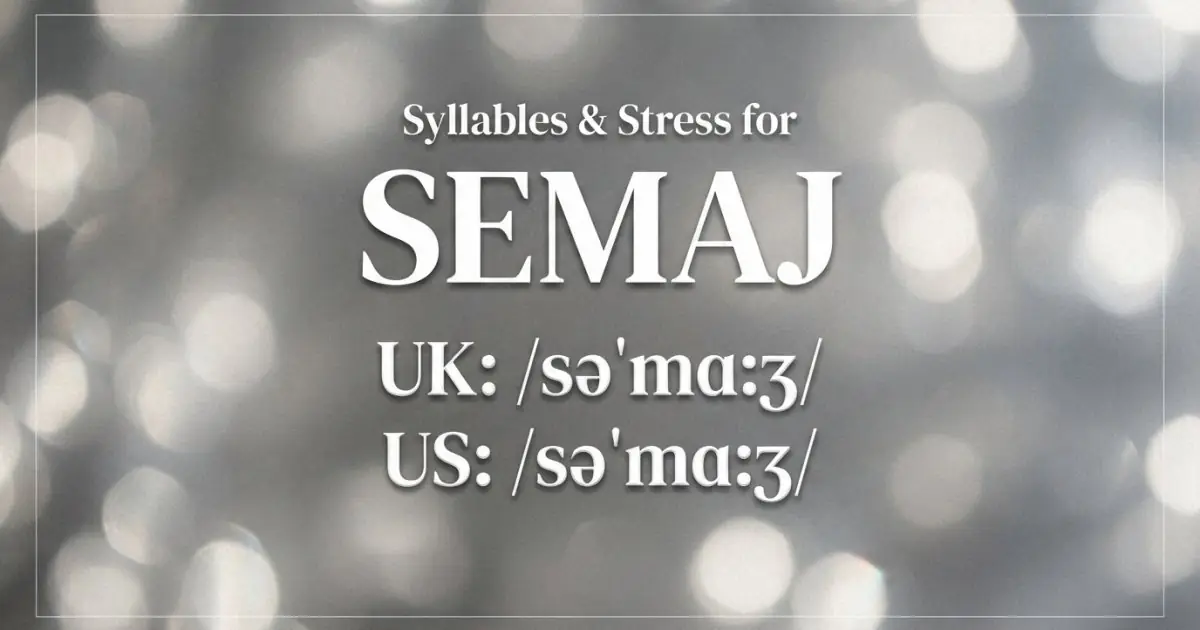
| U.S. IPA | /səˈmɑːʒ/ | The final symbol ʒ is the soft sound in measure and mirage. |
| U.K. IPA | /səˈmɑːʒ/ | The core pronunciation is the same in U.S. and U.K. English. |
| Common short form | Maj | The nickname comes naturally from the stressed second syllable. |
The Everyday Pronunciation of Semaj Depends on the Second Syllable
The most important feature of Semaj is its stress pattern. Unlike many English names that place emphasis at the beginning, Semaj places the weight on the second syllable: suh-MAHZH. The first syllable is light and quick. The second syllable is longer, fuller, and more memorable. Pronunciation lands more fully when the name’s roots and history are already in view, so begin with Semaj meaning.
The first syllable should stay gentle
The opening Se- is pronounced like suh, using a soft, reduced vowel. It should not sound like see, say, or seh with strong emphasis. In the IPA form /səˈmɑːʒ/, the symbol ə represents schwa, the relaxed vowel heard in many unstressed English syllables.
The first sound, s, is a fricative. A fricative is made by letting air pass through a narrow channel, which gives the opening a smooth, airy quality. That softness helps Semaj begin quietly before it lands on the stronger second syllable.
The final sound is not the J in James
The ending of Semaj is the detail most worth teaching. Even though the spelling ends in j, the pronunciation uses the soft zh sound, as in mirage, measure, or vision. This sound is written as ʒ in IPA.
That means Semaj is not usually said with the hard j sound in jump, Jack, or James. Saying suh-MAHJ with a hard final j changes the name’s feel. The softer zh gives Semaj its smooth, polished finish.
Semaj’s IPA Explains Why the Name Sounds So Smooth
The IPA pronunciation for Semaj is /səˈmɑːʒ/ in both U.S. and U.K. English. This spelling shows four important details: the first syllable is unstressed, the second syllable is stressed, the vowel in the second syllable is broad and open, and the final sound is zh.
Reading /səˈmɑːʒ/ in plain English
The first part, /sə/, gives suh. It is short and light. The stress mark before the next syllable shows where the emphasis goes. The middle part, /mɑː/, gives the broad mah sound, like the vowel in many careful pronunciations of father. The final /ʒ/ gives the soft ending.
Put together, the name becomes suh-MAHZH. It should feel like one smooth movement, not like two separate words. The first syllable prepares the sound; the second syllable completes it.
Why Semaj is not pronounced like “seh-madge”
Because English readers often expect final j to sound hard, some may guess seh-MAJ or seh-madge. The intended pronunciation is softer and more elegant. The a in the stressed syllable should be broad, and the final consonant should glide rather than snap.
A helpful correction is: “It’s suh-MAHZH, like the ending of mirage.” That gives listeners a familiar sound to copy without a long explanation.
Accent Differences Usually Leave Semaj’s Core Pronunciation Intact
Semaj is fairly stable across English accents because its IPA form is the same in U.S. and U.K. pronunciation: /səˈmɑːʒ/. The name’s identity depends more on stress and final sound than on small regional vowel differences. As long as the first syllable is light, the second syllable is stressed, and the ending uses zh, the name will be recognizable.
American English may make the second vowel broad but relaxed
In American English, the second syllable may sound like mahzh, with a broad open vowel. Some speakers may make the vowel slightly shorter in quick speech, but the stress still belongs on that syllable. The final zh should remain soft.
British English may sound slightly more clipped
In British English, Semaj may sound a little more clipped or formal, but the same basic structure remains. The first syllable stays reduced, and the second syllable carries the main emphasis. The final zh is still the key sound.
This makes Semaj easier to use internationally than its spelling might first suggest. The pronunciation may need to be taught once, but the sound itself is not long or complicated.
Common Mistakes With Semaj Are Easy to Correct
Most pronunciation mistakes with Semaj come from reading the letters too literally or from assuming the name should behave like James. A short, confident correction usually solves the problem.
Mistake one: saying SEE-maj
The first syllable should not sound like see. It is suh, light and unstressed. The emphasis belongs on the second syllable: suh-MAHZH.
Mistake two: using a hard final J
The final sound should not be the hard j in James. It should be the soft zh sound in mirage. This is the most important correction for keeping the name’s intended style.
Mistake three: stressing the first syllable
Semaj should not be pronounced SEE-maj or SEM-aj. The name rises into the second syllable. A simple rhythm cue is: “soft first, strong second.”
Practice Lines Help Semaj Become Natural in Real Speech
Semaj becomes much easier once it is practiced in real phrases. These lines help parents, relatives, teachers, and the child himself model the name clearly and confidently.
Slow pronunciation practice
Semaj. suh-MAHZH. Semaj.
The first syllable is soft: suh.
The second syllable is strong: MAHZH.
Everyday family practice
Semaj, breakfast is ready.
Good morning, Semaj.
Semaj, come sit over here.
School and introduction practice
This is Semaj.
Semaj is pronounced suh-MAHZH.
It is James reversed, but it has its own pronunciation.
Correction practice
It’s Semaj, pronounced suh-MAHZH.
The ending sounds like mirage.
Two syllables: suh-MAHZH.
Common Questions About Pronouncing Semaj
How do you pronounce Semaj?
Semaj is pronounced suh-MAHZH. The first syllable is light, and the second syllable is stressed.
How many syllables are in Semaj?
Semaj has two syllables: suh-MAHZH.
What is the IPA pronunciation of Semaj?
The IPA pronunciation of Semaj is /səˈmɑːʒ/ in both U.S. and U.K. English.
Is Semaj pronounced like James backward?
No. Semaj is James reversed in spelling, but it is pronounced suh-MAHZH, with a soft final sound like the ending of mirage.