
How to Pronounce Selah: How the Rhythm of the Name Really Works
The real-life test for Selah usually happens in a waiting room, a classroom doorway, or the first few seconds of a formal introduction. Someone sees the name on paper, pauses, and has to decide whether it opens with “say,” “see,” or “seh.” That hesitation is exactly why pronunciation matters here. Selah looks simple, but it is one of those names whose atmosphere depends on getting the vowel right. Spoken correctly, it feels calm, airy, and self-possessed. Spoken incorrectly, it can lose the softness that made the name appealing in the first place.
In everyday English, the most useful guide is straightforward: SEE-luh. The first syllable carries the stress, and the second syllable falls away gently. That pattern is what gives Selah its ease. It begins with brightness and ends with softness. There is no hard stop, no dramatic flourish, and no complicated mouth movement hiding inside it. Once heard aloud, the name usually settles quickly. The challenge is not that Selah is difficult. The challenge is that its spelling invites one brief moment of uncertainty before the sound clicks into place.
What the name Selah is clarifying every time it is spoken aloud
| Element | Phonetic Detail | Quick Tip |
|---|---|---|
| Everyday pronunciation | SEE-luh | Think of a bright “see” followed by a soft, relaxed ending. |
| Syllable count | 2 syllables | Hear it as two beats, not three: SEE + luh. |
| Primary stress | First syllable | The emphasis belongs on SEE; the second syllable should stay light. |
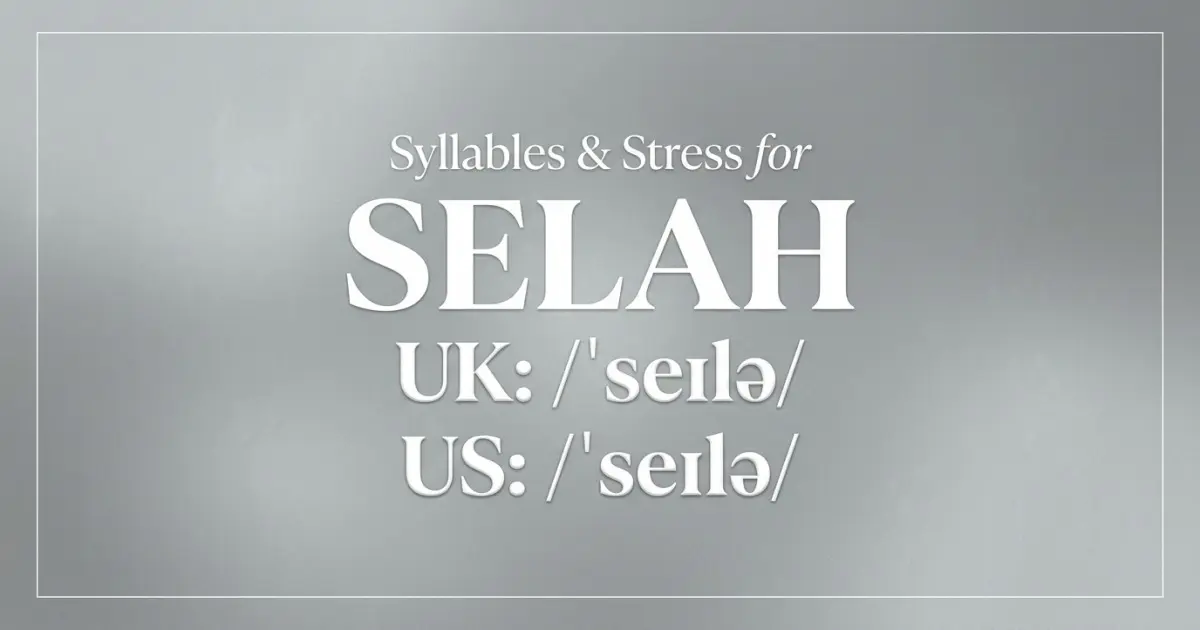
| US IPA | /ˈsiːlə/ | The long ee sound is the anchor. Once that is right, the rest follows naturally. |
| UK IPA | /ˈsiːlə/ | The British and American forms align closely, which makes the name portable across accents. |
| Ending sound | Reduced schwa-like luh | Do not make the ending too heavy or theatrical; let it land softly. |
| Most common confusion | Reading it as SAY-luh or SEE-lah | The first vowel is long ee, and the last syllable is gentler than a full “lah.” |
Selah works because the first syllable does the real work
Selah is only two syllables, but they are not equal. The first syllable carries the identity of the name. It is stressed, bright, and sustained. The second syllable is lighter and more relaxed. That is why the name sounds graceful rather than abrupt. If both syllables were equally strong, Selah would feel choppier. If the second syllable were overemphasized, it could drift into something heavier than the name naturally wants to be. Before focusing only on syllables and stress, it helps to step back into the fuller frame of Selah meaning.
The opening sound is the easiest part to get wrong and the easiest part to fix. It is not “say.” It is not a short “seh.” It is a long ee vowel, as in “see.” Once that long vowel is in place, the name immediately becomes more luminous and more accurate. The second half, luh, is not difficult, but it should remain soft. In English phonetics, that last vowel functions like a reduced unstressed sound, often called a schwa. That means the name does not end with a dramatic open “AH” but with a gentler release.
Why Selah sounds soft without sounding weak
Part of the answer lies in the consonants. Selah opens with an s, a fricative consonant. Fricatives create a stream of air rather than a hard tap or stop, so the name begins with breath rather than impact. Then comes the l, a liquid consonant, which naturally helps the sound flow instead of snapping shut. Those two features make Selah feel smooth in the mouth. The name does not ask the speaker to wrestle with it. It glides.
That glide is important socially too. Names that are easy to say often become easier to remember and easier to repeat confidently. Selah benefits from that. Its sound profile is gentle, but its structure is clear.
Selah in IPA and everyday accent differences
The IPA forms for Selah are reassuringly stable: /ˈsiːlə/ in both American and British English. That does not mean every speaker sounds identical, but it does mean the central pronunciation target stays essentially the same. The long ee vowel remains the anchor, the first syllable remains stressed, and the second syllable remains soft.
What changes a little from accent to accent
In actual speech, some regional accents may make the final syllable slightly lighter, almost fading it into the background. Others may give it a touch more body. But these are small differences, not identity-changing ones. The practical good news for parents is that Selah travels well. Unlike some names that shift dramatically across English-speaking regions, Selah tends to remain recognizable and stable once the speaker knows the intended vowel.
The main caution is not about accent, but about first-glance interpretation. A reader unfamiliar with the name may guess a different first vowel because the spelling is less common than the sound itself. After correction, however, most people do not struggle with it for long.
When family usage should lead
As with any name that has spiritual and textual history, some families may emphasize the ending a little differently or use a slightly more open final vowel. That is not a problem. The bearer’s family usage should always be treated as the most important guide. Still, in general English-language use, SEE-luh remains the clearest and most widely useful pronunciation standard.
Where people usually misread Selah, and why
Most mistakes with Selah are predictable. The first is SAY-luh, which happens because the spelling tempts some readers into applying a more familiar English pattern. The second is SEE-lah, where the final syllable becomes too fully open and weighted. The third is SELL-uh or SEH-luh, which shortens the first vowel and takes away the brightness that defines the name.
Why these mistakes happen
The reason is simple: Selah looks like a word name but behaves like a name with its own established sound pattern. English readers are trained to guess from spelling, and here the spelling alone does not guarantee the right answer. That is not unusual. Many names live comfortably once spoken even if they generate a moment of doubt when first read. Selah belongs to that category. It is easier by ear than by sight.
There is also some understandable confusion because similar-looking forms have circulated in other naming contexts. That can encourage readers to import a different vowel pattern. But in ordinary contemporary use, the clean target remains SEE-luh.
Sound neighbors that help the ear
To get comfortable with Selah, it can help to compare it with names that share some of its sound properties. The opening resembles the beginning of names built on a long ee sound, while the soft second syllable behaves a bit like the endings in many familiar two-syllable girls’ names. The trick is not to over-associate Selah with any one neighbor, but to understand its balance: bright front, quiet back. That is its whole identity. Because the strongest energy lands early, the shorter forms often grow from the opening of the name, and that pattern is easier to see in Selah nicknames.
Selah becomes easy once you place it inside a living sentence
Names often sound harder in isolation than in conversation. Selah is a perfect example. Spoken inside an ordinary line, the rhythm becomes obvious almost immediately. Try these aloud:
- “Selah, your teacher is here.”
- “I’m looking for Selah.”
- “Selah will join us after lunch.”
- “Please welcome Selah.”
In each sentence, the same thing happens: the voice rises on SEE and softens on luh. If the name sounds stiff, you are probably overthinking the spelling. If it sounds heavy, you are probably over-pronouncing the second syllable. The goal is not a dramatic recital. It is a calm, confident everyday saying of the name.
A useful memory trick is to hear Selah as “see” plus a softened “luh.” That is far more reliable than trying to derive the sound from spelling rules in the moment. Once the ear catches the long first vowel, the name tends to stay learned.