
Sean Name Meaning: Its Roots, Symbolism, and Lasting Identity

Sean is one of those names that seems plain until you look at the layers that have made it durable. On the surface, it is compact, familiar, and spoken in a single clean beat: SHAWN. But under that plainness sits a more interesting tension. Sean is deeply Irish in spelling and cultural feeling, yet its meaning belongs to one of the great recurring ideas in naming history: grace. Not beauty, not power, not conquest, but grace. That distinction matters. A name meaning “God is gracious” does not build identity around self-assertion. It builds it around gift, favor, and a sense that goodness arrives not by force but by blessing.
That may be why Sean has lasted so well across countries and generations. It does not sound ornate or pious, even though its meaning is theological. It sounds lived-in. It has the rare ability to carry an old religious idea in a socially modern form. The spelling roots it in Irish tradition; the sound makes it easy in English; the meaning gives it depth far beyond its single syllable. Sean is therefore not just a classic Irish boys’ name. It is a name that turns grace into something plainspoken, masculine, and steady enough for ordinary life.
Sean's U.S. popularity rank over time, 1925–2024
Popularity statistics are based on official data from the Social Security Administration baby name records.
Sean: A Sturdy and Noble Irish Heritage Pillar
Sean presents a chart pattern of a broader past with a clearer present, reflecting a massive naming cycle that reached its height at #9 in the 1970s and 80s. While it behaves as a “legacy classic” today, it continues to offer a sense of reliability and quiet, honest strength parents already trust.
The trace presence in other tracks behaves more like a scattered edge than a broad identity shift. Meaning “God is gracious,” its simple single-syllable punch provides a sense of permanent and ancient resonance.
Sean in One Clear Frame
| Key Facts | Information | Quick Insight |
|---|---|---|
| Name | Sean | The name is brief and familiar in speech, but its spelling keeps a strong Irish identity on the page. |
| Origin | Irish | Its Irish form is one of the reasons Sean feels culturally rooted rather than generically classic. |
| Meaning | God is gracious | This gives Sean a moral and spiritual depth that is much larger than its quiet sound suggests. |
| Pronunciation | SHAWN | The sound is warm, rounded, and direct, which helps Sean feel both approachable and masculine. |
| IPA (U.S. / U.K.) | /ʃɔːn/ / /ʃɔːn/ | The shared pronunciation across major English accents makes Sean unusually stable in daily use. |
| Syllable Count | 1 | Its one-syllable form gives Sean clarity and memorability, but the rounded vowel softens any risk of bluntness. |
| Primary Gender Usage | Male | Although there is slight crossover use, Sean still reads decisively male in contemporary practice. |
| U.S. boys’ rank (2024) | No. 436 | Official data shows Sean remains in circulation without living in the most crowded tier, which strengthens its classic-but-not-overused profile. |
| U.S. girls’ rank (2024) | No. 11943 | The very low girls’ ranking confirms that the name’s identity is overwhelmingly masculine in modern usage. |

Why Sean Makes Grace Sound Plainspoken
The meaning “God is gracious” can easily sound abstract if it is attached to a name that feels ornamental or overtly ceremonial. Sean avoids that problem. It is a compact, socially ordinary name carrying a deeply non-ordinary idea. That creates a useful tension. Grace, in this context, is not about sweetness alone. It implies generosity, favor, and a kind of giftedness that does not need to announce itself loudly. Sean therefore belongs to a class of names whose meanings are larger than their surfaces.
That matters in the emotional life of the name. Some boys’ names build themselves around visible strength, speed, or rank. Sean builds itself around receiving and carrying blessing. Yet because the sound is so clean and masculine, the name does not feel soft in a diminishing sense. It feels balanced. This is part of its appeal in English-speaking cultures: a spiritual meaning housed inside a socially effortless form.
Grace as a masculine inheritance
There is something quietly unusual about a male name that centers grace rather than dominance. In many naming traditions, boys are linked to rulership, battle, or defense. Sean comes from a different moral register. It suggests that a man’s identity can be shaped by favor, mercy, and goodness received from beyond himself. That does not make the name fragile. It makes it humane. If you want to compare Sean with similar choices, explore baby names for boys.
Historically, names in the John family have endured because they bind religious meaning to broad social usability. Sean inherits that durability. It does not require a listener to be religious in order to sound meaningful, because the idea of grace has leaked into wider culture as a human quality: composure, generosity, and something unforced. Sean is one of the Irish forms that preserves this inheritance especially well.
Why Sean feels warmer than many short boys’ names
The sound helps enormously. Sean is only one syllable, but unlike shorter boys’ names that land with hard stops or clipped edges, it opens into a rounded vowel and closes gently. That phonetic shape gives it warmth. The name does not bark. It settles. Compared with names like Scott, Grant, or Brock, Sean sounds less armored. Compared with names like Owen or Liam, it sounds more compact and less openly lyrical. It occupies an attractive middle ground: masculine, but not hard; brief, but not cold.
That is why Sean can carry a meaning as delicate as grace without sounding mismatched. The sound already prepares the listener for something smooth and settled. The theology does not feel bolted on. It feels housed correctly.

Sean Is Irish in Form but Broad in Reach
Sean’s history explains much of its cultural power. Naming references in Irish and English traditions consistently identify Sean as an Irish form connected to John, and historically it developed through older layers of language rather than appearing as a modern invention. That long path matters because it gives Sean two forms of credibility at once: local identity and broad recognizability. It is specifically Irish, but it belongs to a huge international naming family.
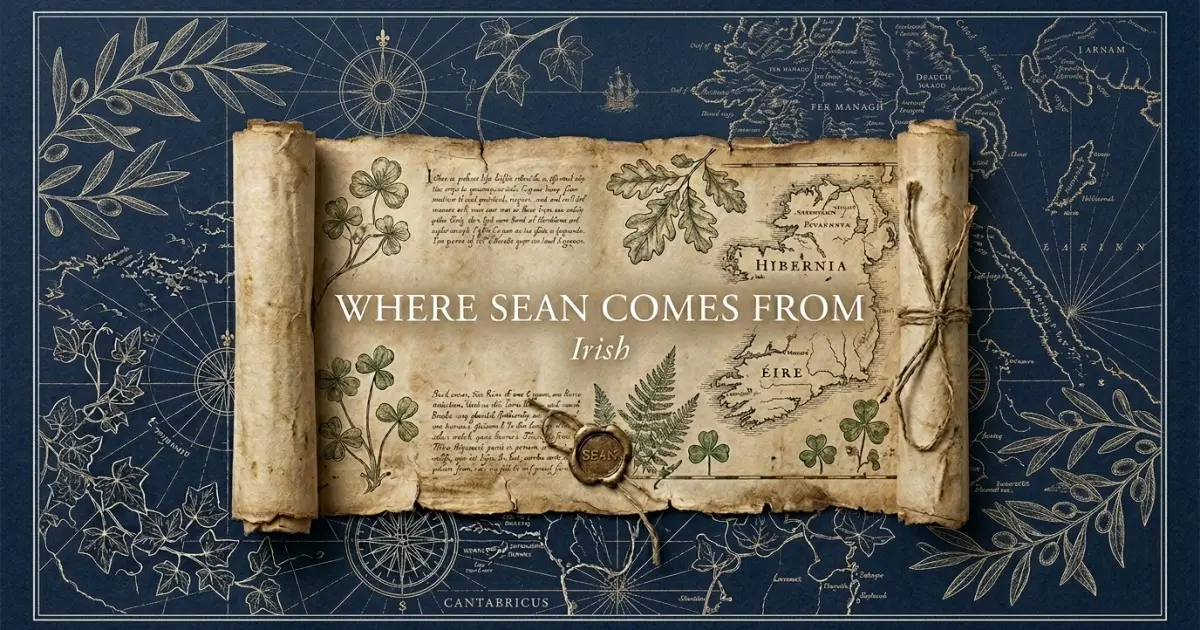
This dual belonging is one reason Sean has been so resilient. Some culturally rooted names remain local in sound and use. Sean did not. It crossed into broader English-speaking life while preserving its Irish spelling, and that is a difficult balance to achieve. Many names lose one side of themselves in the process. Sean largely kept both.
How Sean stayed Irish on the page
The spelling is central to the name’s identity. It is what keeps Sean tied to Irish naming tradition rather than letting it dissolve entirely into phonetic English alternatives. Other spellings such as Shaun and Shawn exist and have had periods of visibility, but historically the original Irish form retained greater cultural depth. That matters for the lived impression of the name. Sean looks like a name with a homeland.
Research from Irish naming references also notes a reversal in the tendency to overuse purely phonetic spellings once the success of globally visible figures such as Sean Connery demonstrated that the original spelling posed no real barrier for international audiences. That is a revealing cultural moment. It shows that Sean was not too difficult for global use; people simply needed to become familiar with it. Once they did, the Irish form looked stronger, not weaker, than the simplified alternatives.
From Irish equivalent to international given name
Sean therefore occupies a fascinating position. It can still function as a marker of Irish heritage, but it is no longer limited to that role. In English-speaking countries, the name has been naturalized enough that it reads as familiar even to people with no Irish family history at all. Yet it has not become stripped of origin in the way some names do. Sean still carries the faint authority of tradition every time it appears in writing. To discover what else belongs to this origin group, browse related names by origin.
This gives the name unusual flexibility. For one family, Sean may feel ancestral and specific. For another, it may simply feel classic and handsome. Both readings are valid, and that range is part of why the name remains usable.
The Sound of Sean Is a Large Part of Its Lasting Appeal
Sean is pronounced SHAWN, with the same IPA in both U.S. and U.K. English: /ʃɔːn/. This shared pronunciation is not a trivial detail. It means the name has remarkable stability across English-speaking settings. The spelling may still cause a momentary pause for those unfamiliar with Irish orthography, but once heard, Sean is almost impossible to misremember. Its sound is simple, rounded, and emotionally legible.
Phonetically, the name opens with the sh sound, a fricative that softens the entry. Then comes the broad rounded vowel, which gives the name warmth and body. It closes with n, a nasal consonant that ends the word gently rather than sharply. This pattern helps explain why Sean sounds masculine without sounding rigid. It has shape, but not aggression.
That sound profile also gives Sean an advantage over some other one-syllable boys’ names. Many monosyllables achieve strength by hardness: crisp stops, blunt endings, tight vowels. Sean achieves it through steadiness. It is less percussive than Jack, less clipped than Blake, less austere than Jude. The result is a name that sounds confident but emotionally accessible.
The spelling, however, adds a second layer of social meaning. Sean is one of those names that can still expose the difference between someone who has encountered Irish naming traditions and someone who has not. That can be mildly inconvenient in isolated first encounters, but it also contributes to the name’s distinctiveness. Sean is simple in speech and marked in writing. That combination is often more attractive than either extreme: not blandly phonetic, not impossibly foreign, but just specific enough to feel textured.
Why Sean Still Feels Familiar Without Feeling Used Up
Official Social Security Administration (SSA) data places Sean at No. 436 for boys in the United States in 2024. That ranking tells a subtle but important story. Sean is not one of the dominant boys’ names of the moment, but neither has it fallen into obscurity. It lives in the very useful middle ground of the naming landscape: widely known, easy to understand, but not sitting in the loudest and most saturated layer.
This position suits the name well. Sean has already had long periods of visibility in English-speaking culture, so it does not need trend momentum to remain legitimate. Its history is secure. What the current ranking suggests is that it now feels steadier and less overexposed than in earlier generations. For many parents, that is an advantage. The name has all the recognizability of a classic, with some of the breathing room of a less common contemporary choice.
Sean among its near neighbors
Stylistically, Sean sits near names such as Shane, Shawn, Sean, Owen, Liam, and John-family relatives more broadly, but it occupies its own particular niche. Shane feels more overtly anglicized in sound. Shawn feels more phonetic and less culturally rooted. Sean keeps the stronger Irish visual identity while remaining completely natural in speech. That makes it the most balanced option for many parents who want heritage and ease at once.
There is also a tonal difference between Sean and some of today’s sleek modern boys’ names. Sean does not feel engineered. It feels inherited. That gives it emotional credibility. The name may be simple, but it does not feel generic. It sounds like it came from somewhere and is still carrying that origin quietly.
Why Sean can feel both traditional and current
Part of the answer lies in its scale. Sean is short, and short names remain attractive to modern parents. But unlike many short names rising now, Sean is not dependent on novelty or visual experimentation. Its distinctiveness comes from tradition rather than invention. That allows it to feel current without trying too hard. It is a classic that does not need polishing because it was never burdened with too much ornament to begin with.

Three Doors Sean Opens Next
Middle names can make Sean feel more formal, more lyrical, or more grounded
Because Sean is so brief and self-contained, the middle name has unusual influence beside it. A longer classic middle can give the full name more grandeur, while a softer or literary middle can warm its already rounded sound. Sean can carry both with ease, which makes middle-name strategy especially important. If you want the full pairing logic behind that contrast, see Sean middle names.
Nicknames around Sean are usually more about intimacy than necessity
The full name is already short enough for daily use, so its nickname life tends to be relational rather than practical. That means any shortened or softened forms often reveal family warmth, peer-group teasing, or cultural preference more than an actual need to reduce the name. To see how those different moods shorten in real life, explore Sean nicknames.
Pronunciation is easy once learned, but the spelling still tells a story
Sean’s pronunciation is simple and stable in English, yet its spelling remains one of the clearest signs that the name belongs to Irish tradition. That gap between page and sound is not a flaw. It is part of what gives Sean its identity. For the detailed stress pattern, accent notes, and IPA, see Sean pronunciation guide.
Why Sean Still Carries More Than It Shows
Sean is a name of compression. One syllable, one rounded vowel, one old meaning, one visually distinctive spelling. Yet inside that small frame are several large inheritances: Irish cultural memory, the broad John tradition, the language of grace, and a masculine sound profile that never needs to harden into force in order to feel secure. That is no small achievement.
In literary terms, Sean is not a grand public monument of a name. It is something quieter and, in some ways, harder to sustain: a name that suggests grace without fragility and heritage without costume. It belongs to the category of names that look modest until one notices how perfectly proportioned they are. The spelling gives it identity, the sound gives it warmth, and the meaning gives it permanence.
For parents who want a boys’ name that feels culturally rooted, spiritually deep, and socially uncomplicated, Sean remains one of the cleanest choices available. It does not need excess to make an impression. It is a single syllable carrying grace across time, and that may be why Sean still feels so sure of itself. It knows where it came from, it knows what it means, and it does not need to speak loudly to be heard.