
Sara Pronunciation: How to Say It with More Confidence
The pronunciation of Sara often becomes visible in a very small social moment: a teacher reading a register on the first day of school, a nurse calling a waiting room, or a colleague pausing for half a beat before saying the name aloud in a meeting. That pause happens because Sara is familiar, but not frozen into only one spoken pattern in every accent and every family. Most people recognize it instantly. What they are really deciding is which vowel to trust.
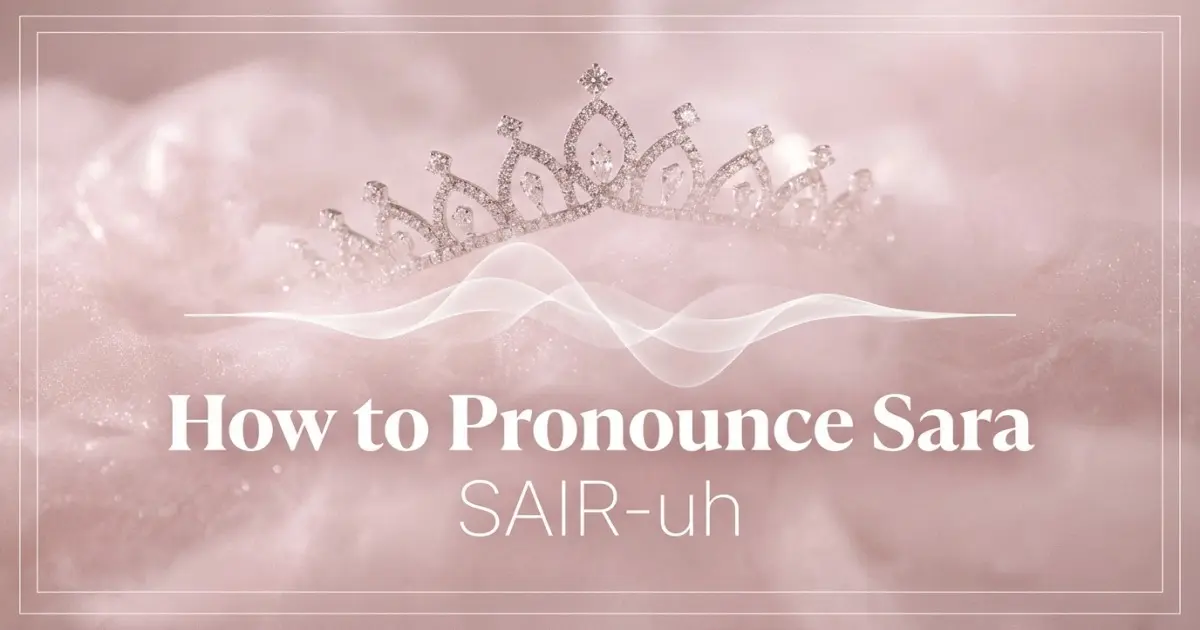
For this form of the name, the intended everyday guide is SARE-uh in U.S. English. In the U.K. rendering, the first vowel often broadens toward SAH-ruh. Either way, the structure remains remarkably stable: two syllables, stress on the first, and a soft second syllable that does not demand attention for itself. That is one reason Sara feels so durable. It is short, clear, and socially easy, but its pronunciation still carries just enough nuance to matter.
What the spelling Sara is really telling the ear to do
| Element | Phonetic Detail | Quick Tip |
|---|---|---|
| Everyday U.S. pronunciation | SARE-uh | Say the first syllable clearly, then let the second one relax. |
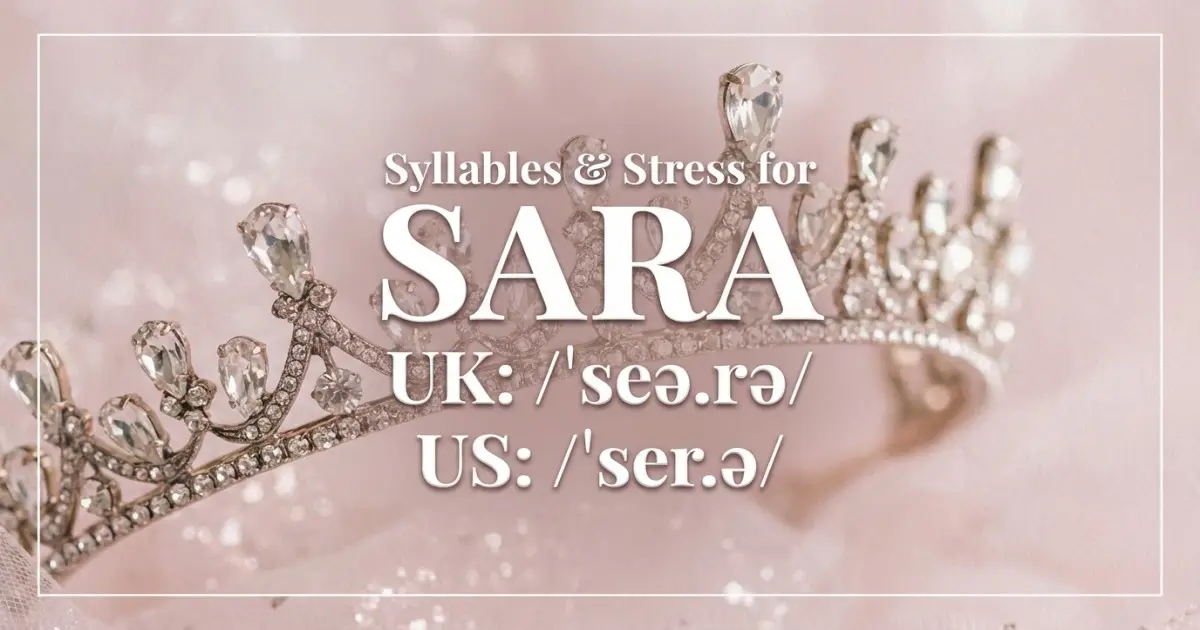
| IPA (US) | /ˈsærə/ | The stress mark before the first syllable shows where the emphasis belongs. |
| IPA (UK) | /ˈsɑːrə/ | In many British accents, the first vowel opens and deepens toward SAH. |
| Syllable count | 2 syllables | Think of it as one strong beat followed by one light beat. |
| Stress pattern | SARE-uh / SAH-ruh | Do not flatten both parts equally; the first syllable leads. |
| Ending sound | Soft reduced -uh | The second syllable should feel easy and unstressed, not sharply separate. |
Sara works because the stress arrives immediately
Two syllables, but only one of them carries the name
Sara is a two-syllable name, but it does not distribute those syllables equally. The first syllable carries the identity; the second simply releases it. That pattern is what makes the name easy to say, easy to hear, and easy to remember. In the U.S. pronunciation SARE-uh, the opening syllable does the real work. In the U.K. pronunciation SAH-ruh, the same thing is true even though the vowel changes. The first beat leads. The second beat follows. Pronunciation lands more fully when the name’s roots and history are already in view, so begin with Sara meaning.
This matters because English listeners rely heavily on stress to orient themselves. A name with obvious initial stress feels stable in the mouth. With Sara, the listener knows where to land almost immediately. The initial s is a fricative, which means the sound begins with smooth, continuous airflow rather than a sudden stop. That helps the name start cleanly. The r that follows is a liquid consonant, which adds softness and motion. Together, those sounds create a beginning that feels fluent rather than blocky.
The second syllable is much less dramatic. In ordinary speech it reduces naturally, which is why the ending sounds more like -uh than a strongly pronounced -ah or -er. People sometimes think a short name should be articulated with equal force on both parts. With Sara, that usually makes the name sound stiff. The natural rhythm is stronger-then-lighter.
Why the final vowel should stay gentle
The ending of Sara matters more than it first appears. If the second syllable is overpronounced, the name can start to sound effortful or overly segmented. In natural English speech, the final vowel usually softens. That is part of the name’s composure. It keeps Sara from sounding clipped, while also keeping it from sounding ornate.
That soft ending is one reason the name performs so well in everyday settings. It can be said warmly, quickly, firmly, or gently without losing its shape. The pronunciation does not require ceremony. It only requires proportion.
Sara changes a little across accents, but not in the way people fear
What stays the same in most English-speaking settings
Although the vowel quality shifts between the supplied U.S. and U.K. forms, the overall structure of Sara stays almost identical. It remains a two-syllable name with first-syllable stress and a relaxed second syllable. That stability is important. It means the name travels well. A person may hear SARE-uh in one setting and SAH-ruh in another, but the name still sounds recognizably like itself.
That kind of accent flexibility helps explain why Sara has remained so internationally usable. Some names become unstable when they cross accents because the stress shifts or consonants disappear. Sara generally does neither. The first syllable remains the anchor. The second remains the release.
Where the ear notices the biggest difference
The main difference between the two supplied pronunciations is the first vowel. In U.S. English, /ˈsærə/ gives you a fronted vowel that many speakers hear as SARE. In the U.K. form /ˈsɑːrə/, the opening broadens into a longer, darker vowel, which makes the first syllable sound closer to SAH. That is a real distinction, but it is a vowel-color distinction, not a rhythm distinction.
This is why most people adapt to the name quickly across regions. Even when the vowel changes, the name still behaves the same way. The listener hears a familiar two-step pattern rather than a different name entirely.
Where Sara gets mispronounced, and why those mistakes are predictable
Mistake pattern one: assuming every Sara is said like Sarah
One of the most common issues with Sara is not that people fail to recognize it, but that they assume the pronunciation they already know from another spelling. Historically, the Sara/Sarah family shares roots and meaning, and many speakers treat the forms as interchangeable in speech. In practice, however, families often use one pronunciation intentionally. That means a reader may import a familiar sound before checking what this particular Sara actually uses.
That is why pronunciation guidance matters even for a name this familiar. Familiarity can create confidence, and confidence can create errors. The spelling looks simple enough that people guess quickly.
Mistake pattern two: flattening the name into two equally heavy syllables
Another mistake is to give both syllables too much weight. A speaker sees a short name and assumes it should be stated with deliberate symmetry: SAR-AH or SARE-UH with both parts pushed forward equally. In real speech, that often sounds unnatural. Sara works best when the second syllable relaxes. The name is not supposed to feel chopped into two equal blocks.
This is a subtle point, but an important one. Many names are technically easy to pronounce and still sound wrong when the stress is mismanaged. Sara belongs to that category. The fix is simple: trust the first syllable, then lighten the second.
Mistake pattern three: drifting toward sound neighbors
Sara lives very close to several sound neighbors: Sarah, Sarai, Saria, and Sarina, among others. Some naming guides also list familiar forms and related variants such as Sari, Sarita, and Sassa. That wider family is part of what makes the name feel rooted and recognizable. It is also why people sometimes overcorrect or overextend the pronunciation when reading quickly. They hear the beginning and mentally complete the rest with a cousin-name they already know. Private forms usually grow from the way a name is actually repeated at home rather than from formal spelling, so see Sara nicknames.
Again, the solution is rhythmic rather than academic. Keep the name short, first-stressed, and gentle at the end. Once that pattern is clear, most confusion disappears.
Practicing Sara in real speech is easier than analyzing it on paper
Practice lines that make Sara sound natural
The easiest way to settle Sara into the mouth is to use it in ordinary phrases rather than isolated repetition. Try lines such as:
“Sara, your table is ready.”
“This is Sara from accounting.”
“Can Sara come to the front desk?”
In each case, the name should move with one clear opening beat and one lighter close. If the ending sounds too deliberate, relax it. If the first syllable feels weak, let it take a little more air and shape.
A quick memory cue for the vowel difference
If someone needs a practical reminder, the easiest one is this: in American English, think SARE-uh; in many British accents, think SAH-ruh. Same name, same rhythm, different color on the opening vowel. That small distinction is often enough to make the pronunciation feel clear rather than vague.
Sara sounds best when it is said simply and with confidence
The best pronunciation of Sara is not the most technical one. It is the one that respects the name’s intended vowel and natural stress without overperforming either. The name is short, familiar, and cleanly structured. It does not want embellishment. It wants accuracy and ease.
That is part of what makes Sara so durable. It feels established without sounding heavy, classic without sounding rigid, and gentle without becoming vague. Once the speaker understands where the stress lives and how lightly the second syllable should fall, Sara becomes exactly what a strong everyday name should be: clear, graceful, and effortless to carry.