
How to Pronounce Samara: The Easy Way to Say It Right
The real pronunciation test for a name rarely happens in a quiet room. It happens in the quick, public spaces where a written name has to become a spoken one with no rehearsal: the teacher calling attendance on the first morning of school, the nurse stepping into a waiting room, the announcer at a recital, the interviewer glancing down at a résumé and then back up. Samara is the kind of name that often earns a half-second pause in those moments, not because it is especially hard, but because people want to place the stress correctly. Once they do, the name opens beautifully.
That is the key to saying Samara well. The name is not flat from left to right. It rises in the middle. The standard pronunciation here is suh-MAHR-uh. The first syllable is light, the second carries the weight, and the third closes gently. When the stress lands correctly, Samara sounds balanced, graceful, and calm. When the stress drifts to the wrong place, the name can lose much of its poise. In other words, Samara is not difficult, but it does depend on rhythm.
How Samara is actually said when the rhythm falls into place
Before looking at common errors or accent notes, it helps to see the structure of the name in one practical guide. Samara is elegant because each syllable has a different job.
| Element | Phonetic Detail | Quick Tip |
|---|---|---|
| Standard pronunciation | suh-MAHR-uh | Keep the first and last syllables light and let the middle syllable carry the emphasis. |
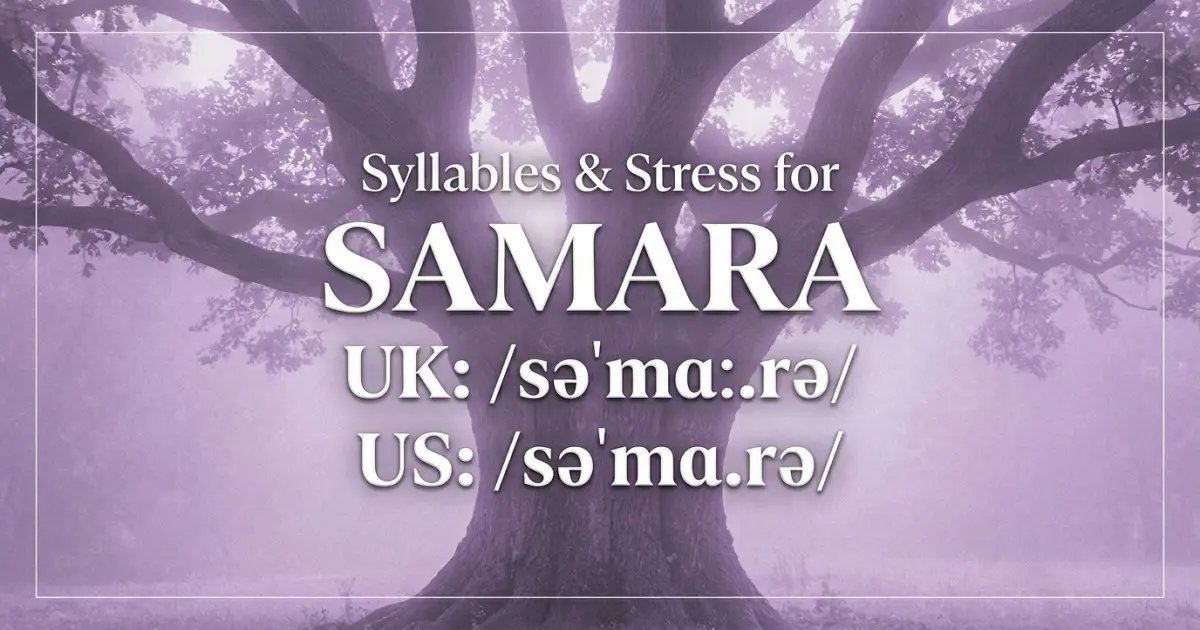
| IPA (US) | /səˈmɑːrə/ | The opening is a soft schwa sound, like the first sound in “about,” not a hard “sam.” |
| IPA (UK) | /səˈmɑːrə/ | The British form follows the same stress pattern, which helps keep the name stable across accents. |
| Syllable count | 3 syllables | Think of the name in three steps: suh / MAHR / uh. |
| Stress pattern | Primary stress on the second syllable | If you stress the first syllable instead, the name immediately sounds less natural. |
| Ending sound | Final schwa | The last syllable should stay soft and relaxed, more “uh” than a broad “ah.” |
Samara rises in the middle, and that is the whole secret
Some names are defined by a strong opening. Samara is not one of them. Its beauty comes from the way the name lifts at the center. The middle syllable is the anchor of the whole pronunciation. Once that is heard correctly, the rest of the name falls into place almost by itself. Pronunciation lands more fully when the name’s roots and history are already in view, so begin with Samara meaning.
The opening of Samara should stay light
The first syllable is represented by a schwa, the soft neutral vowel heard constantly in English speech. That means the beginning of Samara should not be pushed too hard. It is not SAM-uh-ruh. It begins more gently, almost as a preparation for the real center of the name. This lighter opening is one reason Samara sounds graceful rather than abrupt.
Phonetically, the initial s is a fricative, which already gives the name a smooth entrance. Pair that with the relaxed schwa and the opening becomes almost breath-like. It invites the ear forward without trying to dominate.
The heart of Samara is the stressed MAHR
The second syllable, MAHR, is where the name becomes fully itself. It carries the primary stress, and it also contains the broadest vowel in the name. This gives Samara its emotional center. Without that middle stress, the name can sound either flattened or misplaced. With it, the name has elegance and presence.
This is also why Samara sounds more poised than many names of similar softness. The strong middle syllable gives it internal structure. It prevents the name from dissolving into airy prettiness. The center holds.
The ending of Samara should close softly, not dramatically
The final syllable returns to a lighter, more relaxed sound. That matters. Samara should not finish with a hard drop or an exaggerated flourish. The last uh lets the name settle. It is the sound that keeps the name warm and human after the stronger middle syllable.
If the final vowel becomes too broad, the name can feel heavier than intended. If it disappears entirely, the name loses its full shape. The best ending is one that is heard clearly but lightly.
Samara stays surprisingly stable across accents
One of the most practical things about the name is how little it changes between major English accents. The U.S. and U.K. IPA forms are the same here, which is a real advantage. It means the name keeps its shape as it moves between settings. There may be minor differences in voice color, but not in structure.
How Samara tends to sound in American English
In American speech, the opening schwa is usually very light, the middle MAHR is clear and full, and the ending closes softly. The result is smooth and spacious without sounding elaborate. Once an American speaker understands that the stress falls in the middle, the name is usually easy to remember and repeat.
How Samara tends to sound in British English
In British speech, the same architecture remains: soft beginning, stressed middle, gentle finish. The overall sound may feel slightly tidier depending on the speaker, but the name does not fundamentally change. Samara remains Samara. That kind of consistency is one reason it feels so usable internationally.
For families who care about everyday practicality, that matters. A name can be beautiful, but if it constantly shifts or confuses across environments, the burden increases. Samara avoids that problem.
Where people most often get Samara wrong
Most mistakes with Samara do not come from difficult consonants or rare vowels. They come from rhythm. The sounds themselves are straightforward. The challenge is knowing which syllable deserves the emphasis.
The most common mistake is stressing the first syllable
Because many English names are front-stressed, some speakers instinctively want to say something closer to SAM-uh-ruh. That shift changes the character of the name immediately. It makes the opening too heavy and drains the grace from the center. Samara should rise in the middle, not at the front.
Another mistake is making the first vowel too hard
Even when speakers find the correct stress, they sometimes harden the first syllable too much, turning the opening into a stronger sa than the soft schwa-like suh. That small difference affects the whole sound. Amina-like names often begin softly for a reason, and Samara benefits from that same kind of gentle entrance.
Sound neighbors can pull the ear in the wrong direction
Samara can sit near names such as Samantha, Samira, Tamara, or Sara in the mind of a new reader, and those similarities can create false shortcuts. Samantha encourages first-syllable stress. Tamara may tempt some speakers toward a different vowel shape. Samira may pull the rhythm elsewhere. The safest guide is to return to the actual pattern in front of you: suh-MAHR-uh. Once the sound pattern is clear, some shortenings stop feeling optional and start feeling natural, and the clearest map is in Samara nicknames.
How to practice Samara until it feels natural in real speech
Samara is one of those names that becomes easy quickly once the middle stress is heard properly. The best way to practice it is not to overcomplicate it, but to feel the rise and fall across the three syllables.
Practice Samara in three clear beats
Say the name slowly as suh / MAHR / uh. Then connect the three parts without losing the weight in the middle. The goal is not to turn the pronunciation into a chant. It is simply to hear how the name naturally arches.
Use short real-life practice lines
These simple lines help settle the pronunciation into ordinary speech:
Samara is here.
This is Samara.
Samara, your table is ready.
I’m looking for Samara.
If the name sounds flat in those lines, the middle syllable is probably not carrying enough weight. If it sounds stiff, the first syllable may be too hard. The right version has a soft entry, a strong center, and a gentle release.
How to correct Samara politely
If someone mispronounces the name, the easiest correction is usually the best one: “It’s suh-MAHR-uh.” That quick guide solves the main issue immediately, because most people do not need help with the individual sounds. They just need help with where the stress belongs.